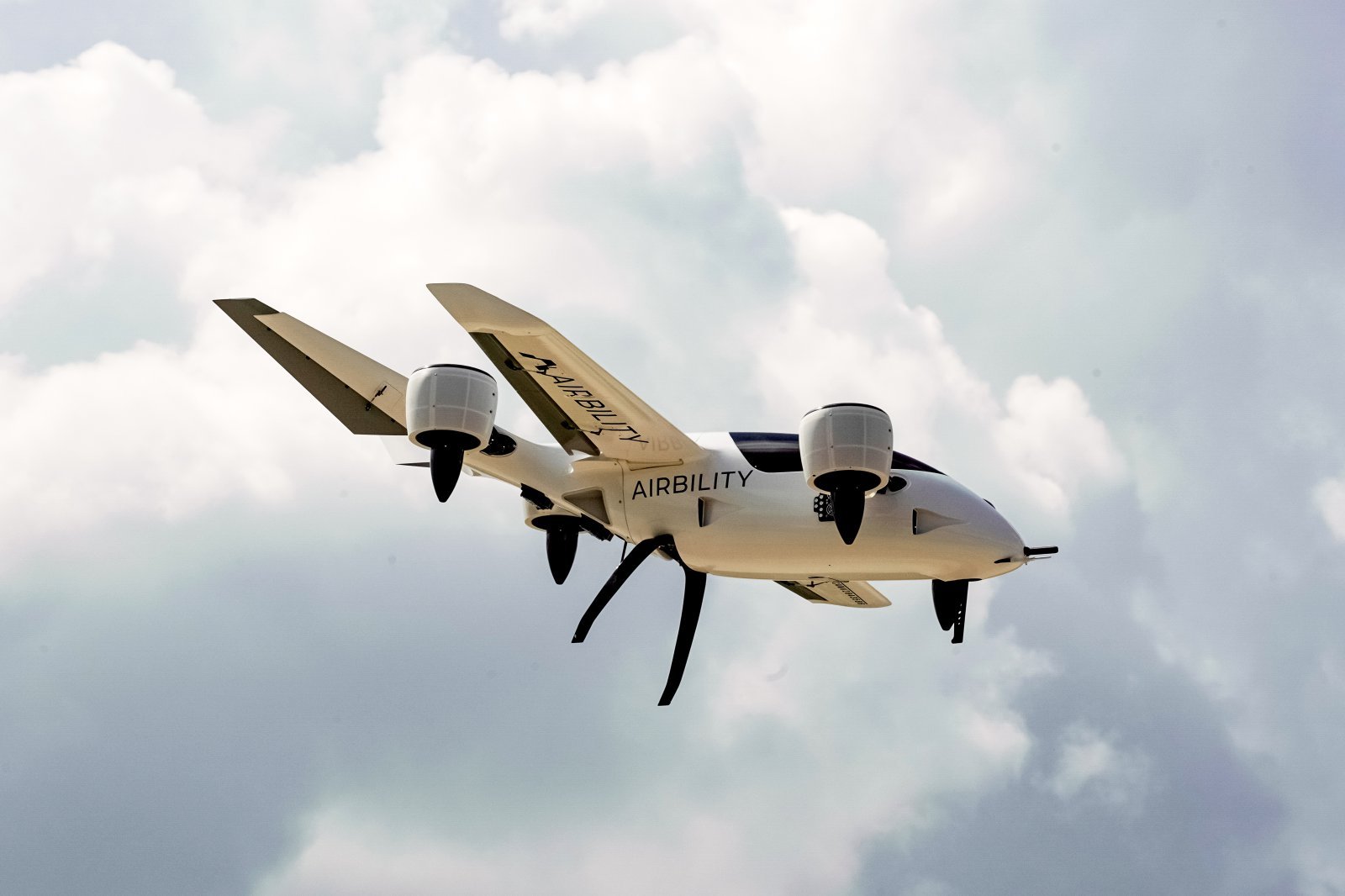
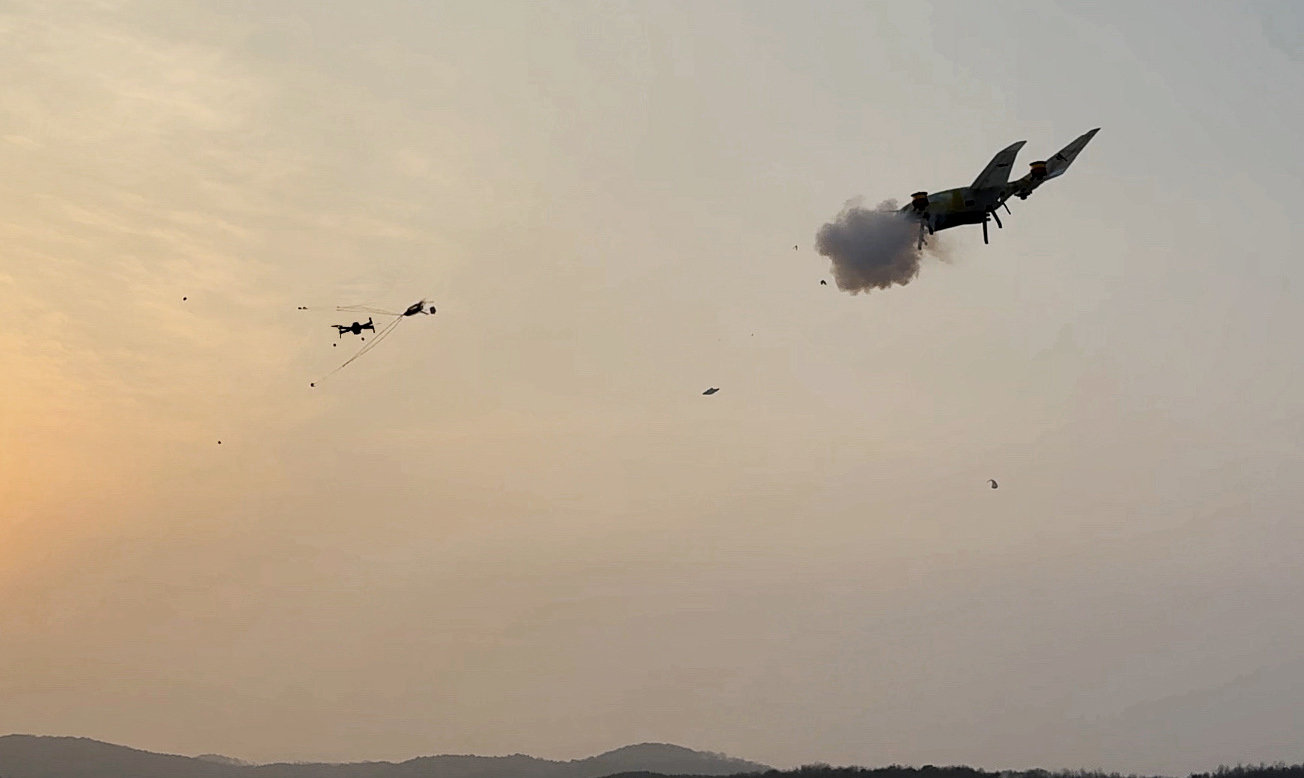
Airability’s AB-U60 in flight. Courtesy of Airability
Ryu Tae-gyu, CEO of Airability, said that when he left the Agency for Defense Development (ADD), he intended never to look back at the defense industry. He believed the long development and business cycles made it difficult for startups to survive.
Yet Airability, which he founded in 2023 with former colleagues, is now developing a “drone that catches drones.” The company has postponed its initial target, a two-seater urban air mobility (UAM) aircraft. The decision came as the threat of low-cost attack drones grew due to the war in Ukraine, while the UAM market expanded more slowly than expected.
The reasons why developers who used to build manned aircraft and fighter jets have pivoted to an interceptor drone startup were examined.
● Startup founded by T-50 and KF-21 development team membersAirability was founded in 2023 by personnel who built their careers at ADD, Hyundai Motor, LG Electronics, and elsewhere.
CEO Ryu worked at ADD for 25–31 years alongside Chief Technology Officer (CTO) Kim Hyun-soon and Executive Vice President Kim Geon-woo. Co-CEO Lee Jin-mo previously worked at Hyundai Motor and the Massachusetts Institute of Technology (MIT) Media Lab in the United States, while Chief Operating Officer (COO) Ahn Min-young came from LG Electronics. Chief Product Officer (CPO) Lee Jae-hyun worked in the Genesis design division. About 80% of the company’s 35 employees are research and development staff.
Ryu participated in the entire development process of the T-50, South Korea’s indigenous supersonic trainer. In the KF-21 Korean Fighter program, he took part in the conceptual research phase by proposing configuration designs, and during the system development phase he served as program director for the AESA radar system.
He worked with CTO Kim on the stealth unmanned aircraft “Kaori” (KAORI-X1) project. At the time, Ryu was the project lead and Kim oversaw day-to-day execution. Executive Vice President Kim, who handled artificial intelligence (AI) at ADD, joined earlier this year and now leads in-house AI technology development.
Lee pointed to Airability’s differentiator as being “a team of developers who have actually built real aircraft.” He explained that the aviation development experience and talent network accumulated as South Korea rapidly developed platforms from basic trainers to 4.5-generation fighters can now be leveraged in a startup environment.
Ryu likewise said his experience developing manned and high-speed fighter aircraft helps him design and validate new airframes quickly. The starting point from which the company views aircraft is fundamentally different from that of typical drone manufacturers, he noted.
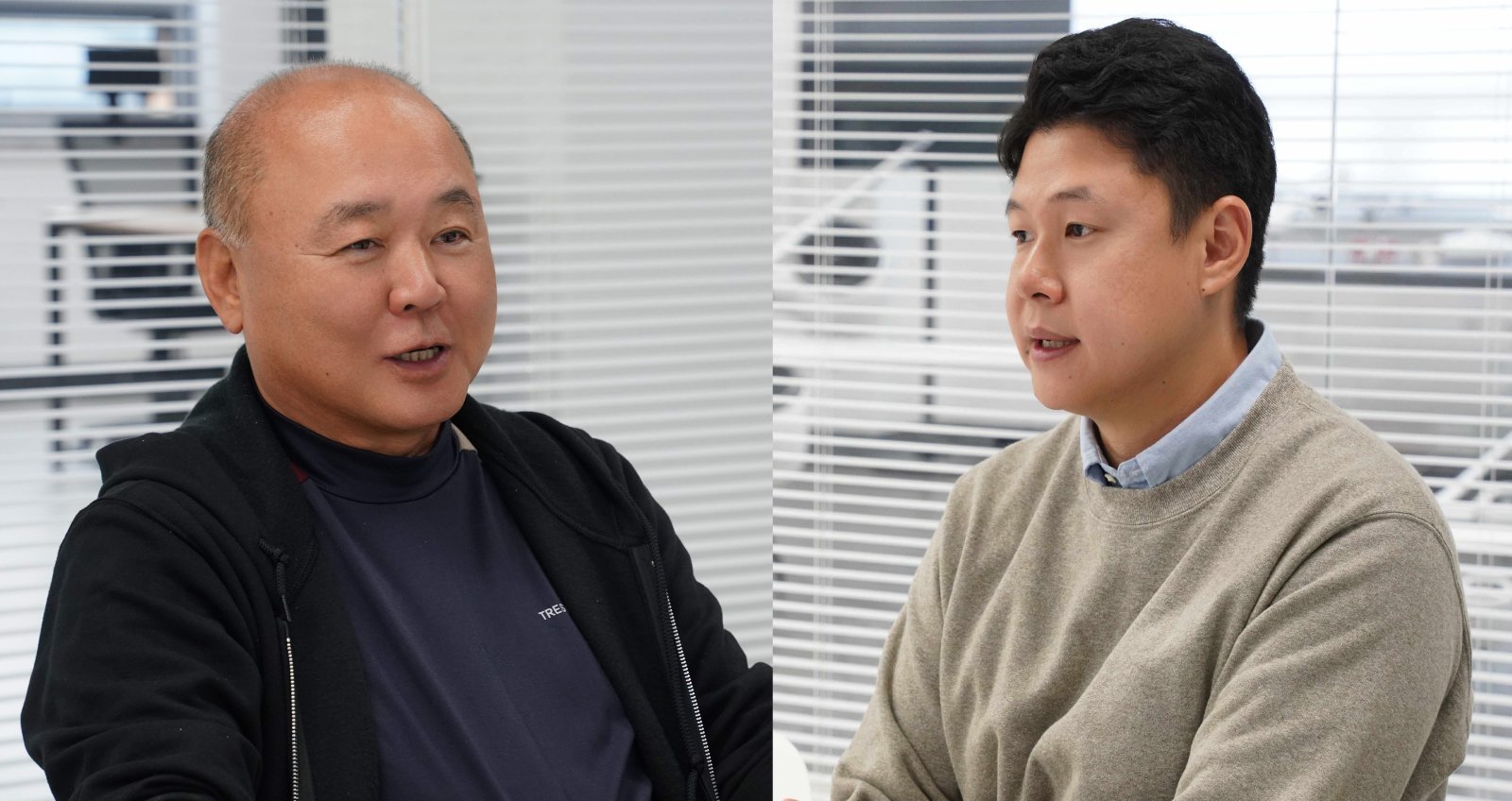
(From left) Airability CEO Ryu Tae-gyu and Airability Co-CEO Lee Jin-mo. Courtesy of Airability
● Started with UAM, but… “The technology is the same, only the order has changed”At the time of its founding, Airability’s first envisioned business was a personal two-seater UAM aircraft.
Rather than taking on front-runners such as Joby Aviation head-on in the large-airframe market, Ryu focused on U.S. demand for personal aircraft. He judged that in a geographically large country like the United States, there is demand for personal aircraft for long-distance travel and leisure purposes.
He also calculated that selling 1,000 high-end vertical take-off and landing aircraft at KRW 1 billion each could create a market worth KRW 1 trillion in revenue.
However, as market conditions changed, so did the company’s priorities.
The first turning point was the war in Ukraine. Cheap commercial and FPV drones began to be deployed at scale for reconnaissance and attack on the battlefield, and the importance of counter-drone technologies surged rapidly.
To secure UAM technologies, Ryu first built and tested a 1-meter-class small airframe using a 3D printer, and he said he continuously received proposals from people around him to adapt it for military drone use. Similar questions followed at home and abroad, but at the time he still had no intention of returning to defense programs.
The second factor was the pace of the UAM market. The view that commercialization would take longer than expected grew stronger, and investors held a similar outlook.
Ultimately, at the end of last year Airability shifted course and decided to pursue defense industry projects in parallel.
Lee explained that “the core technology has not changed.” What changed was the sequence of application: whether to use electric vertical take-off and landing technology first for carrying people, or first for unmanned airframes that carry interceptor drones.
The entry of civilian UAM companies into defense also influenced this decision. U.S.-based Archer Aviation has teamed up with defense company Anduril to develop autonomous military aircraft, while Joby Aviation is working with L3Harris to develop hybrid aircraft for defense applications.
Lee said the technological boundaries between civil and military aviation are increasingly blurring, and explained that the company envisages first accumulating flight data in the military domain and later expanding into manned passenger transport and logistics in the civilian sector.
Ryu also stressed that “UAM has not been abandoned.” He added, “Hybrid propulsion technologies for long-distance flight are also being applied and validated first on unmanned platforms. The flight data and technologies accumulated there will transition directly to manned aircraft. If investment is clearly secured, the UAM project can be resumed.”
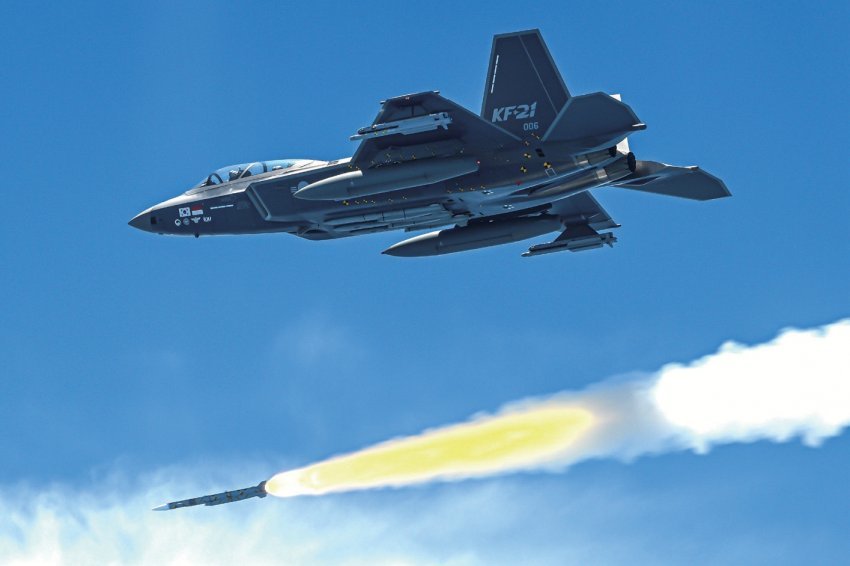
The Korean Fighter (KF-21) firing a Meteor air-to-air missile. Courtesy of the Republic of Korea Air Force
● KRW 6.5 billion investment secured… Government R&D projects total KRW 8.0 billionFunding followed the change in business direction.
On 1 September, Airability announced that it had secured a KRW 6.5 billion Series A investment led by Silicon Valley venture capital firm Sazze Partners. The company’s cumulative fundraising now stands at KRW 10.5 billion. Its valuation was not disclosed.
Sazze Partners has so far focused its investments on AI and software companies, and Airability is its first investment in the defense sector.
According to Airability, Sazze Partners based its decision on a comprehensive assessment of the team’s aircraft development experience, its technological achievements to date, and the rapid growth of the defense technology market.
The Series A funds will be used to enhance the company’s unmanned aerial interceptor system “kill chain,” build out mass production capabilities, and expand its product portfolio.
Separately, the company said it has secured government research and development (R&D) projects totaling approximately KRW 8.0 billion. This figure does not include private investment funds.
The Scale-up TIPS program selected this year, worth about KRW 3.0 billion, will be used to develop interceptor systems to counter swarming drones. Airability is also progressing with the Deep Tech TIPS program and the “Ultra-Gap Startup 1000+” initiative selected in 2024. The roughly KRW 8.0 billion figure represents the combined total support amount for all selected and contracted research projects, and actual disbursement will be made annually over each project’s duration.
In the United States as well, large-scale procurement targeting defense technology startups is expanding. Defense company Anduril signed a 10-year indefinite delivery/indefinite quantity (IDIQ) contract with the U.S. Army in March this year, with a maximum value of USD 20 billion, to supply its software, hardware, and data/computing products. It is not a contract for a single specific counter-drone system, but an overall order ceiling covering Anduril’s product lineup.
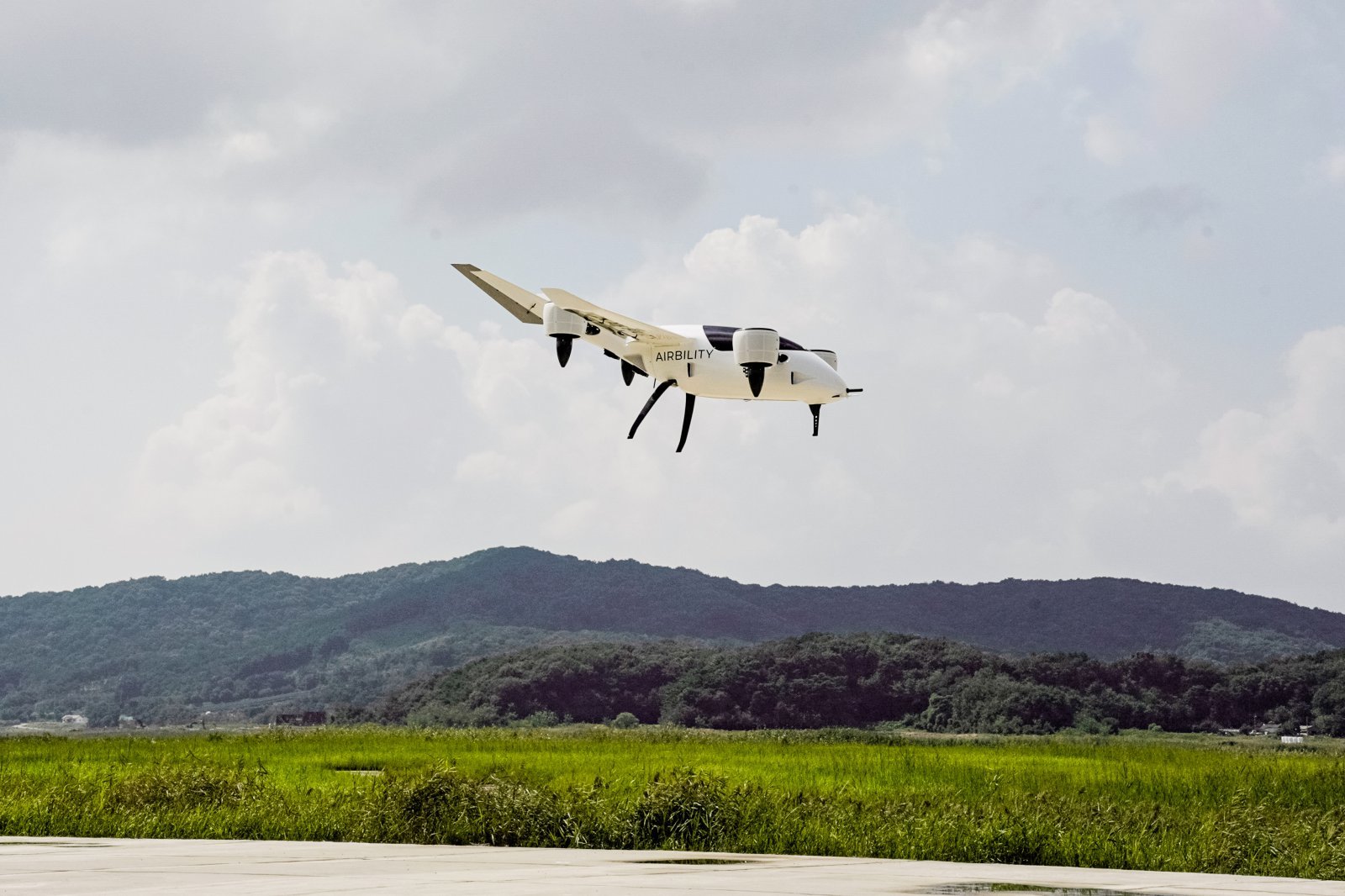
AB-U60 in vertical take-off. Courtesy of Airability
● “Domestic market for reference, profits from overseas”Airability is initially targeting overseas markets.
Lee noted that Russia launched more than 50,000 Shahed-series unmanned aerial vehicles at Ukraine last year alone, showing how attack drones are being deployed in large numbers. He explained that rather than relying on a single weapon system to block every threat, a multilayered defense network is required.
He said, “The United States and NATO (North Atlantic Treaty Organization) are looking to Taiwan, Japan, South Korea, and others as supply chain alternatives to Chinese-made drone components,” adding, “Taiwan has a head start, but there are opportunities for Korean companies as well.”
In April this year, Airability signed a four-party memorandum of understanding (MOU) with NT iBuzz, a subsidiary of Thai state-owned telecom operator NT, SmartOKO Thailand, the Thai subsidiary of Korea’s HeritageIT, and Singapore-based KILSA Global. The partners plan to jointly develop and deploy unmanned aerial vehicle (UAV) solutions for Thailand’s public sector, including border surveillance, public safety and law enforcement support, disaster response, and critical infrastructure monitoring.
The company said NT iBuzz is also active in the defense systems sector and that the parties are considering expanding cooperation into counter-drone systems. However, the specific scope and timetable of the projects have yet to be determined.
The company assesses that the domestic counter-drone market is still at an early stage. Concrete interceptor requirements that would lead to actual procurement have not yet emerged in sufficient detail.
Lee’s strategy is to develop products based on performance requirements from overseas battlefields while using domestic procurement records as references to support entry into foreign markets.
He said, “In South Korea, discussions still largely focus on multirotor ‘kamikaze’ drones, but overseas, technologies are rapidly expanding into fixed-wing and jet-propelled systems.”
Ryu commented, “Our biggest concern is not the technology but the price,” adding, “Domestically, we are thinking of establishing references at a level the market can bear, and generating profits in overseas markets.”
The first competitor Airability identifies is Ukraine, because Ukraine is rapidly developing and validating counter-drone technologies in actual combat.
The company believes that as many players are already developing propeller-type interceptor drones, it should differentiate itself not through simple volume competition, but through technologies such as air-launched systems using a mothership platform, AI-based guidance, and high-speed interception.
The net-gun capture device of the Airability AB-U10 scoring a direct hit on a target drone. Courtesy of Airability
● “Defense unicorn within five years… The next two to three years are the window of opportunity”Lee stated that the company’s goal is to grow into a unicorn representing South Korea’s defense sector within the next five years.
He said, “South Korea has produced unicorns in semiconductors, AI, and robotics, but there are still no such examples in defense,” adding, “Unlike traditional defense development, which takes 10–15 years, the scope of work that startups can take on is growing, based on rapidly building prototypes and repeating testing and improvement.”
Ryu believes the next two to three years will be a critical period.
He explained that South Korea concentrated on aircraft development from the late 1980s through the 2000s, thereby securing technical personnel with real-world development experience, whereas in some Western countries prolonged gaps in new aircraft development have reduced the number of engineers with practical development experience.
Ryu said that if personnel with such experience are deployed to develop new types of unmanned aircraft and weapon systems, there is room for differentiation even in the counter-drone market where Ukraine currently leads.
Further details on the mothership-type interceptor system, AI-based interceptor drones, and high-speed airframe technologies under development at Airability will be covered in a subsequent article.
A “geek” is someone deeply absorbed in a particular field. “The Geeks” meets people who are pioneering their own path through technology, and listens to their challenges and ideas.
ⓒ dongA.com. All rights reserved. Reproduction, redistribution, or use for AI training prohibited.
Popular News