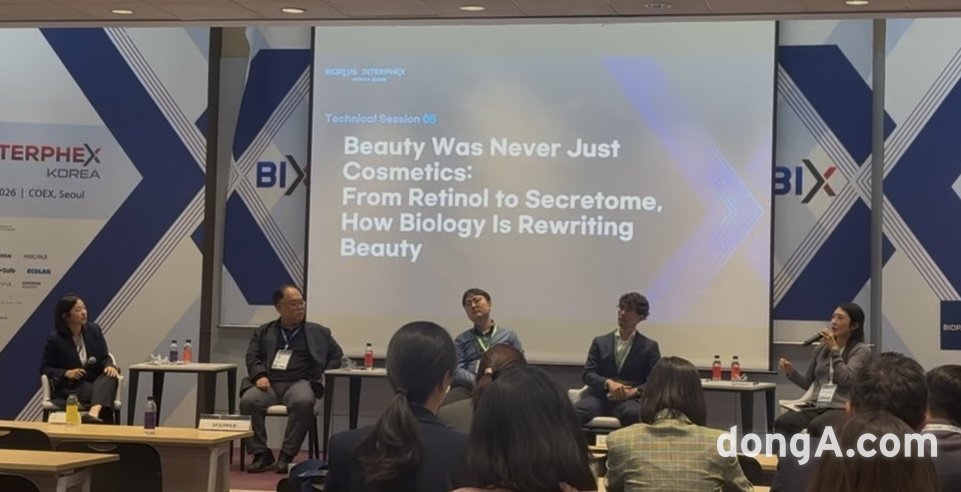
At the “BioPLUS-INTERPHEX KOREA 2026” beauty specialist session held at COEX in Seoul on the 28th of last month, participants discussed the intersection of biotechnology and the beauty industry. From left: Huh Young-jin, Director at DS Investment Partners; Shin Dong-myeong, Head of the Cell Therapy Center at Asan Medical Center; Lee Hyun-ung, Team Leader at L’Oréal Korea; Lee Heon-jong, Vice President at NovMetaPharma; and Kyung Seo-yeon, Team Leader at COSMAX BTI. Photo by Hwang Soo-young
Expansion of GLP-1-based obesity treatments is also influencing product development directions in the beauty industry. Demand related to changes in skin and hair following weight loss is being viewed as a new business opportunity. Cosmetics companies are reviewing the development direction of ingredients and formulations, while bio companies are exploring ways to connect existing research to beauty products.
At the specialist session titled “Beauty Has Always Been Bio: From Retinol to Secretome, Biology Rewrites the Future of Beauty” during “BioPLUS-INTERPHEX KOREA 2026 (BIX 2026)” held at COEX in Seoul on the 28th of last month, such shifts in boundaries between industries were a central topic of discussion.
● From anti-aging to facial volume: shifting development targets
L’Oréal Korea explained that the spread of GLP-1 is affecting the development of cosmetic ingredients and formulations. The company is particularly focusing on post-weight-loss care demand in countries such as the United States and believes that development targets may shift beyond conventional anti-aging to areas such as facial volume.
It also emphasized the need to respond to a consumer environment in which cosmetics are used alongside aesthetic procedures. As topical products, ingestible products, and medical/aesthetic care become interconnected, the scope of markets that companies can address is expected to expand.
Hair care was also cited as a research subject. COSMAX BTI noted that RNA analysis comparing hair follicles affected by hair loss with normal follicles showed decreased activation in pathways related to carbohydrate metabolism. Based on this, the company is focusing on the metabolic function of hair follicles and is examining the potential to apply this research to GLP-1-related hair issues.
● Bio companies move into skin boosters: seeking business opportunities in existing researchBio companies are searching for ways to translate their existing research outcomes into beauty products.
NovMetaPharma stated that it is approaching the beauty business from the perspective that research focused on inflammation, fibrosis, and mitochondrial function could be applied to other tissues. While continuing new drug development, which requires long timelines and substantial capital, the company also needs a structure that can generate business results at different points in time.
The company reported that it is working to commercialize a skin booster combining peptides and polynucleotides (PN). Potential applications in the dermatological field were discovered during joint research related to kidney transplantation, and the company is now seeking ways to differentiate its product from existing PN offerings.
● New ingredients alone are not enough: safety and efficacy delivery are keySome participants pointed out that, to use bio-based materials in cosmetics, efficacy and safety verification suitable for real-world usage environments must be secured.
L’Oréal Korea explained that, when evaluating new ingredients, it places high importance on safety under long-term, repeated use. Unlike pharmaceuticals, which are used over a fixed period, cosmetics can be used by consumers for an extended time, making verification that considers application concentration and usage conditions essential.
The way research outcomes are communicated to consumers was also identified as a challenge. COSMAX BTI noted that differences in allowable efficacy claims by country influence commercialization strategies. It was also suggested that clearly explaining the functions and intended uses of new materials such as secretome in a way that consumers can understand is crucial.
Panelists agreed on the need to link the research capabilities of bio companies with the formulation, manufacturing, and distribution capabilities of cosmetics companies from the early stages of development. To translate research results into actual products, they said, companies must establish not only efficacy and safety verification but also consumer communication and commercialization strategies.
Meanwhile, BIX 2026, hosted by the Korea Biotechnology Industry Organization, was held from the 28th to the 30th of last month. More than 300 companies from around the world participated, and the conference discussed technology and commercialization strategies such as the use of bio-based materials in the beauty industry and market changes in the GLP-1 era.
ⓒ dongA.com. All rights reserved. Reproduction, redistribution, or use for AI training prohibited.
Popular News