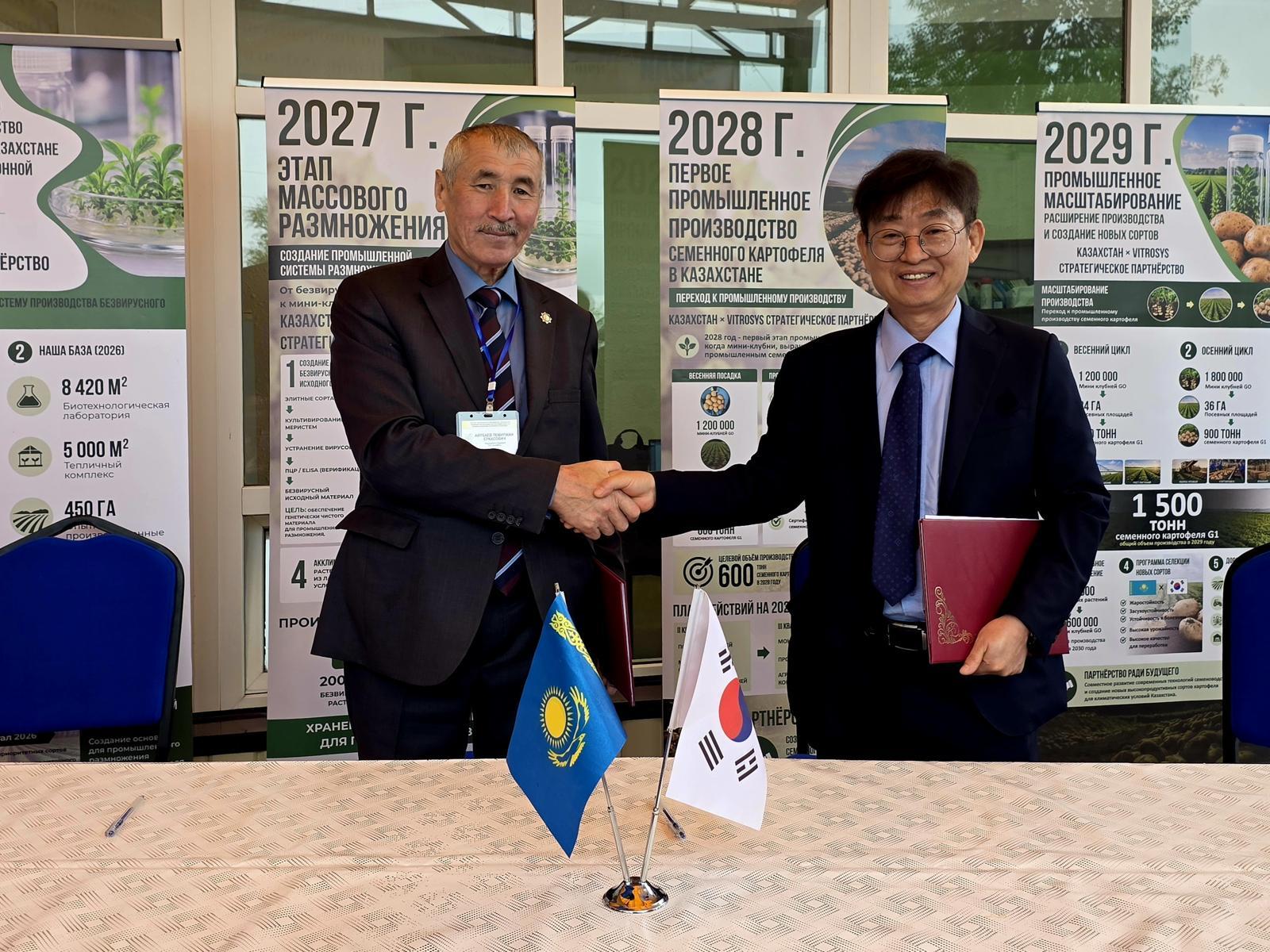
Son Sung-ho, Chairman of Vitrosys (right), shakes hands with a local Kazakh official after signing an agreement to establish a production and export hub for seed potatoes. Courtesy of Yeongju City
Korea’s plant biotechnology is taking root in food production sites in Central Asia. A domestic bio company has launched a project in Kazakhstan to mass-produce high-quality seed potatoes and build a hub for exports to neighboring countries. It is a long-term agricultural cooperation project in which the company participates not only in technology transfer but also in production, operations, and distribution.
Plant biotechnology specialist Vitrosys Co., Ltd. (Chairman Son Sung-ho) announced that it is promoting a seed potato production project with the Kazakhstan Research Institute of Potato and Vegetable Growing (KazNIIPO), which is affiliated with the National Agrarian Science and Educational Center (NASEC) under the Ministry of Agriculture of Kazakhstan.
The two sides signed a basic agreement in April this year for a 20-year joint project with the National Agrarian Science and Educational Center. Subsequently, they shared the project vision at a recent event attended by the Kazakh Vice Minister of Agriculture and officials from agricultural and research institutions in the Almaty region.
The core of this project is the stable production of healthy seed potatoes free from viral infection. Potatoes are cultivated by planting seed potatoes, and continued use of virus-infected seed potatoes can reduce yields and degrade quality. As Kazakhstan has not been able to produce sufficient quantities of high-quality seed potatoes, it has relied on imports from abroad or on seed potatoes secured directly by farmers.
Vitrosys plans to use its proprietary plant tissue culture technology to produce virus-free plantlets and then mass-propagate small seed potatoes, known as minitubers. These will then be grown step by step in greenhouses and open fields to establish a supply system for farmers. The goal is to establish in the local area a comprehensive seed potato production system that links production, storage and sorting, and certification.
The Kazakh side is planning site and initial facility investments worth about USD 10 million. A 8,420㎡ tissue culture facility, a 5,000㎡ greenhouse, and a 958ha site dedicated to potato production are scheduled to be used in the project. Vitrosys plans to begin by producing about 1.2 million minitubers (48 tons) in 2027, followed by 1,200 tons in 2028, 1,500 tons in 2029, and 3,000 tons of seed potatoes annually by 2030.
Korean companies will also play a leading role in project operations. Vitrosys’s local subsidiary, “Vitrosys KZ,” will be responsible during the initial 10 years for production process management, commercial contract execution, and the development of sales markets and export channels. Thereafter, operational management will be transferred to the Kazakh side, while technical support will continue. The two parties have agreed to split net profits, excluding operating expenses, equally.
Vitrosys, which owns plant resource mass-production technology including a 20-ton class large-scale bioreactor, plans to use this project to expand its entry into the Central Asian agricultural market.
ⓒ dongA.com. All rights reserved. Reproduction, redistribution, or use for AI training prohibited.
Popular News