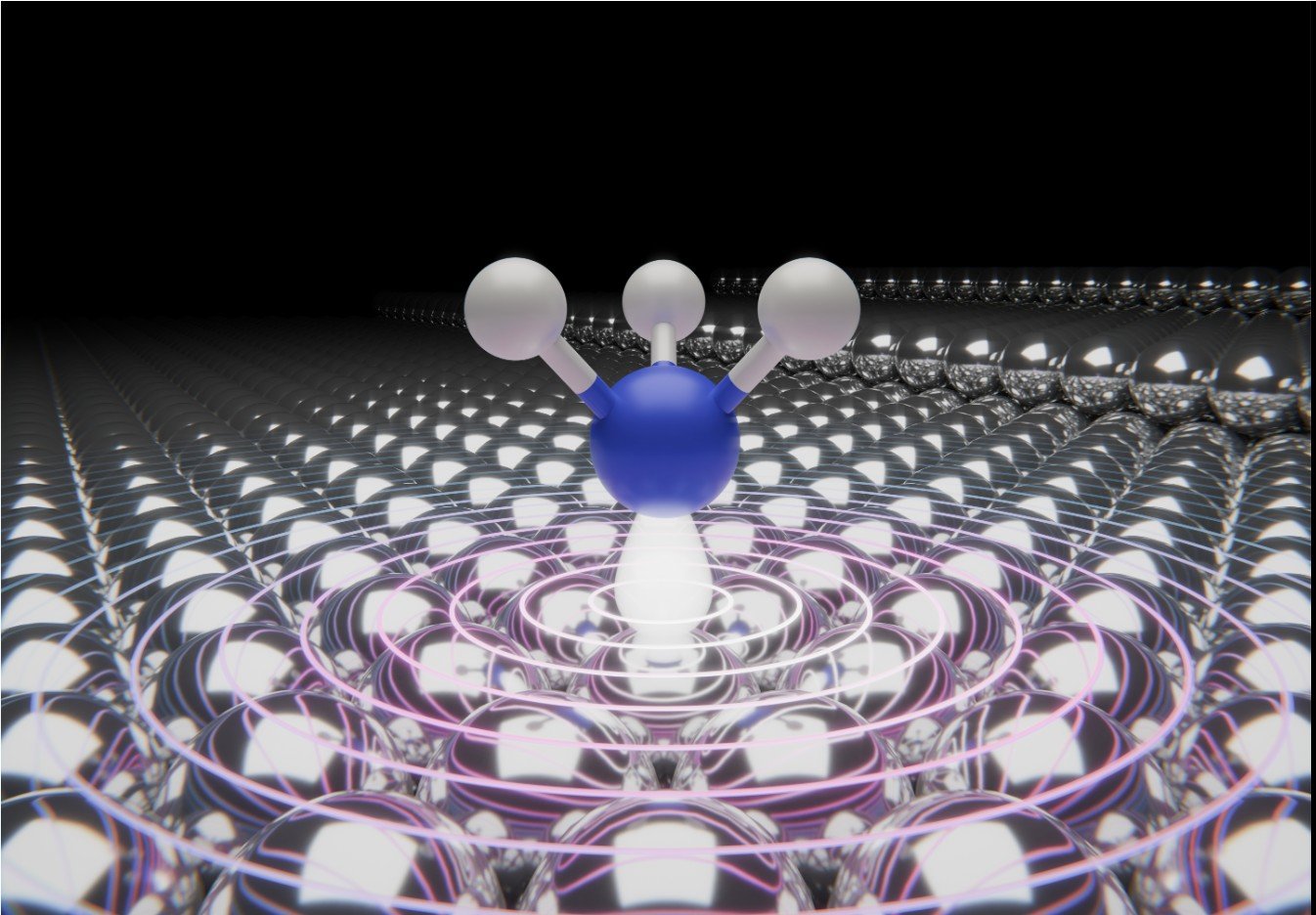
Schematic illustration showing how the electronic response that occurs when a molecule bonds to a metal surface propagates along the surface beyond the immediate bonding site. It demonstrates that the metal’s sea of electrons responds to the presence of the molecule, allowing the influence of the bond to extend over a wide area. Provided by the Ministry of Science and ICT
Korean and German joint research teams have identified a new variable involved in the chemical reactions of catalysts. Contrary to conventional wisdom, they found that changes in atomic structures far from the reaction site can also have a significant impact on chemical reactions. The findings are expected to provide a foundation for expanding high-efficiency catalyst design research—previously driven mainly by experiments and trial and error—into the realm of calculation and prediction.
The Ministry of Science and ICT announced on the 30th that a joint research team from the Institute for Basic Science (IBS) Center for Quantum Nanoscience (QNS) and the Max Planck Institute for Multidisciplinary Sciences in Germany had identified that the wide-ranging atomic structure of a metal catalyst surface affects the strength of chemical bonding of molecules. The research results were published on the 29th (local time) in the international journal Science.
Catalysts promote chemical reactions that break molecular bonds with low energy and enable mass synthesis of new molecules. They are used in various industrial processes, including the production of fertilizers essential for agriculture. The strength of chemical bonding between a metal catalyst and molecules is a key factor that determines reaction rate and efficiency.
Until now, chemical bonding between molecules and metals has mainly been described in terms of interactions at the adsorption site and with the surrounding atoms. It was unclear how far the atomic structure of the metal surface could influence the bond strength between the molecule and the metal.
The research team implemented a stepped structure on a platinum (Pt) crystal surface. By varying the spacing between the step edges of the crystal surface, they used it like a measuring ruler. They then precisely measured and compared the bonding strength of ammonia (NH₃), carbon monoxide (CO), and nitric oxide (NO) molecules with platinum.
The experiments showed that, depending on the type of molecule, atomic structures up to approximately 10 nm (nanometer; 1 nm is one-billionth of a meter) away from the bonding site had a significant effect on the bond strength. For nitric oxide (NO), the bonding energy differed by about 0.2 eV (electron volt, a unit of energy) depending on the distance between steps. According to the researchers, this is sufficient to substantially change the characteristics of the chemical reaction.
A distance of 10 nm is large from an atomic perspective, enough to line up several dozens of atoms. This means that when a molecule bonds to a metal surface, extensive structural differences in the metal are reflected in the bonding energy. Because the electronic structures of the three molecules and their interactions with the metal surface differ, the specific manifestations of the long-range effect also varied.
The results are significant in that they reveal a new physical variable that must be considered in catalyst design. When the size of metal nanoparticles used in reactions changes, the way molecules bond to the surface also changes, altering the properties of the catalyst. While it has been well known that the catalytic efficiency of nanoparticles varies with their size, the reasons have not been fully elucidated. The size of metal nanoparticles is comparable to the range of the long-range effects identified in the study.
Dmitry V. Fedorov, QNS group leader and research professor in the Department of Physics at Ewha Womans University, corresponding author of the study, explained, “We have identified another tunable factor that can be used to improve the performance of catalysts such as nanoparticles.”
The achievement is also expected to contribute to emerging AI-based catalyst design research. Fedorov said, “AI also needs knowledge. If it is not known exactly which effects contribute to the strength of chemical bonding, they cannot be taken into account in design.”
The study is also noteworthy as a multidisciplinary achievement that integrates the molecular perspective of chemistry with the treatment of the electronic properties of metals in physics. Fedorov emphasized, “This is a case where chemistry and physics worked together to create new knowledge, and it was made possible by close collaboration across national borders.”
ⓒ dongA.com. All rights reserved. Reproduction, redistribution, or use for AI training prohibited.
Popular News