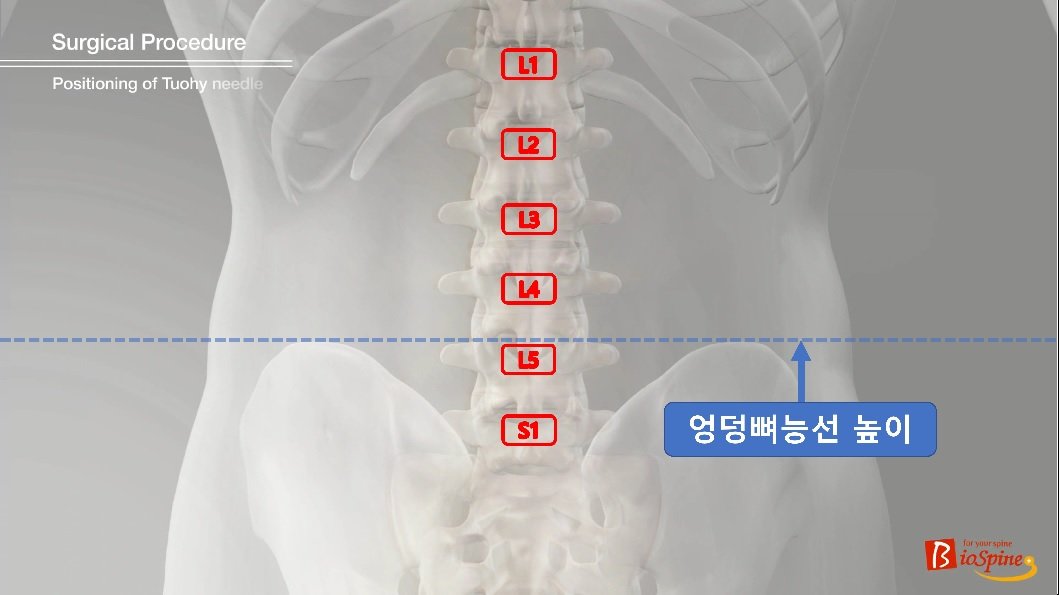
An illustration showing the height of the iliac crest, which varies by patient and becomes an important factor when accessing the L5–S1 level. Provided by Seoul Gwanghye Hospital
A man in his 60s, Mr. A, had been experiencing discomfort for several months due to lower back pain accompanied by tingling that extended from the buttock to the calf. More recently, sensation in his toes had also become dulled. Examination confirmed foraminal stenosis at the L5–S1 segment, where the fifth lumbar vertebra meets the first sacral vertebra. The challenge was that this segment is adjacent to the pelvic bone, making foraminal access with treatment instruments more difficult than in other lumbar segments.
The spine consists of a total of 33 vertebral segments: 7 cervical, 12 thoracic, 5 lumbar, 5 sacral, and 4 coccygeal. Among these, the lumbar vertebrae bear the weight of the upper body and are involved in flexion and extension of the lower back. In particular, L5–S1 is the boundary where the highly mobile lumbar spine connects to the relatively fixed sacrum, making it vulnerable to repetitive loading and degenerative changes.
On both sides of L5–S1 lie the intervertebral foramina through which nerve branches pass. When disc height decreases or surrounding ligaments and bony tissues thicken, the nerve passage can narrow and the nerves can be compressed. In such cases, not only low back pain but also radiating pain and sensory abnormalities can occur, extending to the buttock, thigh, calf, and foot.
The key issue is the anatomical structure of L5–S1. In other lumbar segments from L1 to L4, during foraminoplasty, a special kit can be inserted from the lateral side in a relatively horizontal direction to access the lesion. Foraminoplasty is a non-surgical treatment applied to various spinal conditions such as spinal stenosis, lumbar disc herniation, and adhesive spinal disorders. Its advantage lies in combining mechanical treatment, which widens the space by selectively resecting ligaments around the foramen, with biochemical treatment, which facilitates the discharge of inflammation-inducing substances into that space. Although performed through minimal incision, the timing of symptom improvement after the procedure can differ from patient to patient. At L5–S1, however, the foraminal space is narrow and the iliac crest, which protrudes above the pelvis, obstructs the access route. For this reason, it is difficult to approach in the same manner as L1–L4.
To overcome this, an oblique downward approach is used. The entry point at the L4–L5 level is maintained, but the special kit is angled downward to avoid the iliac crest. The iliac crest is the highest ridge-like portion of the ilium. Because the height of the iliac crest, pelvic shape, and size of the intervertebral foramen differ for each patient, the entry point and angle must be finely adjusted.
At L5–S1, the anatomical structure of the foramen and pelvic bones is closely related to the direction and path of instrument insertion. It is important to use imaging studies to identify each patient’s iliac crest height and foraminal size and to establish the appropriate entry point and route.
At L5–S1, treating stenosis or adhesions sufficiently may be difficult with a direct extra-foraminal approach alone. In such cases, a bidirectional approach that targets both the inner and outer portions of the foramen is recommended. First, in Stage 1, the caudal approach involves inserting a flexible catheter through the sacral hiatus and following the spinal canal to reach the lesion on the inner side of the foramen. Next, in Stage 2, the foraminal approach uses a special kit introduced from the lateral side to selectively resect part of the outer foraminal ligament and widen the nerve passage.
This stepwise bidirectional approach mechanically relieves nerve compression while simultaneously enabling biochemical treatment that promotes the elimination of inflammation-inducing substances through the secured space. For technically demanding segments such as L5–S1, rather than forcing access from a single direction, a combined treatment strategy that accounts for the characteristics of both the inner and outer aspects is required.
ⓒ dongA.com. All rights reserved. Reproduction, redistribution, or use for AI training prohibited.
Popular News