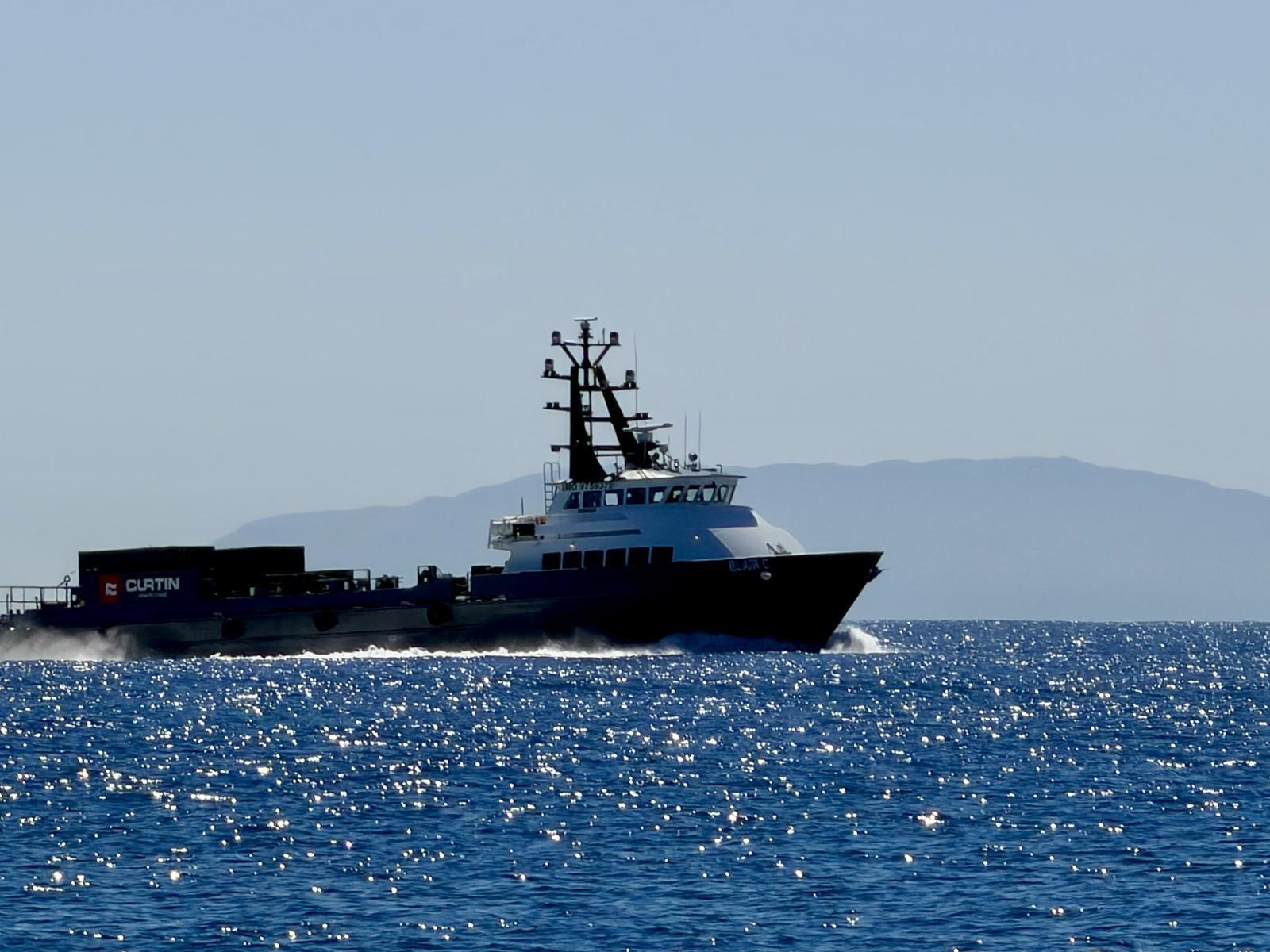
An unmanned surface vessel test ship equipped with HD Hyundai and Anduril’s autonomy solutions carries out a mission during an unmanned surface vessel demonstration held at the Port of Long Beach in California, United States. Provided by HD Hyundai
HD Hyundai announced on the 19th that it had successfully demonstrated unmanned surface vessel autonomous navigation technology in the United States. By combining its independently developed ship autonomy solution with mission autonomy technology from U.S. artificial intelligence (AI) defense company Anduril, the company stated that it had verified unmanned mission execution capabilities in a variety of maritime conditions.
According to HD Hyundai, a joint demonstration of unmanned surface vessel autonomous navigation with Anduril was recently held in waters off the Port of Long Beach in California.
The demonstration was attended by approximately 40 participants, including Jang Kwang-pil, Executive Vice President and Head of the Future Technology Research Institute at HD Korea Shipbuilding & Offshore Engineering, as well as representatives from Anduril, the U.S. Navy and Coast Guard, the American Bureau of Shipping (ABS), the Republic of Korea Navy, and the Defense Acquisition Program Administration of Korea.
The two companies reported that over the course of about 3 hours and 30 minutes, they implemented a range of maritime scenarios, including autonomous navigation and mission changes, formation sailing, and emergency measures in response to engine failures. The demonstration process was broadcast in real time via a shore-based control center, allowing observers to monitor the unmanned surface vessel’s mission execution in detail.
The demonstration used a modified 368-ton large unmanned surface test vessel previously operated by the U.S. Navy. The vessel was equipped with “VAone,” a total ship autonomy solution independently developed by HD Korea Shipbuilding & Offshore Engineering, and “Lattice,” Anduril’s mission autonomy solution.
VAone is based on “HiNAS Prime,” developed by Avikus, HD Hyundai’s autonomous navigation specialist subsidiary. In addition to autonomous navigation functions, it includes an engine autonomy system that continuously monitors the condition of the ship’s machinery and automatically responds to anomalies, as well as a damage autonomy solution that detects and addresses hull damage.
Anduril’s Lattice is responsible for the autonomy technology required for mission execution. HD Hyundai explained that by integrating the two solutions, it had validated autonomy technologies necessary for carrying out the complex missions of unmanned surface vessels, including navigation, machinery and damage response, and weapons operation.
HD Hyundai stated that, based on this demonstration, it plans to expand into the global market, including participation in U.S. unmanned surface vessel programs. The company also intends to pursue further development and advancement of related technologies to meet the U.S. Navy’s growing demand for unmanned capabilities.
Executive Vice President Jang Kwang-pil of HD Korea Shipbuilding & Offshore Engineering said, “Through this demonstration, we confirmed the complex mission execution capabilities of unmanned surface vessels in response to a wide range of real-world situations that may arise after departure,” adding, “We will continue to focus on technology development and advancement to secure an early lead in the unmanned surface vessel market.”
ⓒ dongA.com. All rights reserved. Reproduction, redistribution, or use for AI training prohibited.
Popular News