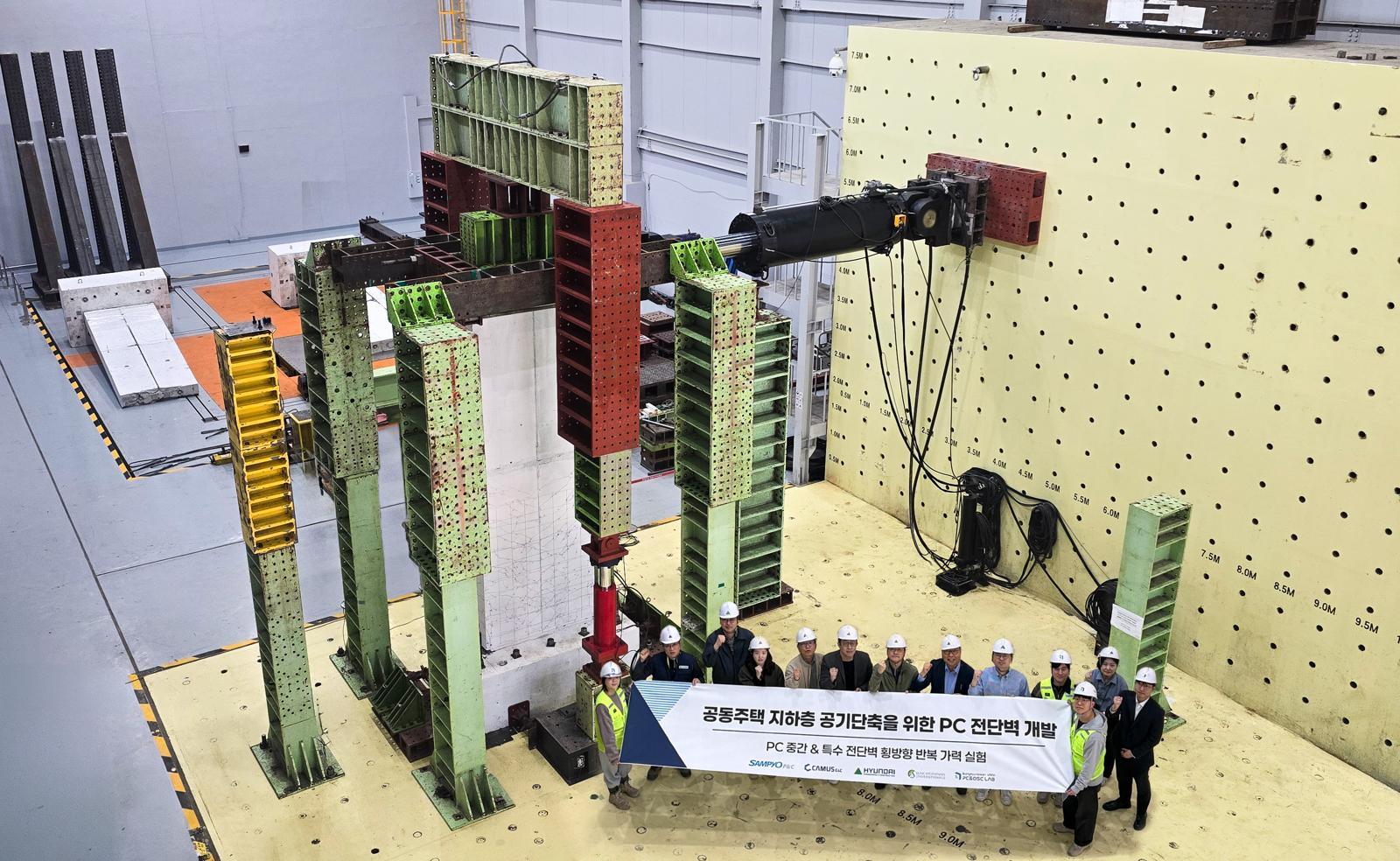
At the structural testing laboratory of the HMG Construction Technology Research Institute in Mabuk-dong, Yongin-si, Gyeonggi Province, officials from Hyundai Engineering & Construction pose for a commemorative photo after conducting a verification test on the structural performance of a precast concrete (PC) wall system. Courtesy of Hyundai Engineering & Construction.
Hyundai Engineering & Construction announced on the 16th that it has obtained conformity certification to the standards of the Architectural Institute of Korea for its technology that applies a precast concrete (PC) method to key structural components such as apartment elevators and stairwells.
The PC method is a construction technique in which concrete members are manufactured in advance at a factory and then transported to the construction site for assembly. Unlike the conventional reinforced concrete (RC) method, in which rebar is arranged and concrete is poured on site, it reduces on-site work and can help shorten construction periods, improve quality control, and prevent safety accidents.
However, for core parts of buildings that are responsible for structural safety, such as elevators and stairwells in multi-family housing, the conventional RC method has mainly been used to ensure seismic performance and related safety.
The newly certified H-PCW is a technology developed to enable the application of the PC method to these core areas as well. It has secured the structural performance required under the national design standard (KDS 41 20 10), thereby verifying its seismic safety.
Hyundai Engineering & Construction jointly developed H-PCW with Sampyo P&C and Kamu E&C. The core is the “H-Link” connection technology that uses ring-shaped U-hook reinforcing bars. It is designed to secure structural performance while enhancing construction convenience in the process of vertically connecting PC wall panels. This technology is currently in the process of patent application.
Last year, Hyundai Engineering & Construction also obtained technology certification from the Korea Association of Structural Engineers for its “residential PC rigid-frame (ramen) structure system.” Through technology for connecting columns and beams, it established a foundation for minimizing internal columns in units and improving space utilization.
With the latest certification of the wall system, the company explained that it has secured a technological foundation to apply the PC method not only to columns and beams but also to core areas such as elevators and stairwells, thereby increasing the feasibility of realizing “ALL-PC” construction, in which the entire structure of multi-family housing is built using the PC method.
A Hyundai Engineering & Construction official said, “Off-site construction (OSC) has many advantages, including improved quality and productivity and reductions in safety accidents and environmental load, but in the multi-family housing market there have been some concerns over structural safety,” adding, “Since H-PCW technology has secured the structural performance required under the national design standard, it is expected to contribute to expanding the application of the PC method and revitalizing the OSC market.”
Meanwhile, HMG Construction Technology Research Institute, the integrated research and development organization of Hyundai Engineering & Construction and Hyundai Engineering, is expanding the development of future residential technologies beyond PC structural technology. It is conducting related research on design technologies that separate the structural frame from interior space to enhance flexibility in layout changes, as well as on “Energy Care” for energy savings and residential comfort, and “All-Life Care” to support residents’ health and living convenience.
ⓒ dongA.com. All rights reserved. Reproduction, redistribution, or use for AI training prohibited.
Popular News