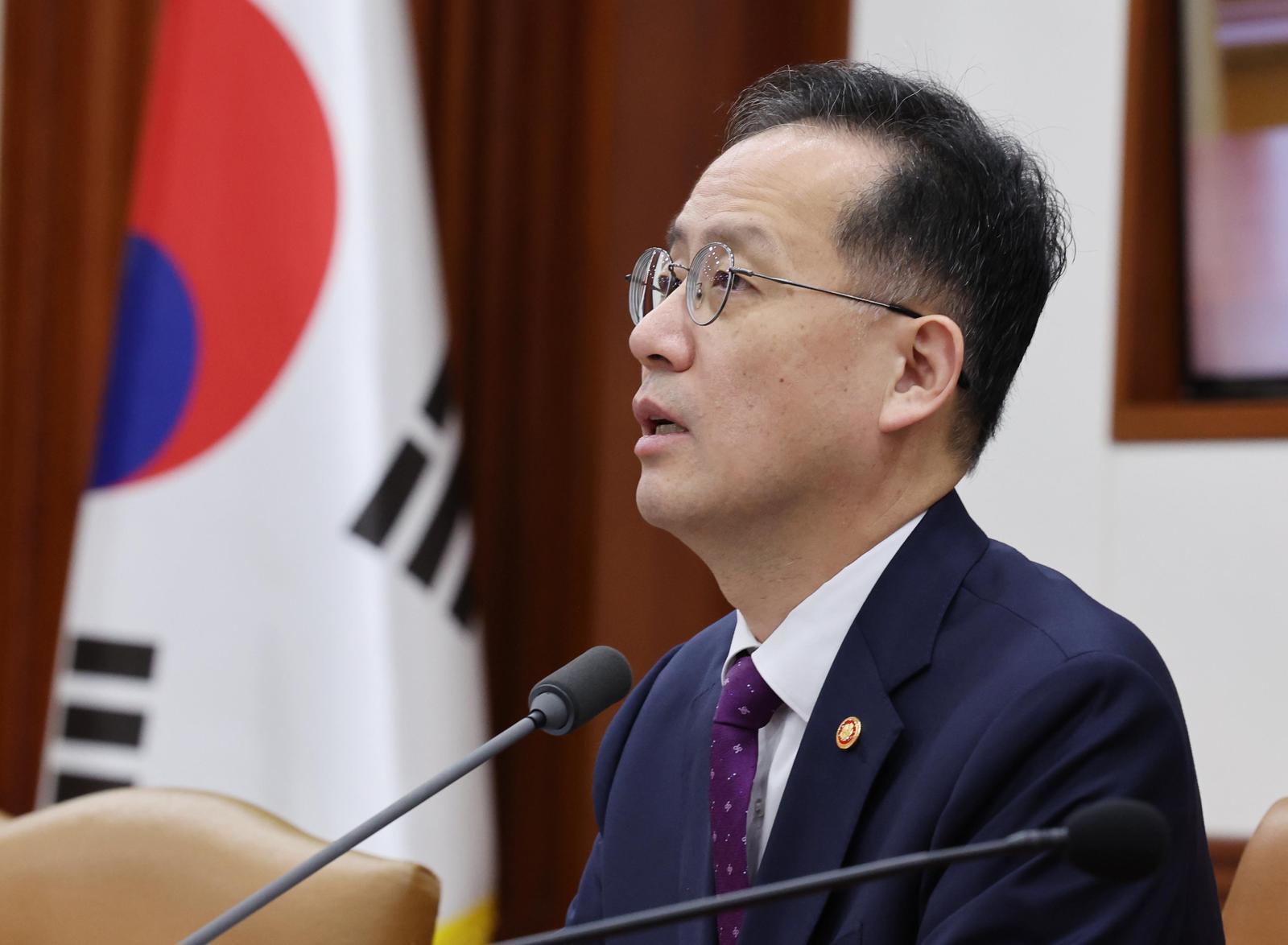
Vice Prime Minister and Minister of Economy and Finance Lee Hyung-il presides over a joint Emergency Economic Headquarters Meeting, Ministerial Meeting on the Economy, and Service Industry Development Task Force at the Government Complex Seoul in Jongno-gu, Seoul, on the 14th. 2026.10.14 ⓒ News1
The government will reorganize a skin databank, which has accumulated skin characteristic information from more than 17,000 people in 18 countries, into a format suitable for artificial intelligence (AI) training to support companies in developing customized cosmetics. It will also ease visa issuance requirements for medical tourism and increase the number of hospitals eligible for visa fast-track procedures. The plan is to foster the K-beauty industry, which has grown mainly around cosmetics manufacturing, into a high value-added service industry that combines AI, healthcare, and tourism.
On the 14th, the government announced the “Support Plan for AI and Convergence-Based K-Beauty Services” at a joint Ministerial Meeting on the Economy and Service Industry Development Task Force (TF) chaired by Vice Prime Minister and Minister of Economy and Finance Lee Hyung-il. The aim is to enhance the competitiveness of the cosmetics manufacturing sector while nurturing related service industries such as skincare and medical aesthetics as new growth engines.
Skin characteristic data managed by the Korea Cosmetic Industry Institute will be converted into AI-trainable data so that companies can easily utilize it. Currently, information from more than 17,000 individuals across 18 countries has been accumulated, and next year the number of surveyed countries is planned to increase to a cumulative 19. With consent for the provision of personal information, the government will collect pre- and post-makeup photos and survey data from 2,000 foreign visitors to Korea.
Companies will be able to use this data to diagnose and analyze skin with AI and provide services for developing personalized cosmetics. For example, Kolmar Korea has developed a device that, when a wound area is photographed, uses an AI algorithm to analyze it and precisely spray a treatment and cover makeup powder that match the user’s skin tone. Regulations will be rationalized so that multiple outlets can be operated using AI and automated devices, and the distribution of standard QR codes will be doubled next year to improve payment convenience for foreign tourists.
Services that link medical aesthetics and tourism will also be expanded. The government plans to establish a “K-Healthcare Integrated Hub” that allows foreign patients to handle everything in one place, from checking medical institution information and making reservations and payments to pre- and post-treatment care and accommodation and tourism. To spread medical tourism demand, which is currently concentrated in the Seoul metropolitan area, to regional areas, the government will also increase the number of high-performing local clinics designated as excellent patient-attracting institutions eligible for expedited visa issuance.
Visa screening requirements and procedures for medical and wellness tourism purposes will also be improved. Currently, visas are issued only to foreign patients who have an invitation from a certified medical tourism agency, are entering Korea for the purpose of receiving treatment or recuperation at a domestic medical institution, and can prove their financial capacity.
Vice Prime Minister Lee stated, “The service industry is one of the second and third runners that will drive growth alongside semiconductors,” adding, “The service industry has a very large job creation effect, and as high value-added sectors such as K-content have recently taken off, it is emerging as a new growth engine.”
ⓒ dongA.com. All rights reserved. Reproduction, redistribution, or use for AI training prohibited.
Popular News