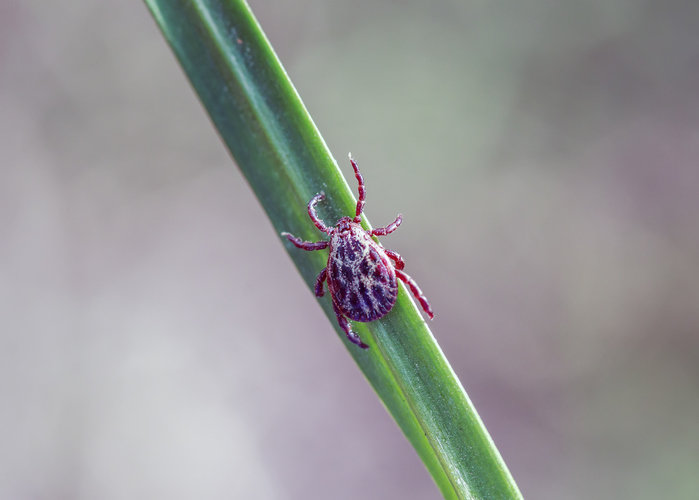
Tick. Photo=Getty Images Bank.
A domestic clinical trial is being pursued for the development of a treatment for severe fever with thrombocytopenia syndrome (SFTS), an illness mainly transmitted by bites from virus-carrying hard ticks.
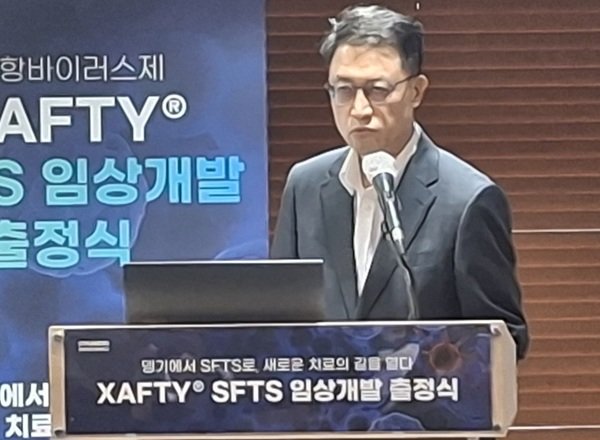
On the 13th, Hyundai Bioscience held a “Host-Targeted Broad-Spectrum Antiviral Zepti (development code CP-COV03) SFTS Clinical Development Kickoff Ceremony” at the Korea Press Center in Jung-gu, Seoul, and announced its strategy for entering a domestic Phase 2 clinical trial in SFTS patients.
SFTS is a viral infectious disease that causes high fever and thrombocytopenia, and severe cases can be fatal due to multiple organ failure. According to data presented by the company, 280 patients were reported domestically last year, of whom 41 died. The cumulative case fatality rate in Korea is about 18%, and it is particularly higher among the elderly.
The main route of transmission is bites from infected ticks, but human-to-human transmission can also occur through exposure to patients’ blood or bodily fluids. In June last year, at a hospital in Cheongju, North Chungcheong Province, seven healthcare workers who performed cardiopulmonary resuscitation on an SFTS patient were secondarily infected.
SFTS occurs mainly in East Asia, including Korea, China, and Japan. In Korea, no antiviral treatment has yet been formally approved, and patient care is focused on symptomatic and supportive treatment.
The active ingredient of Zepti, niclosamide, is a drug that has been used as an anthelmintic to treat tapeworms and other parasites. Although its potential to inhibit various viruses has been studied, it has had the limitation of poor absorption in the body. Hyundai Bioscience is developing it as an antiviral therapeutic by improving this through drug delivery technology. A key feature is that it targets functions of the host cell rather than the virus itself.
The potential of Zepti to inhibit the SFTS virus has been confirmed in prior cell experiments. In addition, a separate research team reported 100% survival in SFTS-infected mice in experiments using another nano-formulation of niclosamide.
Hyundai Bioscience stated that it has secured the scientific rationale for developing Zepti as an SFTS treatment by comparing and analyzing these animal experiment results with existing clinical data on Zepti from COVID-19 trials. However, it has not yet been clinically verified whether Zepti actually improves survival rates in SFTS patients.
Bae Byung-joon, President of Hyundai Bioscience.
One reason cited for the slow progress in developing SFTS treatments is limited marketability due to the relatively small number of patients.
President Bae Byung-joon stated that the company plans to secure economic feasibility by applying the same drug to multiple viral infectious diseases, including the development of a dengue fever treatment currently in clinical trials in Vietnam.
Hyundai Bioscience is pursuing a strategy to begin with Phase 2 clinical trials in SFTS patients by leveraging safety data obtained from its previous COVID-19 clinical trials. The company explained that this strategy reflects the characteristics of SFTS, which has a small patient population.
Chief Executive Officer Jin Geun-woo said, “The primary goal in developing this treatment is to protect the nation’s citizens,” adding, “Based on the scientific evidence secured, we plan to proceed swiftly toward entering Phase 2 clinical trials in SFTS patients, following close prior consultation with the Ministry of Food and Drug Safety.”
Hyundai Bioscience announced that, taking into account the seasonal nature of SFTS, with cases occurring mainly from April to November, it aims to start the clinical trial in early May next year.
ⓒ dongA.com. All rights reserved. Reproduction, redistribution, or use for AI training prohibited.
Popular News