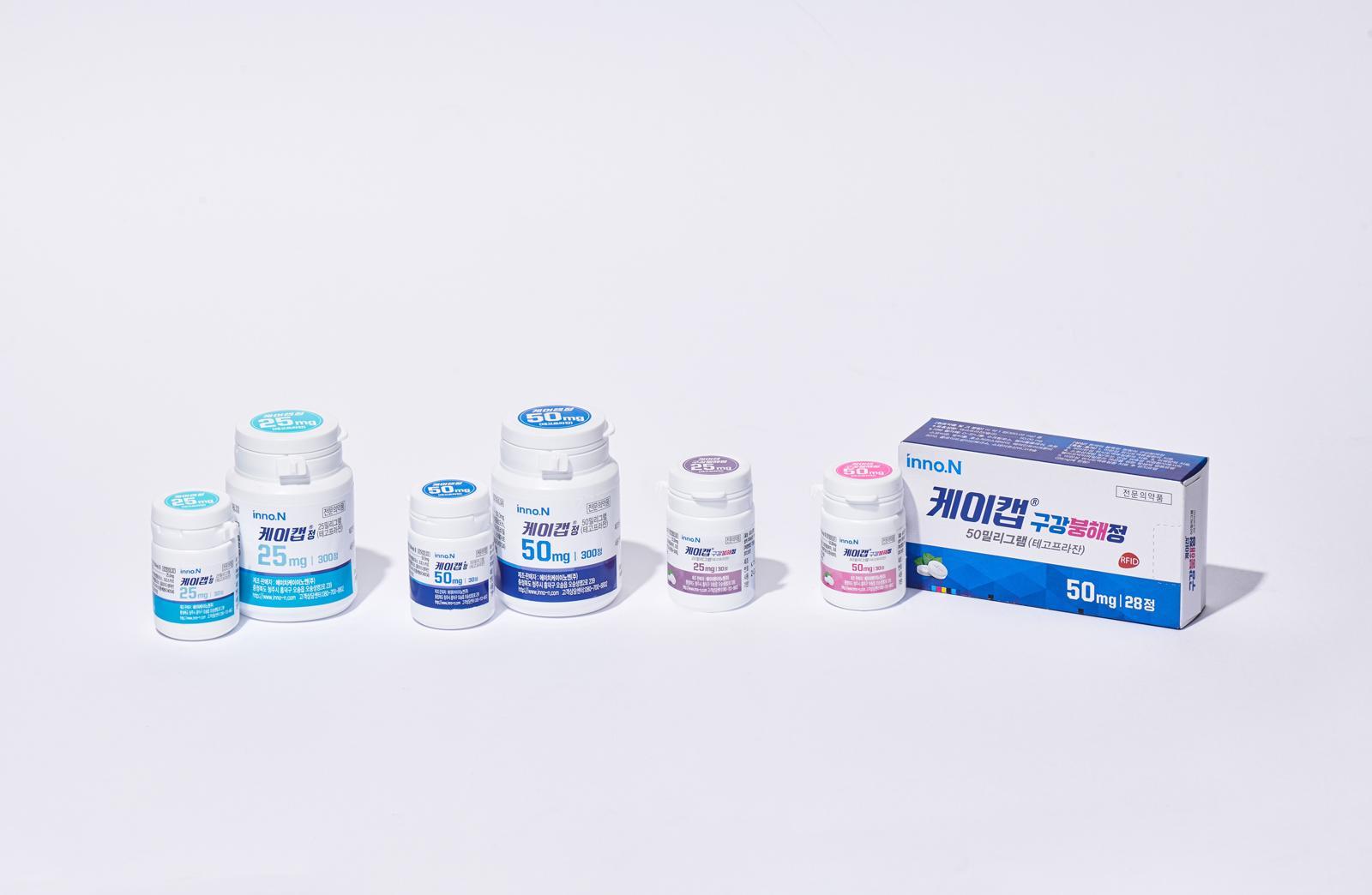
HK Inno.N’s new drug K-CAB for gastroesophageal reflux disease. Courtesy of HK Inno.N.
K-CAB (ingredient name: tegoprazan), HK Inno.N’s new drug for gastroesophageal reflux disease, was shown in a U.S. Phase 3 clinical trial to improve heartburn and acid regurgitation symptoms.
U.S. partner Sebela expects approval from the U.S. Food and Drug Administration (FDA) in January next year, and once local sales begin, HK Inno.N will receive royalty income.
HK Inno.N announced on the 12th that its U.S. partner Sebela Pharmaceuticals plans to present the Phase 3 clinical trial results of K-CAB in non-erosive reflux disease (NERD) at the American College of Gastroenterology Annual Scientific Meeting (ACG 2026), to be held on the 14th (local time) in Tennessee, United States.
Sebela had previously disclosed the key results of K-CAB’s U.S. Phase 3 trial last year, but specific clinical data were not released at that time. At this conference, detailed clinical results, including the drug’s effect on improving heartburn and acid regurgitation, will be presented.
The trial was conducted on 783 patients with non-erosive gastroesophageal reflux disease, who show heartburn or acid regurgitation symptoms without distinct damage to the esophageal mucosa. Patients received once-daily doses of tegoprazan 50 mg, 100 mg, or placebo for four weeks, followed by participation in a 20-week extension study.
In the clinical results, both doses of tegoprazan met the primary and secondary endpoints. The proportion of days without 24-hour heartburn through week 4 was 26.2% in the 50 mg tegoprazan group and 30.1% in the 100 mg group, compared with 17.3% in the placebo group.
The proportion of days without nocturnal heartburn was 27.0% in the placebo group, 36.1% in the 50 mg tegoprazan group, and 39.9% in the 100 mg group. Both doses showed statistically significant differences compared with placebo.
The proportion of days without both acid regurgitation and heartburn also improved. In the composite endpoint that evaluated both symptoms together, the 50 mg group and the 100 mg group showed relative improvement effects of 60% and 76%, respectively, compared with placebo.
The symptom improvement effect was maintained in the 20-week extension study. The proportion of days without 24-hour heartburn was 48% in the 50 mg tegoprazan group and 50% in the 100 mg group.
The conference will also feature a post-hoc analysis applying “Lyon Consensus 2.0,” the international diagnostic criteria for gastroesophageal reflux disease, to the U.S. Phase 3 results of K-CAB in erosive esophagitis (EE), which were released in May. This study received the American College of Gastroenterology Presidential Award (ACG Presidential Award).
Among the 1,245 subjects analyzed, the week 2 healing rate of esophagitis in patients with definitive gastroesophageal reflux disease was 75.4% in the tegoprazan group and 60.7% in the lansoprazole group, an existing therapy. The maintenance of healing at week 24 was also higher in the tegoprazan group than in the lansoprazole group. However, among patients with non-definitive gastroesophageal reflux disease, there was no statistically significant difference observed between treatment groups.
The approval process for entry into the U.S. market is also under way. Sebela submitted a New Drug Application (NDA) for K-CAB to the FDA in January and is expecting approval in January next year. According to HK Inno.N, once sales begin in the United States, the company will receive royalty income from its local partner.
Ronnie Fass, professor at Case Western Reserve University School of Medicine and the presenting investigator, said, “To provide meaningful therapeutic benefit for patients with non-erosive gastroesophageal reflux disease, both heartburn and acid regurgitation symptoms must be resolved,” adding, “In this study, tegoprazan showed statistically significant improvements in both symptoms and across composite symptom endpoints.”
K-CAB is the 30th domestically developed new drug in Korea, created by HK Inno.N, and has recorded cumulative outpatient prescription sales of KRW 1.0433 trillion in Korea from its launch in March 2019 through the first half of this year. The company has signed technology export or finished-product export contracts with 55 overseas countries, and the drug has been approved in 24 countries including Korea and launched in 22 countries.
An HK Inno.N official said, “This presentation is meaningful in that it shares K-CAB’s clinical results, confirmed in a large U.S. patient population, at an international academic conference,” adding, “The company will continue to work with its partner to strengthen K-CAB’s presence in the U.S. market.”
ⓒ dongA.com. All rights reserved. Reproduction, redistribution, or use for AI training prohibited.
Popular News