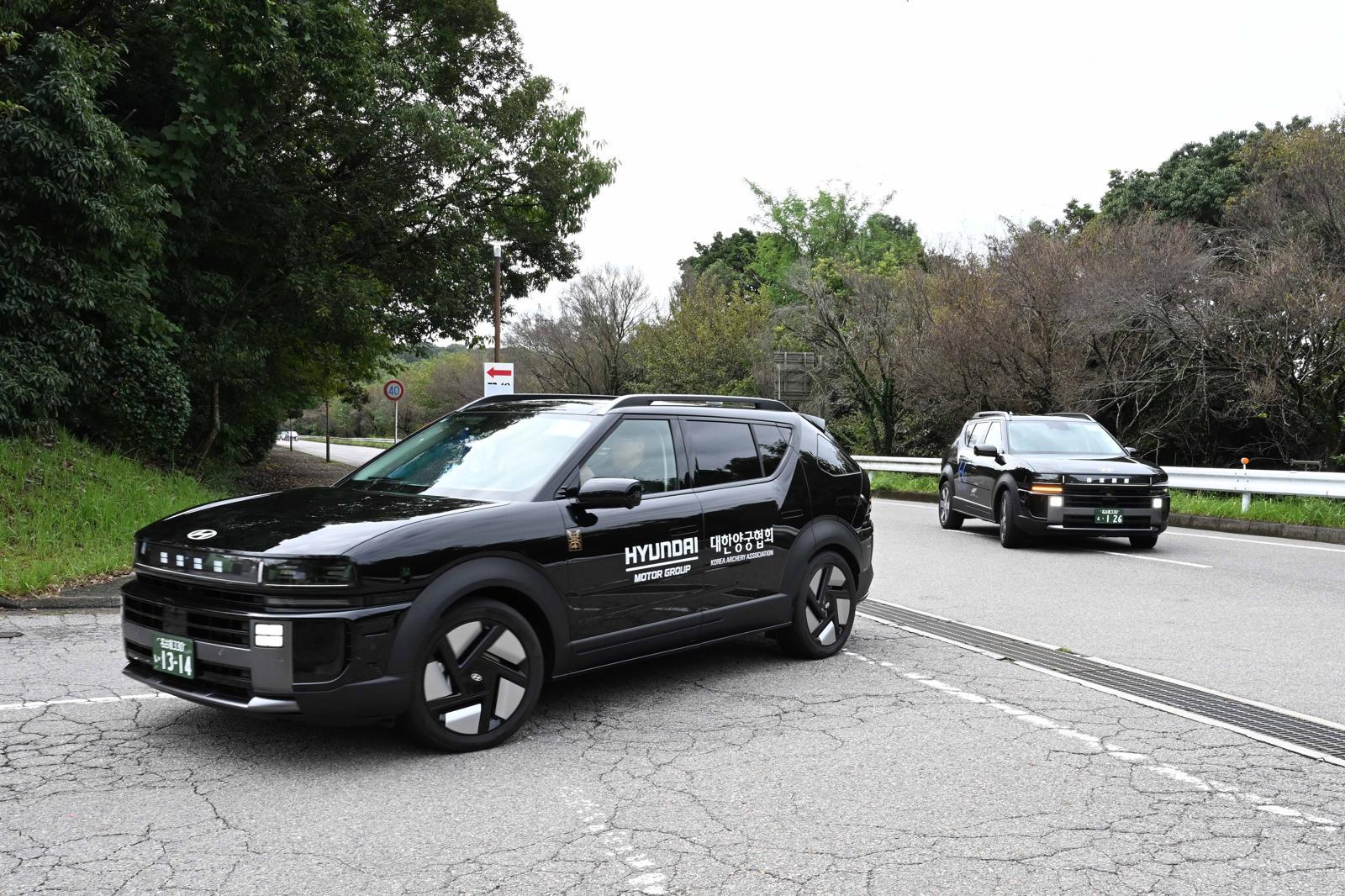
The All New NEXO in Japan that Hyundai Motor used together with a Japanese taxi company as a protocol vehicle for the national archery team during the Nagoya Aichi Asian Games. Provided by Hyundai Motor
Hyundai Motor Group, which has designated the establishment of a hydrogen ecosystem as a future growth engine and is accelerating related businesses, is moving to broaden its base by successively exporting hydrogen mobility overseas following the domestic market. The company has exported hydrogen fuel cell electric vehicles (FCEVs) to Japan to positive reviews and is also set to supply hydrogen trams to Africa.
Hyundai Motor’s new FCEV, “The All New NEXO,” began to be exported to Japan in April this year. A total of 20 units were exported through August, and 15 units with completed contracts are awaiting delivery. Although the number of units exported is small, the FCEV market share in Japan is in double digits. According to the Japan Automobile Dealers Association (JADA), 183 FCEVs were sold in Japan during this period, giving the NEXO a market share of 10.9%.
Of the 35 NEXO units that have been exported to Japan or are scheduled for export, 22 units have been contracted by taxi companies. Under Korean certification standards, the NEXO’s driving range is 720 km, but under Japanese certification standards it extends to 1,014 km, allowing drivers to secure 2 to 3 days’ worth of operating distance on a single refueling. In addition, as the only taxi in Japan with a sport utility vehicle (SUV) body style, it has a large trunk space that is advantageous for transporting foreign passengers with substantial luggage, which the company believes is why Japanese taxi operators are choosing this vehicle.
South Korea and Japan are currently in a competitive relationship over the activation of the hydrogen economy. The Tokyo Metropolitan Government is pursuing the “Tokyo H2” project, under which it plans to increase the number of FCEV taxis to 600 units by 2030 and FCEV commercial vehicles to 10,000 units by 2035. Hyundai Motor has set a goal of leveraging this project to raise the NEXO’s market share in Japan. To this end, it is adding localized convenience features, such as equipping models sold in Japan as standard with a “V2L” function that allows electricity from the vehicle to be used in reverse if power is cut off due to earthquakes or other disasters.
Hyundai Rotem has also taken its first step toward exporting its independently developed hydrogen fuel cell tram to Egypt. Taking advantage of Egyptian President Abdel Fattah El-Sisi’s state visit to Korea, Hyundai Rotem signed a memorandum of understanding with the Egyptian Tunneling Authority on 7 October at the Lotte Hotel Seoul in Jung District, Seoul, during the “Korea–Egypt Business Round Table,” for the construction of a hydrogen electric tram system in Egypt’s New Administrative Capital. The Egyptian government is building a large administrative city with a population of 6 million, 35 km east of Cairo, with completion targeted for 2030. Hyundai Rotem aims to supply 44 hydrogen electric tram sets for a 28 km line to be laid in this city.
Hyundai Rotem has already supplied rolling stock to the Cairo Metro and has earned the trust of the local government and railway-related institutions, which is seen as increasing the likelihood of the deal being finalized. A Hyundai Rotem official stated, “If the export is actually concluded, we will be able to export various systems of Hyundai Motor Group’s hydrogen brand ‘HTWO,’ including hydrogen refueling facilities and railway infrastructure, at the same time,” adding, “We will make every effort to win the order so that we can secure a favorable position in the global hydrogen business.”
ⓒ dongA.com. All rights reserved. Reproduction, redistribution, or use for AI training prohibited.
Popular News