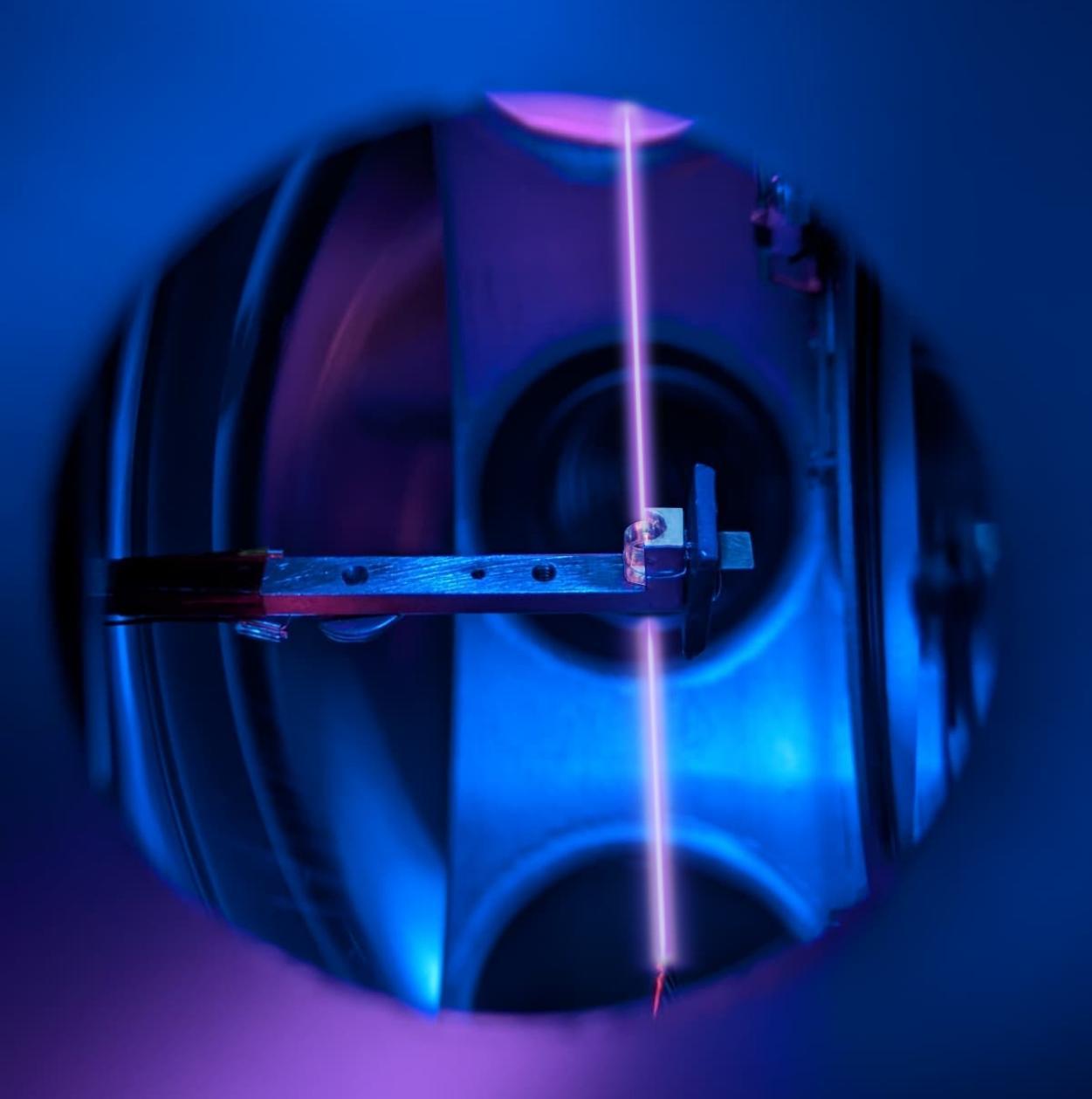
A calcium fluoride crystal is fixed inside a vacuum system. When a laser is directed at the thorium atomic nuclei inside the crystal, time can be measured with high precision. Courtesy of Professor Thorsten Schumm
A “nuclear clock” that measures time using atomic nuclei has begun operating for the first time. Theoretically, a nuclear clock can achieve a higher level of precision than existing atomic clocks, which currently offer the highest precision, drawing significant attention from the academic community.
Research teams led by Professor Thorsten Schumm of the Quantum Metrology Group at TU Wien in Austria and Professor Ding Cezheng of the Department of Physics at Tsinghua University in China independently realized continuously operating nuclear clocks based on thorium (Th)-229 nuclei, functioning like actual clocks. They published their findings in two separate papers on 7 October (local time) in the international journal Nature.
● The most precise method of time measurementAccurate time measurement is essential for fundamental physics and advanced technologies. A clock is a device that counts regularly recurring phenomena. Atoms consist of a central nucleus and surrounding electrons. Atomic clocks use the characteristic frequency of light absorbed or emitted as electrons transition between two energy states as a reference scale for seconds, and they have served as the standard for precise time measurement for the past 70 years. The most precise current atomic clocks would accumulate an error of 1 second only after operating for 260 billion years.
The concept of a nuclear clock, which measures time based on energy transitions within atomic nuclei, was first proposed in 2003. Because atomic nuclei are relatively less affected by external electric fields and similar influences, it was theorized that nuclear clocks could measure time more precisely than conventional atomic clocks.
In particular, the isotope thorium-229 of the metallic element thorium has long been regarded as virtually the only candidate whose nuclear energy can be directly controlled by currently available lasers. Isotopes are elements with the same atomic number but different mass. Previous studies succeeded in measuring the transition frequency of thorium nuclei, but the nuclear signal itself had not been implemented as a continuously operating clock that stabilizes the laser frequency.
The team led by Professor Schumm embedded thorium-229 nuclei in a room-temperature calcium fluoride (CaF₂) crystal and directed a vacuum ultraviolet (VUV) laser with a wavelength of 148 nm (nanometers; 1 nm is one-billionth of a meter) at it, then measured changes in nuclear light absorption in real time. They built a feedback loop that automatically retunes the laser when it deviates from the nuclear transition frequency. They then succeeded in operating the nuclear clock continuously for about one day. They also confirmed that frequency instability decreases as the measurement time increases.
The team led by Professor Ding independently implemented a nuclear clock by using a calcium fluoride crystal containing thorium-229 and a vacuum ultraviolet laser with a wavelength of 148.4 nm to automatically synchronize the laser with the nuclear transition signal. By comparing the frequencies of calcium fluoride crystals produced in different locations, they also verified reproducibility.
● “Nuclear clocks to provide a new time standard”The two studies are significant in that, 23 years after the thorium-229 nuclear clock concept was proposed, they have advanced from the experimental stage of observing nuclear transitions to the realization of a self-calibrating clock that uses nuclear transitions as a frequency reference.
The Schumm team verified the performance of the nuclear clock by comparing it with an ytterbium (Yb) ion-based atomic clock. Although the timekeeping performance of the nuclear clock has not yet reached that of the best atomic clocks, they estimate that the stability can be improved by more than a factor of several thousand by enhancing the quality of the calcium fluoride crystals and increasing the output of the vacuum ultraviolet laser.
Nuclear clocks are also expected to be used not only for ultra-precise time measurement but also to explore realms beyond current theories of modern physics, such as dark matter, whose nature remains unknown to humanity.
The Schumm team in fact used the thorium nuclear clock to search for dark matter. According to some “ultralight dark matter” theories, the influence of dark matter can cause extremely slight variations in the fundamental constants of nature. The team analyzed whether the frequency ratio between the thorium nuclear clock and the ytterbium atomic clock fluctuated over approximately 23 hours and proposed a new upper bound showing that no dark matter signal was detected within a certain mass range.
In a Nature commentary on the research, Senior Researcher Akio Kawasaki of the National Institute of Advanced Industrial Science and Technology (AIST) in Japan stated, “If several technical components are improved, nuclear clocks could become a new time standard,” adding, “It has also been confirmed that nuclear clocks may become powerful tools for future explorations in fundamental physics.”
ⓒ dongA.com. All rights reserved. Reproduction, redistribution, or use for AI training prohibited.
Popular News