NumzAI builds an AI that understands and predicts numbers in tables
Companies manage key data in tables, yet LLMs still struggle with them
After confirming TFM’s commercialization potential, SNU–KAIST alumni formed a team
“There’s no data moat for training… unlike LLMs, Korea can be No. 1 here”
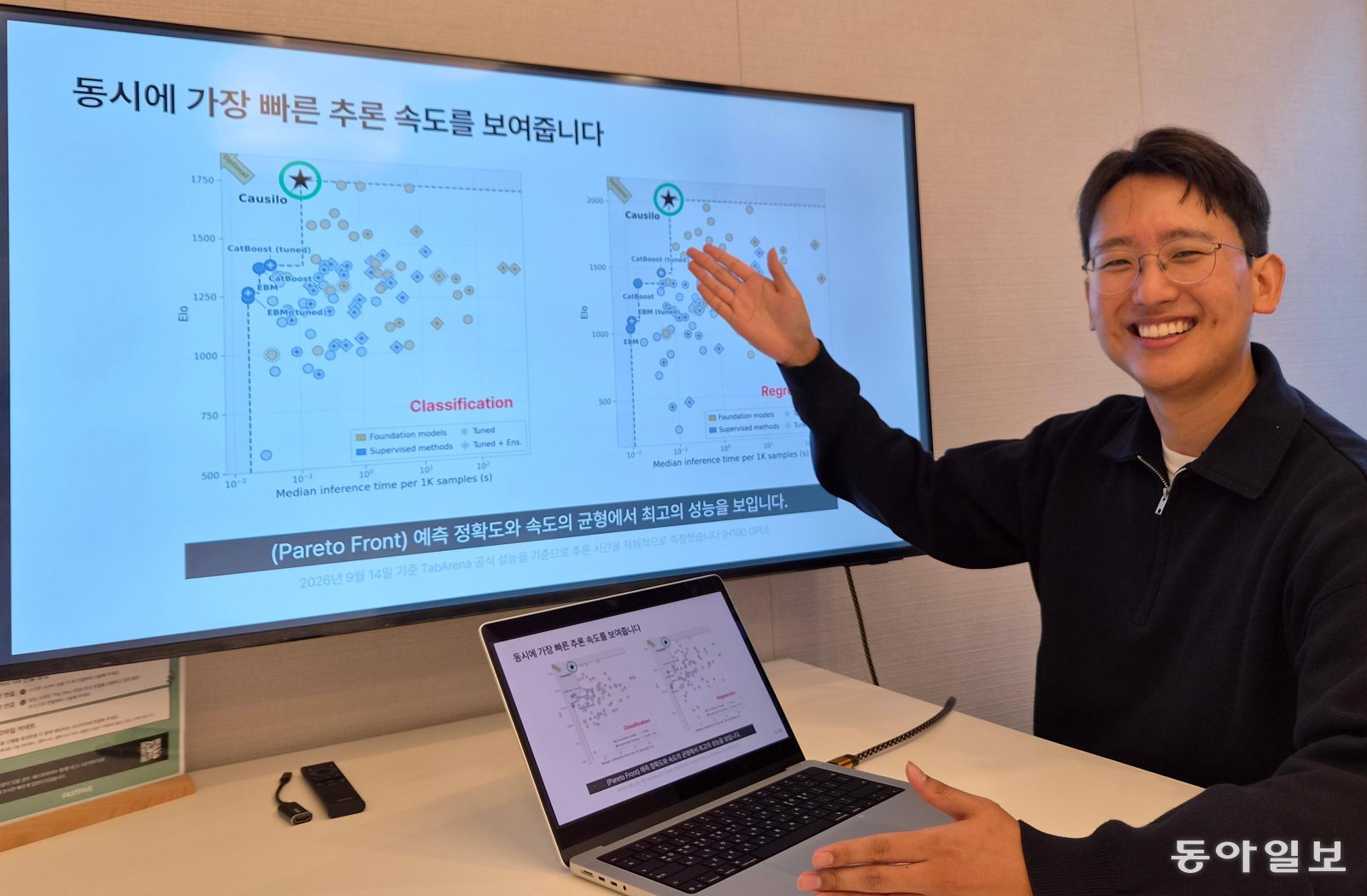
Yoo Jae-min, CEO of NumzAI, explains the significance of a performance graph for Causilo while pointing to it at the company’s office in Gangnam District, Seoul, on the 28th of last month. Photo by reporter Heo Jin-seok, jameshur@donga.com
There are only 500 coupons for 10,000 customers. Sales will differ depending on whom they are distributed to. A bank credit officer must decide which loans to approve, and a plant manager must anticipate which equipment is likely to fail. Customer lists, credit information, and defect rates by facility are all managed as tables organized in rows and columns. A company’s daily operations run on top of such tables.
Meeting at NumzAI’s office in Gangnam District, Seoul, on the 28th of last month, CEO Yoo Jae-min (32, Assistant Professor at the Department of Computer Science and Engineering at Seoul National University) said, “When a company transitions to AI, the goal is not just to use agents that replace humans, but to enhance productivity through better decision-making,” adding, “For that purpose, numbers are more important than language.”
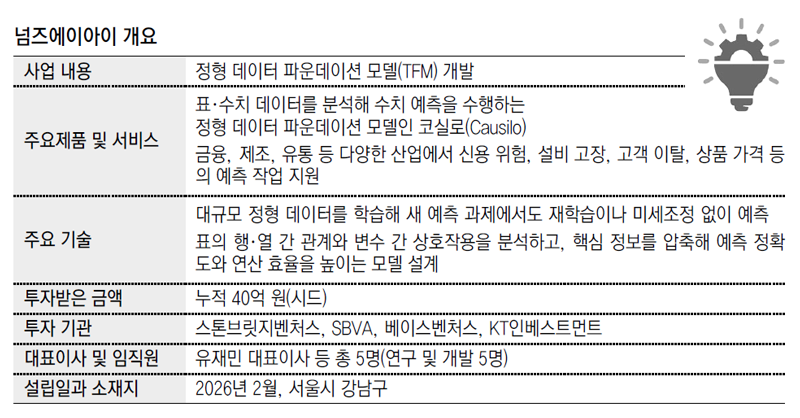
Large language models (LLMs), which are currently referred to as artificial intelligence (AI), are trained on language and therefore cannot directly handle tables and numerical data. Yoo said, “NumzAI is building and improving the performance of a structured data foundation model (TFM, also called a table foundation model) that can immediately perform predictions when given a new table,” and added, “In this field, which began globally only within the last one to two years, we are a startup that is globally ahead.” The company is creating a foundation model that understands data composed solely of numbers arranged in rows and columns.
● The concerns of large corporations’ data science teams
Tables contain critical information about corporate activities. Large corporations have dedicated data science teams that predict customer churn, assess the likelihood of debt recovery, optimize inspection and maintenance schedules for manufacturing equipment, and forecast changes in sales volumes following price increases. The core technology used by these data science teams is machine learning-based MLOps (machine learning operations automation). To obtain operational insights for the company and manage customers, logistics, and more, they build solutions by repeatedly performing data preprocessing, machine learning model training, and fine-tuning tailored to each specific objective.
The issue is that this process must be repeated each time a solution is developed, and even changing a single variable (one row or one column of data) requires building everything from scratch. Completing a project typically takes several months. Yoo said, “This approach is labor-intensive, which creates the problem that more people must be hired for each new task,” adding, “Recently, there have been attempts to combine MLOps with LLMs to solve this labor-intensive problem, but due to the inherent limitations of LLMs, they have not been able to find proper answers.”
NumzAI believes that table foundation models will ultimately replace the existing MLOps market and open a new horizon in prediction and decision-making. Yoo said, “The MLOps market is growing at an average annual rate of 43.2% and is expected to reach USD 25.8 billion (approximately KRW 35 trillion) by 2030.” NumzAI is targeting this market.
● A model that understands relationships among numbers in tables and makes predictions
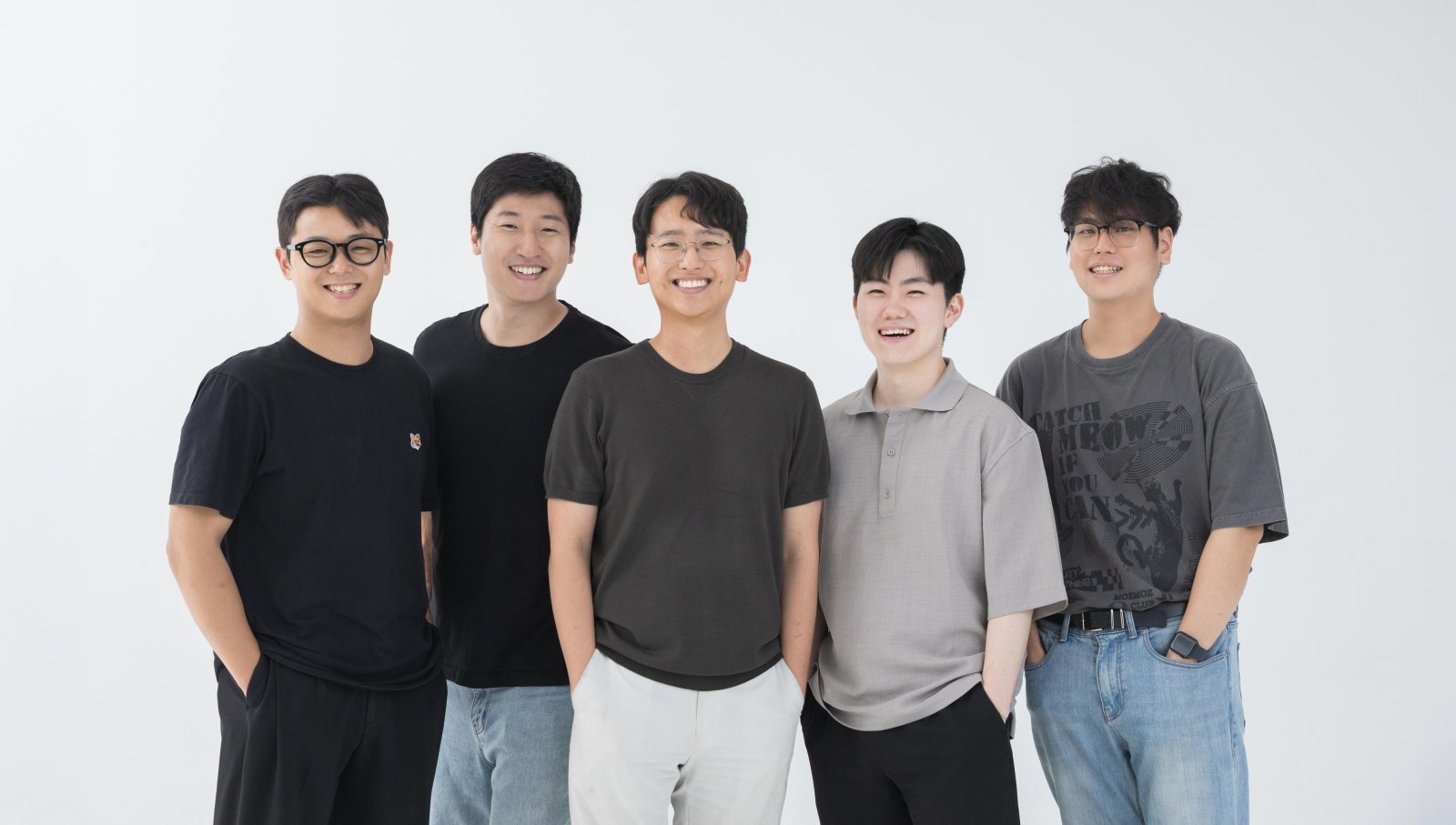
NumzAI CEO Yoo Jae-min (center) and researchers. Provided by NumzAI
NumzAI’s answer is not to build a separate model for each solution. It developed “Causilo,” a structured data foundation model (TFM) that can fill any blank cell in any table with a single inference.
Its operating principle resembles in-context learning of large language models. When a table is input, Causilo represents each cell as a vector based on the numeric value in the cell and its position within the table. It then repeatedly traverses within rows to identify relationships among values and across rows within the same column to grasp patterns. Yoo explained, “It can make predictions based solely on the numbers inside the table without looking at the column name ‘total customer purchase amount’.” Based on the vectors generated in this way, it predicts intentionally blank values, as well as currently unknown information such as whether a customer will churn or future product demand.
Its performance is demonstrated in scores. In September this year, on the global benchmark TabArena, Causilo ranked first in all overall, classification, and regression categories with a score of 1,792 in performance evaluations based on 51 diverse datasets, including customer churn and bankruptcy. It outperformed Google (TabFM, 1,772 points), Amazon (Mitra v2, 1,771 points), LG (Exaone Tabular, 1,749 points), and Germany’s PriorLabs (TabPFN-3, 1,633 points), which was acquired by SAP.
Results are produced within a few seconds. In predicting churn among telecom subscribers, it outperformed 91% of existing machine learning models with an accuracy of 93%. For collateral value predictions, it outputs not a single figure, but a range. With a model size of around 100 million parameters, it can be run on a laptop PC. The code and model weights are open so that anyone can verify them.
● Believing it to be a technology that can change the world, he founded a startup
Yoo is an expert who has researched AI for numerical data for more than 10 years, even before AlphaGo and ChatGPT emerged. He graduated from the Department of Computer Science and Engineering at Seoul National University in 2016, received his PhD from the same university in 2022, and worked as a postdoctoral researcher at Carnegie Mellon University. He received a Google PhD Fellowship in machine learning and became an assistant professor at KAIST’s School of Electrical Engineering in 2023 at the age of 29. He moved to Seoul National University in March this year.
A paper on a table foundation model by a German research team, published in Nature in January 2025, led him to start a company. His initial reaction upon reading the paper was skepticism. Common sense suggested it would be difficult for a single model to make predictions across highly heterogeneous tables, such as those from manufacturing and finance. Yoo said, “I was one of those who thought it could not be done. From experience in repeated research attempts, I believed it was impossible, but when I implemented what was in their paper and ran it, it actually worked.” The more experiments he ran himself, the more his conviction solidified.
Yoo said, “The German team’s paper did not look like just a single academic paper but a technology that could completely transform the structured data field. I thought it would be impossible with only university resources, so I chose to launch a startup and seek investment.” He recalled that the thought, “If it is not done now, it will never be,” was very strong. Stonebridge Ventures and others invested KRW 4 billion at the seed stage in his startup plan.
The team has five members. Chief Technology Officer (CTO) Lee Doo-ho, a former student who first introduced him to TFM, Chief Product Officer (CPO) Cho Min-yong, a colleague from his Seoul National University lab, and researchers Lee Jin-mo and Jung Min-ho, who have handled numerical data in the field using conventional methods, all joined. Yoo said, “They have experienced traditional machine learning model approaches and therefore understand the limitations precisely. They believe TFM is the future, which is why they are here.” All are graduates of Seoul National University or KAIST and have published papers at top-tier AI conferences.
● “Korea was late to LLMs, but can be No. 1 in TFM”
The core technology lies in properly generating pretraining data. Yoo said, “Feeding 1 million synthetic numbers yields better training results than collecting 100 or 1,000 real datasets,” and compared it to “creating the most suitable practice questions so that a student can be trained to score highly on a college entrance exam by solving problems of appropriate difficulty.” He added, “If competition in LLM development is about collecting training data, competition in TFM is about generating training data correctly.”
For now, Causilo is available via API. It has been selected for InBody’s open innovation program and is undergoing proof-of-concept (PoC). NumzAI is also in talks with a logistics company to work on logistics optimization and with a major manufacturing company on quality prediction. The company is preparing “Causilo Chat,” which will provide predictions and supporting evidence in response to natural language queries, and “Causilo Agent,” which will connect to corporate databases and handle tasks autonomously.
Certain risks are anticipated. Yoo said, “Right now, the contest is about who can come up with better ideas, so little capital is needed. But once the winners and losers are decided and scaling begins, capital will have a much greater impact. To prepare for that time, we must have a more efficient and higher-performing model ready in advance.”
Full-fledged global competition began after the German team’s paper was published last year, and the market is moving quickly. PriorLabs, the company founded by the German research team, was acquired by SAP at a valuation exceeding KRW 1 trillion, and a company called Kumo was sold to NVIDIA for KRW 600 billion.
Yoo believes that in the TFM field, Korea has sufficient capability to lead with its own models. He said emphatically, “In LLMs, Korea started late, and there seems to be a social mood that has given up on becoming No. 1 globally, which I think is unhealthy. To become an AI powerhouse, there must be many companies aiming for the top. TFM has no borders because numbers are a universal language, and since training data can be generated synthetically, there is no data moat. And because the models are smaller, they require less capital than LLMs. Korea’s AI research capabilities rank in the global top five, or in an aggressive assessment, top three. In foundation models for structured data, Korea can fully emerge as a pioneer.”
ⓒ dongA.com. All rights reserved. Reproduction, redistribution, or use for AI training prohibited.
Popular News