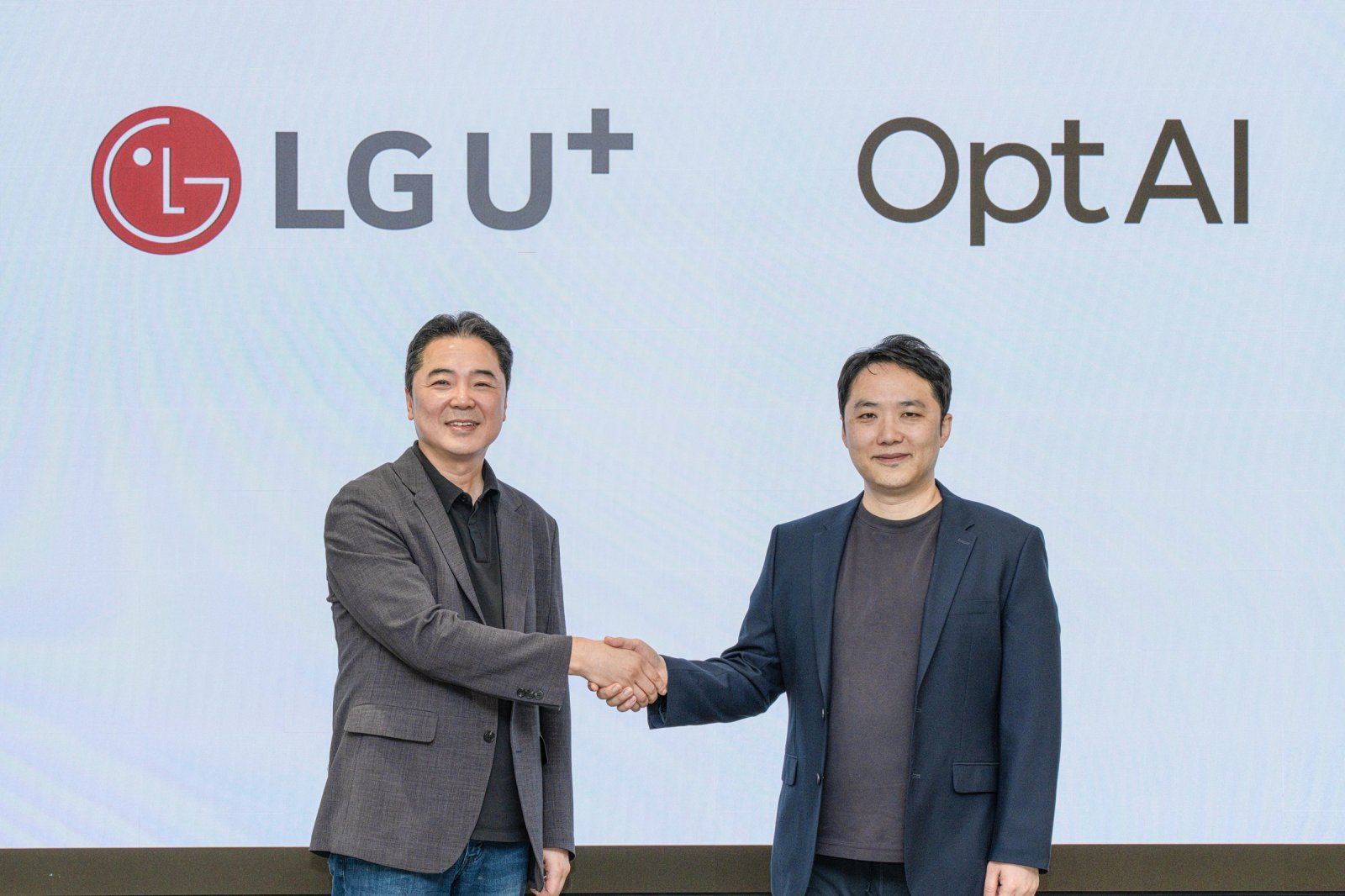
Lee Sang-yeob, CTO (Executive Vice President, left) of LG Uplus, and Lee Jae-ho, CEO of OptAI, pose for a commemorative photo related to their cooperation on token optimization.
LG Uplus announced on the 2nd that it will jointly research “token optimization” technology with AI model optimization company OptAI to improve the operational efficiency of AI services.
A token is the basic unit of data processed when AI understands users’ questions and generates responses. Token optimization is a technology that enables an AI model to handle more requests with the same resources by making the model lighter or streamlining computational processes. As AI services proliferate and operating costs such as GPUs and power consumption increase, the importance of technologies that can deliver the same level of service with fewer resources is growing.
Based on its real-world AI service operation experience, LG Uplus will be responsible for technology verification and application, while OptAI will undertake research and development of technologies that run AI models more lightly and quickly. The two companies aim to reduce GPU and power usage while improving response speed and service quality. In their ongoing research on GPU-based AI model optimization, they have already reported initial results, including improving the computational process for answer generation to better fit actual service environments and increasing the volume of tokens processed on the same GPU by up to four times compared with previous levels.
The two companies first collaborated in the on-device AI field. In September last year, LG Uplus, together with LG AI Research and OptAI, developed an on-device small language model (sLM) based on LG AI Research’s “EXAONE 3.5.” By applying lightweighting technologies, they enabled the model to run on the NPU, an AI-dedicated chipset in smartphones, while maintaining performance comparable to the conventional CPU-based approach, but reducing power consumption by 78% and model size by 82%.
They also co-hosted the “Efficient AI Tech Seminar” the previous day. The event was attended by representatives from AI semiconductor company FuriosaAI, AI platform company VesselAI, the Korea Electronics Technology Institute (KETI), and Hanyang University, who discussed topics ranging from AI model optimization and AI semiconductors to real-world service application cases.
Building on this collaboration, the two companies will expand the scope of their joint research to include server GPU environments. They plan to focus on technologies that streamline model computation processes so that large-scale AI services can handle more user requests with the same GPU resources.
In addition, LG Uplus plans to gradually apply the acquired technologies to its own AI services and large-scale AI infrastructure operating environments.
Lee Sang-yeob, CTO of LG Uplus, said, “AI competitiveness depends not only on improving performance but also on how efficiently it can process as many tokens as possible with the same resources,” adding, “LG Uplus will work with various partners, including OptAI, to expand research on token optimization technologies and achieve results that can be applied to real services.”
Meanwhile, OptAI is a specialized AI model optimization startup founded in November 2021 that develops lightweighting and optimization solutions enabling complex AI models to operate in real time on edge devices with limited resources, such as smartphones, robots, and vehicles.
ⓒ dongA.com. All rights reserved. Reproduction, redistribution, or use for AI training prohibited.
Popular News