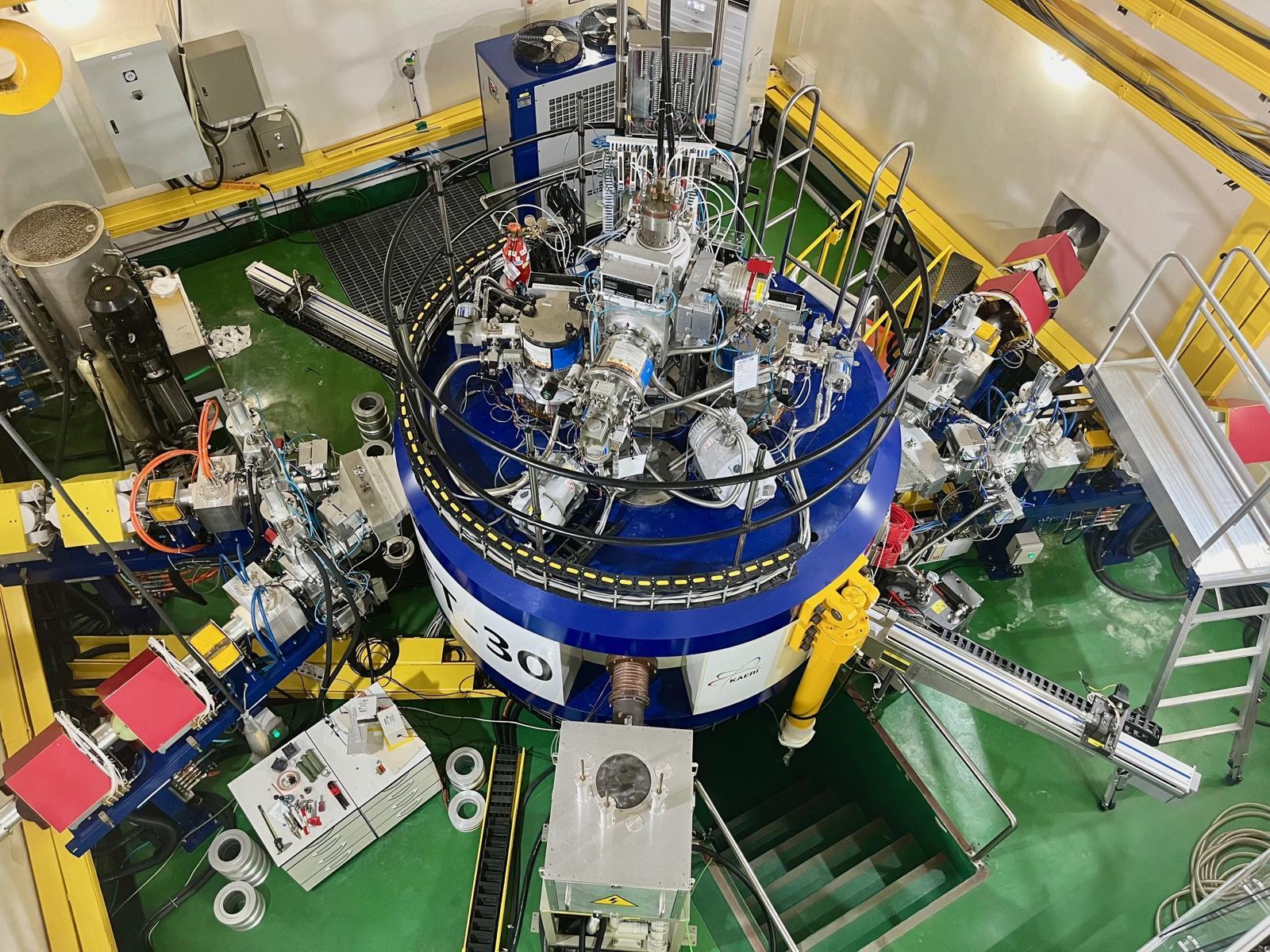
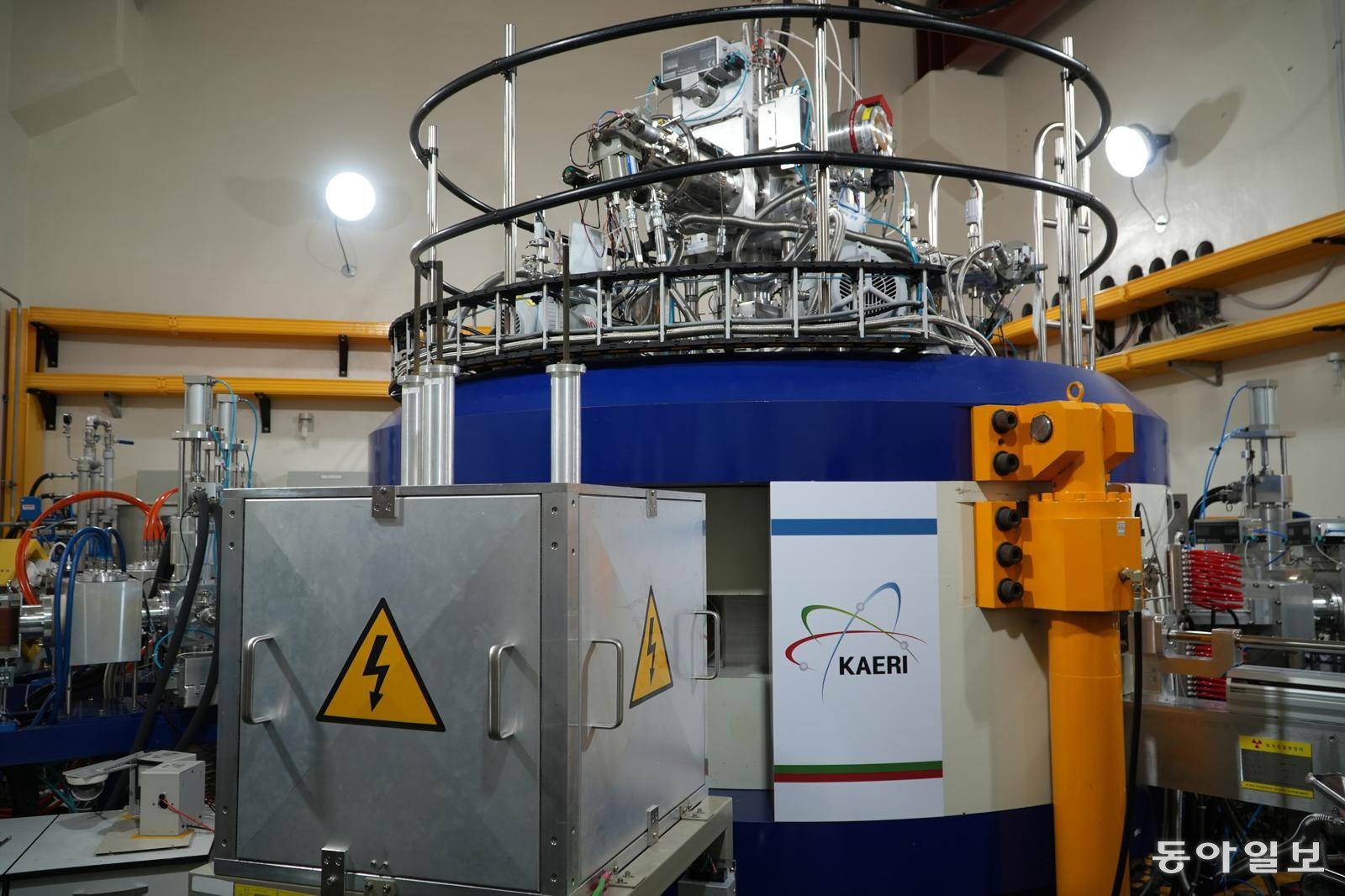
On the afternoon of the 29th at the Advanced Radiation Technology Institute of the Korea Atomic Energy Research Institute in Jeongeup, North Jeolla Province. Upon entering the first floor, a massive blue cylindrical machine immediately caught the eye. Above the equipment, silver pipes and cables through which tiny particles pass were densely intertwined, and a booming roar emanated from the metal conduits extending in all directions from the main body. On the control screen, rows of green indicators showed that the cooling water and vacuum conditions were normal.
This device is the mid-sized particle accelerator “RFT-30” cyclotron, developed with domestic technology in 2009. A cyclotron is a state-of-the-art particle accelerator that spins invisible tiny particles along a circular orbit and shoots them out at high speed. By accelerating particles and emitting protons to collide with other substances, it becomes possible to obtain “medical radioactive isotopes” used to detect or treat cancer in the human body. Park Jung-hoon, head of the Cyclotron Application Research Division at the Advanced Radiation Technology Institute, who was explaining the RFT-30, said, “Thanks to this equipment, Korea has been able to join the ranks of countries that export radioactive isotopes.”
● Domestic zirconium supply rises from 0% to 98% The level of domestic radiation technology used in cancer detection and treatment is steadily advancing. Because the Advanced Radiation Technology Institute has developed domestic technologies and secured a production base, Korea has, unlike 10 years ago, reached a world-class level where it exports domestic technology and medical radioactive isotopes. Medical radioactive isotopes are substances that emit radiation on their own. Since this radiation can be detected to determine the location of cancer or destroy cancer cells, these isotopes are used as raw materials for pharmaceuticals.
A representative substance is “Zirconium-89,” used in antibody immunology research. It enables visual tracking of where antibodies travel within the body. Since 2015, the institute has upgraded the RFT-30 in three stages, and thanks to this, Zirconium-89 is now largely supplied domestically without relying on imports. Park said, “Ten years ago, Zirconium-89 was not produced at all in Korea. But after repeated research using our own technology, we now cover 98% with domestically produced material.” As the technological level has risen, the production portfolio has expanded from being limited to cancer diagnosis to including “therapeutic” applications. In 2020, the institute also secured production technology for “Copper-67,” a next-generation therapeutic isotope that directly attacks cancer cells.
● Expanding technology to space and semiconductorsThrough such efforts, Korea has emerged as a leading player exporting technology overseas, including to the United States and China. The institute first exported “Germanium-68,” a radioactive isotope used to diagnose glioma, to Sanders Medical in the United States in 2022 and to an institute under the Chinese Academy of Sciences in 2023. Zirconium-89 is also being exported to China, South Africa, and Pakistan.
The institute is seeking to apply radiation technology in various fields such as space and semiconductors. Particle beams from the accelerator are used to recreate on the ground the intense radiation environment of outer space for testing equipment, or to evaluate the durability of semiconductors. In addition, the Advanced Radiation Technology Institute is conducting research in a wide range of areas including secondary battery development, cultural heritage restoration, and odor removal in industrial sites. Jung Byung-yeop, director of the Advanced Radiation Technology Institute, said, “The institute began in the fields of advanced materials and medicine and is gradually expanding the application scope of electron beam technology,” adding, “We will continue to support research and demonstration tailored to diverse needs and establish ourselves as a national research hub.”
ⓒ dongA.com. All rights reserved. Reproduction, redistribution, or use for AI training prohibited.
Popular News