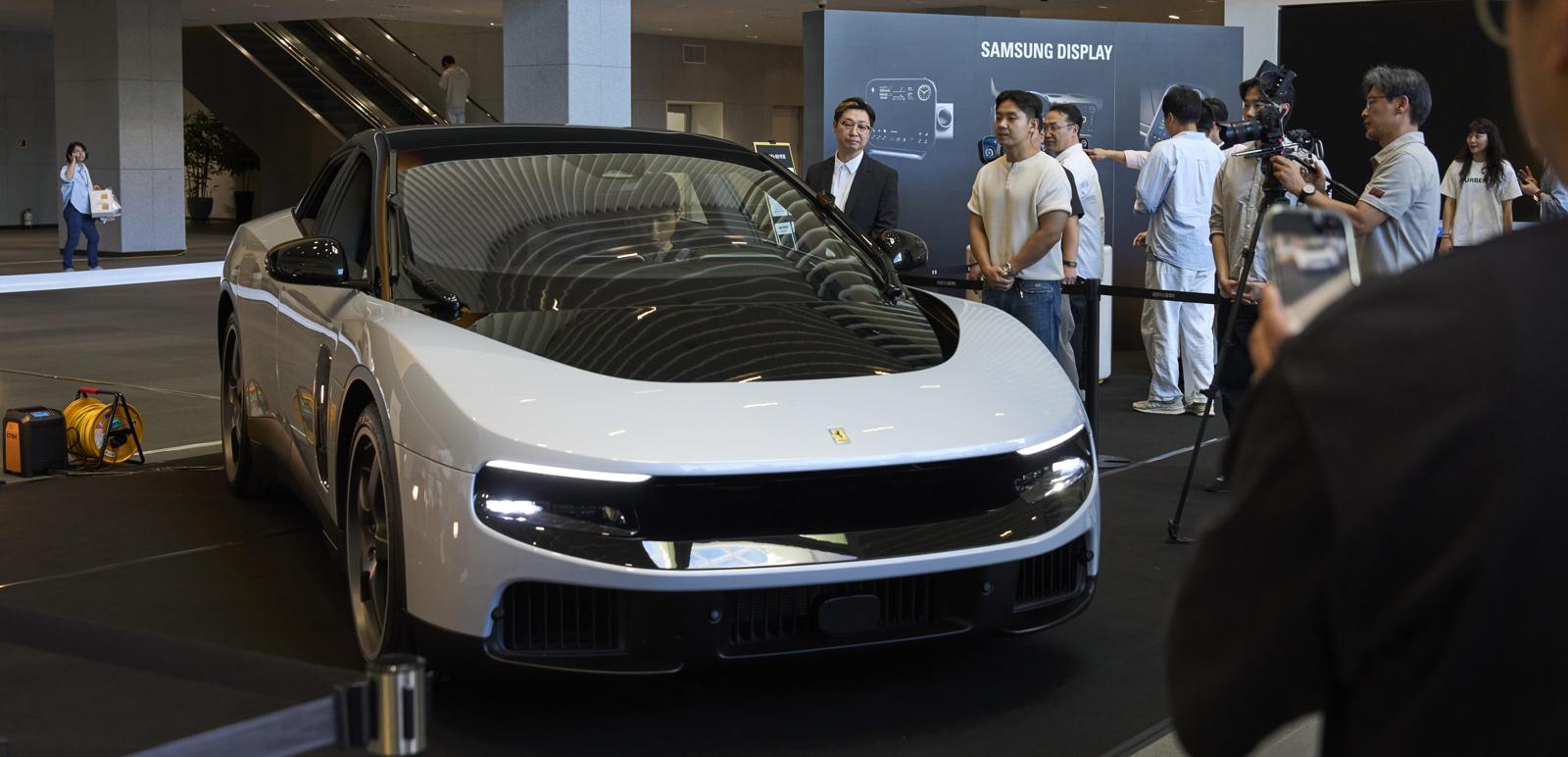
On the 22nd, employees gathered around Ferrari’s first electric vehicle “Luce,” displayed on the first floor of Samsung Display’s headquarters in Yongin, Gyeonggi Province. Provided by Ferrari
On 22 September, as Ferrari’s first all-electric vehicle, the yet-to-be-officially-launched “Ferrari Luce,” was unveiled in the lobby of Samsung Display’s headquarters in Yongin, Gyeonggi Province, employees flocked around the vehicle. About 1,500 people registered for viewings, which were conducted in 10-minute slots through advance reservations. Employees who had booked a slot queued in turn to look inside the vehicle, priced at around KRW 1 billion, and examined the company’s organic light-emitting diode (OLED) panels applied throughout the interior.
This was an event to introduce Samsung Display’s newly targeted automotive OLED business to its employees, beyond its core smartphone and TV display operations. It was also an occasion to showcase tangible “results,” following President Lee Chung’s remarks at an internal town hall in July this year, where he stated, “Automotive is only just beginning,” and stressed, “The importance and share of in-vehicle displays are steadily increasing. If we prepare well, this can become a very significant opportunity.”
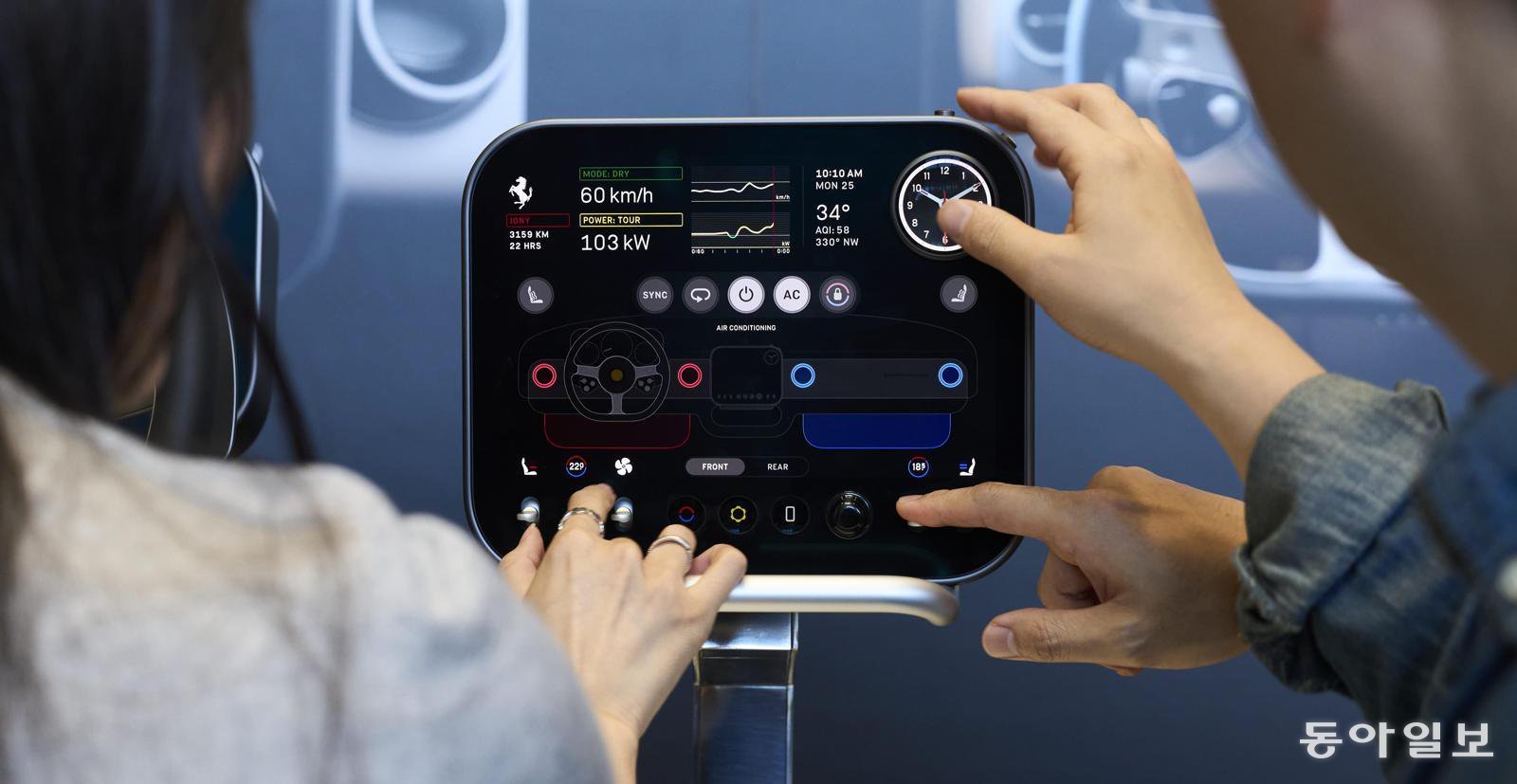
Samsung Display is the exclusive supplier of four OLED types for the Luce: 12.9-inch, 12-inch, 10.1-inch, and 6.3-inch panels. Two OLED panels are layered in the driver’s instrument cluster “vinculum,” while the 10.1-inch panel is used in the central control panel and the 6.3-inch panel is applied to the rear-seat control panel. Samsung Display and Ferrari signed a memorandum of understanding (MOU) in April 2023 for the development of next-generation automotive displays, and developed these OLEDs in about three years.
On the 22nd, employees look at a model of the multilayer “big-hole cut-out” display applied to the interior of Ferrari’s first electric vehicle “Luce,” exhibited at Samsung Display’s headquarters in Yongin, Gyeonggi Province. Yongin = Reporter Lee Min-a omg@donga.com
Upon directly getting into the Luce that day, the most striking feature was the instrument cluster with “big-hole cut-out” technology. At a glance it appeared to be a single instrument panel, but viewed up close, it was unfamiliar yet attractive to see two OLED panels layered, with three circular holes cut into the front screen. The physically moving needles visible through the space between the panels added a sense of depth. With another display and mechanical components visible inside the holes, it looked as if a digital screen and an analog gauge cluster were superimposed.
This was the outcome of intense trial and error. The technology to drill holes itself was not unfamiliar to Samsung Display, as it had already used it to create small openings on smartphone screens for front-facing cameras. However, unlike in smartphones, the diameter of the holes in vehicles had to be expanded to as much as 10 cm. The challenge was that, as the holes became larger, it became more difficult to maintain uniform screen brightness and to protect the OLED from external air and moisture. Nonetheless, the company completed the product after hundreds of failures. President Lee said, “It was an extremely difficult technology involving drilling an unimaginably large hole,” adding, “It has become an opportunity for our technological capabilities to be highly evaluated in many places.”
Song Young-dae, a professional staff member met on-site, said, “It is moving to see in person a product that colleagues worked so hard to develop,” and added, “I think employees’ interest in automotive displays will also increase.” Kim Gyu-min, another professional at Samsung Display, said, “It seems possible to imagine a future where foldable technology is applied to automobiles.”
Samsung Display has recently been expanding its supply of automotive OLEDs, mainly to premium vehicles. Following Audi, Hyundai Motor, and MINI, since August this year it has been supplying a 24.6-inch OLED “popup” display that rises when needed, as well as a 13.2-inch rear-seat OLED, for Genesis’s flagship electric sport utility vehicle (SUV), the GV90.
ⓒ dongA.com. All rights reserved. Reproduction, redistribution, or use for AI training prohibited.
Popular News