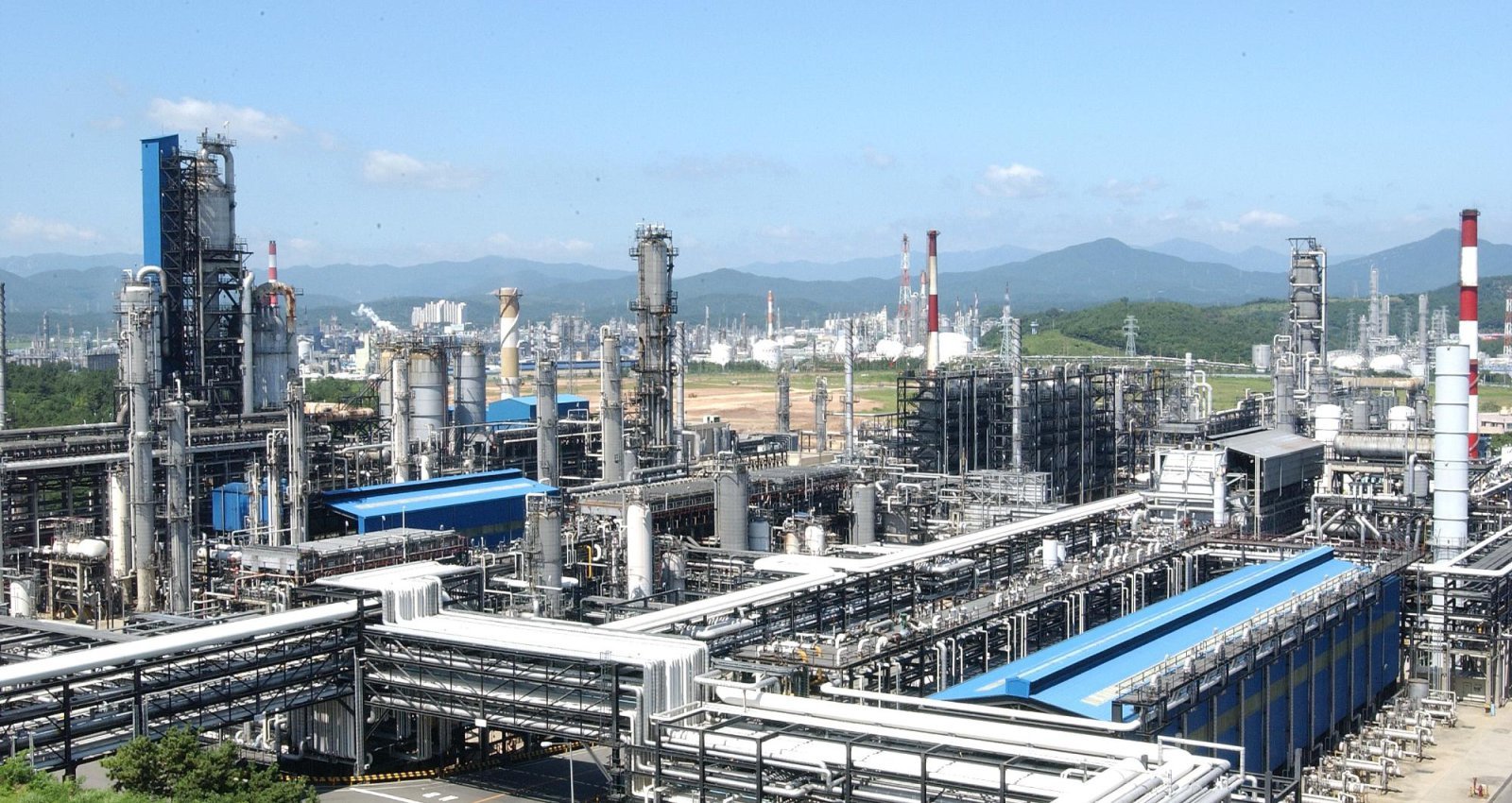
Panoramic view of SK Innovation’s Ulsan Complex located in Nam-gu, Ulsan. Provided by SK Innovation
In the SK Innovation Ulsan Complex (CLX) in Nam-gu, Ulsan—a massive site covering 2.5 million pyeong, three times the size of Yeouido in Seoul, and crisscrossed by 200,000 pipes stretching a total of about 600,000 km, more than half the distance from Earth to the Moon—workers on the ground were scarcely visible amid the huge, aging facilities that began operation in 1964 and now process 840,000 barrels of crude oil per day.
In the central control room (DCS) of the heavy oil upgrading (HOU) process at Ulsan CLX, visited on the 10th, hundreds of monitors were densely arrayed to monitor processes in real time, and only a small number of field operators working in four teams on a two-shift rotation were focused on their tasks.
This is the result of SK Innovation’s effort to implant artificial intelligence (AI) into this more than 60-year-old production site to overcome the limits of petrochemical processes that require humans to finely adjust vast numbers of variables. To efficiently manage multigenerational aging facilities with an average age of 33 years scattered across 98 processes, the company is proactively introducing AI solutions by domain. In particular, more than half (56%) of on-site workers are in their 50s, making it an urgent task to convert their operational know-how into data.
The core strategy of the AI transformation (AX) is the “Dual Brain” system. AI analyzes massive volumes of data 24 hours a day and proposes optimal solutions, while experienced on-site staff review these proposals and make the final decisions in a collaborative structure. The company aims to establish this system across the entire plant by 2030 and improve annual earnings by about KRW 100 billion.
The area where cost savings are especially anticipated is “energy utilities.” Operating the plant requires enormous amounts of energy such as steam, electricity, and hydrogen. In the past, energy use was managed separately by each process, resulting in substantial waste. Now, however, a central AI system has a real-time overview of the plant’s overall energy status and identifies the most efficient, least wasteful distribution method. This technology is currently applied to the steam network, and the company plans to expand its scope to all fuels and electricity to significantly reduce fixed costs.
The company is also accelerating AI adoption for production optimization and plant safety. AI sensors have been deployed, and technology that autonomously identifies and controls the temperature and pressure values that maximize profitability has completed verification. AI is also preventing sudden incidents in which the plant comes to an abrupt halt. Large pumps and compressors, which serve as the “heart” of a refinery, run continuously for three to four years. The company has attached its proprietary platform “SKADI” to these key devices to detect vibration and temperature. AI diagnoses minute signals from the machines like a doctor, predicting failures in advance. By 2027, the company plans for AI to autonomously prescribe not only the cause of failures but also the maintenance methods.
AI also safeguards the safety of the site, where 3,000 workers perform 330,000 tasks annually. The integrated safety platform “SHIELD,” officially introduced this year, provides a consolidated view of hazardous work conditions. The company plans to increase the current one four-legged walking robot (robot dog) to ten units to cover blind spots in the vast plant where it is difficult for humans to monitor everything, and to deploy drones and intelligent closed-circuit (CC)TV to operate a “24-hour unmanned patrol network” in a dense configuration.
Jeong Chang-hoon, Head of Manufacturing DX at SK Ulsan CLX, said, “AI does not take away people’s jobs; it supports on-site employees in making faster and more accurate decisions,” adding, “We are also considering a business model to sell our proprietary AI platforms, whose performance has been proven at our plants, to external customers in the future.”
ⓒ dongA.com. All rights reserved. Reproduction, redistribution, or use for AI training prohibited.
Popular News