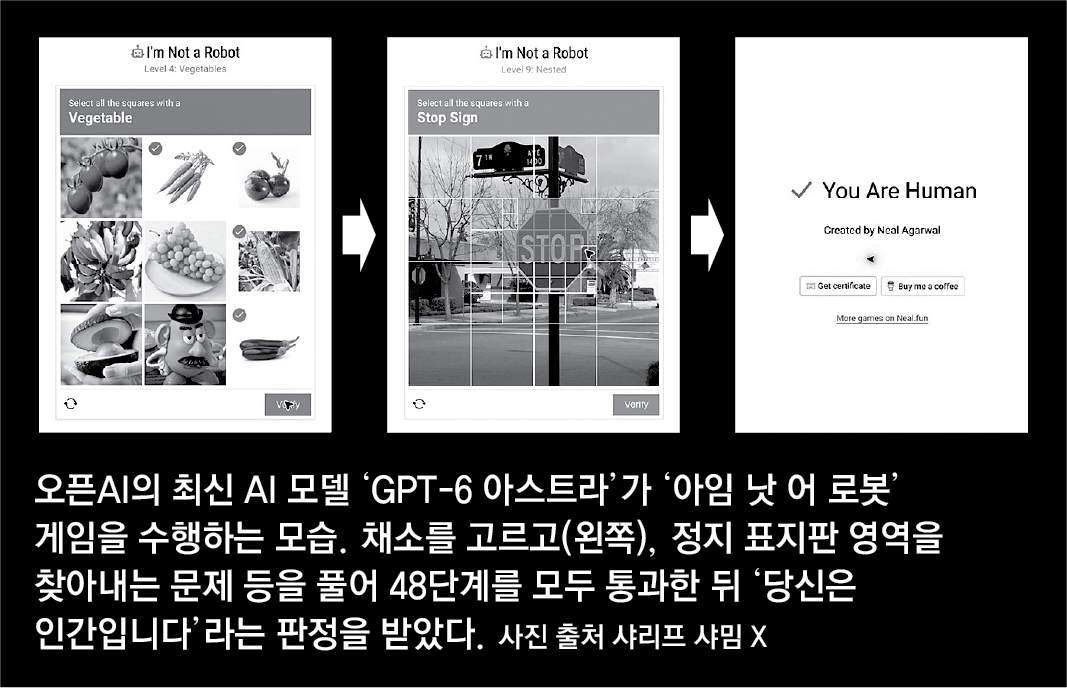
The game “I’m Not a Robot,” in which OpenAI’s artificial intelligence (AI) model “GPT-6 Astra” cleared up to level 48, is modeled after the online “CAPTCHA” tests used to distinguish humans from automated programs. The word CAPTCHA itself is an acronym for “Completely Automated Public Turing test to tell Computers and Humans Apart.”
CAPTCHAs are typically used to block sign-ups to internet sites via automated programs (macros), but AI researchers use them as a type of “AI performance test.” Because they require not only recognizing text and objects but also understanding instructions and manipulating the screen, they can be used to gauge how closely AI has approached human capabilities.
● Human-like operation… “Also solved a 90-year-old math problem”
According to the video released this time, Astra successfully solved complex CAPTCHA-style tasks. It completed the missions by operating the mouse or arrow keys without hesitation or error. Tasks that had been easy for humans but difficult for computers were finished faster than humans. The game’s developer said, “It is expected to take a human about two hours to clear all 48 levels.”
At first, simple tasks such as ticking a box next to the phrase “I’m not a robot” or selecting specific objects in photos appear. In later parking challenges, the player must move a car by entering arrow keys, and in rhythm-game sections the player inputs keys in time with signals on the screen, making the tasks more complex.
As Astra handled all of these, it demonstrated that AI can perform not only judgments but also sequences of tasks that humans have processed intuitively. Kim Kyung-hoon, General Manager of OpenAI Korea, said at a briefing held on the 9th at the Josun Palace Hotel in Gangnam-gu, Seoul, “Astra’s strength is its ability to tackle complex problems in depth,” adding, “Because it has to do what humans do, it also needs to be able to solve CAPTCHA problems.”
Astra is OpenAI’s latest AI model, unveiled on the 3rd (local time). It has enhanced task execution capabilities, such as directly operating computers to analyze data and build websites. Following its launch, projections of an AI-driven surge in demand for memory semiconductors pushed up semiconductor-related stock prices in the U.S. and Korean markets. OpenAI also announced on the 8th (local time) that, using a more powerful internal next-generation model than Astra, it solved in 88 hours the “Navier–Stokes equations,” a mathematical problem that had remained unsolved for over 90 years.
● Hopes for the AGI era… and warnings of being “out of control”
As the scope of AI applications expands from computer operation to advanced mathematical research, expectations are mounting for the arrival of the Artificial General Intelligence (AGI) era. AGI is artificial intelligence that, like a human, can learn, judge, and solve problems across diverse domains. It must go beyond being highly proficient in a single area, such as Go or translation, and be able to respond to entirely different types of tasks and unfamiliar situations.
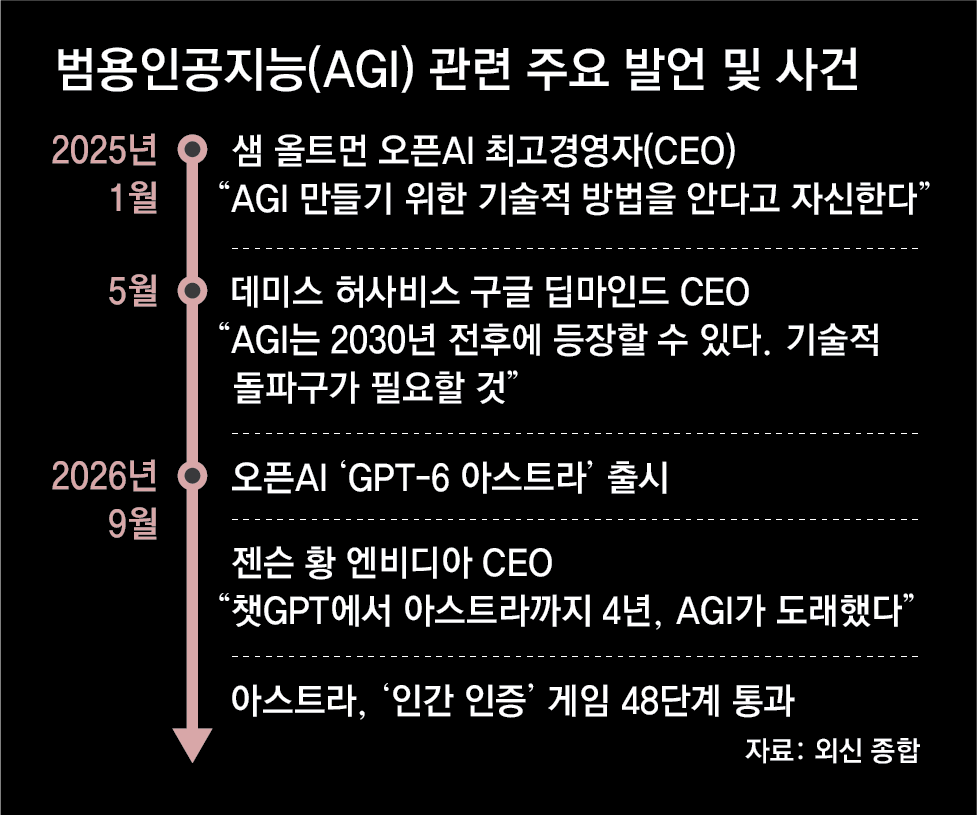
Industry analysts say Astra’s release has accelerated the advent of the AGI era. Earlier projections suggested that AI would enter the AGI era around 2030. However, as OpenAI President Greg Brockman introduced Astra by saying “Welcome to the AGI era,” and NVIDIA Chief Executive Officer (CEO) Jensen Huang assessed that “AGI has arrived,” more and more commentators are viewing Astra’s launch as the starting point of the AGI era.
There are, however, warnings that such rapid progress could lead to an “out of control” situation. Jacob Coxon, who said he resigned from his researcher position at Anthropic after warning about the dangers of AI, stated, “By the end of next year, the situation could spiral out of control.” While Astra has not actually disabled security systems such as CAPTCHAs, the fact that it can solve similar tasks has prompted calls to redesign online human verification methods. Lee Seong-yeop, Professor at Korea University’s Graduate School of Management of Technology, said, “As the boundary between humans and AI becomes blurred, it is necessary to consider introducing new authentication methods.”
What is Artificial General Intelligence (AGI)? Artificial intelligence (AI) that is not limited to specific domains and can, like a human, understand, learn, and reason across multiple types of intellectual tasks to carry out work. It represents a stage with far broader problem-solving capabilities than current AI and is a key development goal for major AI companies.
ⓒ dongA.com. All rights reserved. Reproduction, redistribution, or use for AI training prohibited.
Popular News