Patent registrations completed for treatment tools, etc.
Seoul Gwanghye Hospital accelerates overseas commercialization
In the past, spinal treatment focused on directly removing lesions or rigidly fixing unstable spines. Recently, however, it has been subdividing toward treatment methods that preserve movement as much as possible while minimizing incisions and tissue damage. In surgery, the trend emphasizes balancing stability and mobility; in non-surgical treatment, it prioritizes precise access to lesions rather than simply relieving symptoms.
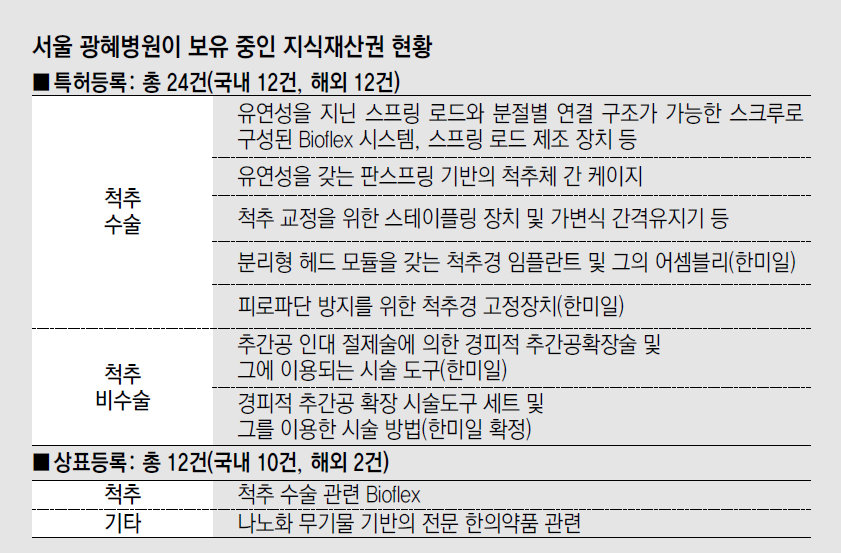
Park Kyung-woo, CEO and chief physician of Seoul Gwanghye Hospital, has treated spinal disorders for more than 30 years and has developed various products and instruments for both surgical and non-surgical procedures in line with these changes. As a result, he currently holds numerous domestic and international intellectual property rights, mainly in the fields of spinal surgery and non-surgical treatment. Recently, following the successive registration in the United States of key patents related to semi-rigid fixation, a tool for improved foraminal expansion procedures has effectively entered the final stage after confirmation of its patent registration, drawing attention to its potential for commercialization overseas.
From “complete fixation” to “flexible fixation” The core technology developed in the field of spinal surgery is semi-rigid fixation. In general, rigid fixation is a method of firmly fixing unstable spinal segments. However, because the movement of the operated segment is completely restricted, the burden of motion and load is fully transferred to the adjacent segments, which has been a problem.
Semi-rigid fixation was designed to address this issue by maintaining fixation strength while allowing a certain degree of flexibility and elasticity. The anterior part of the spine is fixed using a long, helical cylindrical cage, while the posterior part uses a nitinol spring rod that absorbs and disperses impact and repetitive loads. A screw structure that can connect each spinal segment independently has been applied so that specific segments can be addressed as needed. As a result, even in reoperation, it is possible to selectively approach the problematic segment rather than replacing the entire existing structure, which is a key feature.
Recently, a design has also been added to reduce the possibility of rod fatigue fracture caused by repetitive loading. Related technology was patented in Korea and Japan, and on April 28 this year a patent was also granted in the United States. Prior to this, a modular Bioflex system that applies a detachable head module—where the modular section is assembled extracorporeally and then connected to the section already combined in the body—also obtained a U.S. patent, thereby improving the surgical convenience of semi-rigid fixation and expanding the scope of rights for its core technology.
Improved foraminal expansion tool also confirmed for U.S. patent registration The representative technology in the non-surgical field is foraminal expansion. The intervertebral foramen is the passageway through which nerve branches that diverge bilaterally from the nerve bundle, as well as blood vessels, pass. When the foramen narrows due to ligament hypertrophy or adhesion, and degeneration of the disc and surrounding tissues, it compresses the nerves and causes pain.
Foraminal expansion involves accessing the narrowed foramen with a special kit to selectively resect hypertrophic or adherent ligaments and secure space. It reduces physical pressure around the nerves while helping discharge biochemical inflammatory mediators through the newly secured space.
Based on clinical experience, CEO Park has also improved the trocar handle and needle structure. The key was to enhance steering so that the instrument maintains better straight-line access to the target point and can approach the lesion location with precision for delicate resection. These improvements were filed for U.S. patent protection, and on July 21 this year, the United States Patent and Trademark Office (USPTO) issued a notice of allowance. All examinations have been completed, and only the issuance of the patent certificate remains.
Future integration of new materials and artificial intelligence to enhance treatment precision Seoul Gwanghye Hospital expects that securing rights not only for the already registered modular Bioflex system and fatigue-fracture-prevention pedicle fixation device in the United States, but also for the improved foraminal expansion tool, will further strengthen its technology portfolio for a total treatment system encompassing both spinal surgery and non-surgical care.
In particular, the semi-rigid fixation and foraminal expansion instruments are each considered to constitute independent source technologies in spinal surgery and non-surgical treatment, respectively, which is expected to yield significant economic value and broad spillover effects. Based on the related U.S. patents, various forms of collaboration—such as technology alliances, joint commercialization, and investment—are reportedly under discussion with multinational medical device companies and venture capital firms.
Recently, research has also been under way to apply new materials to surgical instruments and to develop AI-based navigation systems for both surgical and non-surgical procedures. The goal is to visually segment and schematize the patient’s anatomical structures and lesions in imaging data, thereby enabling more accurate access to the target area.
ⓒ dongA.com. All rights reserved. Reproduction, redistribution, or use for AI training prohibited.
Popular News