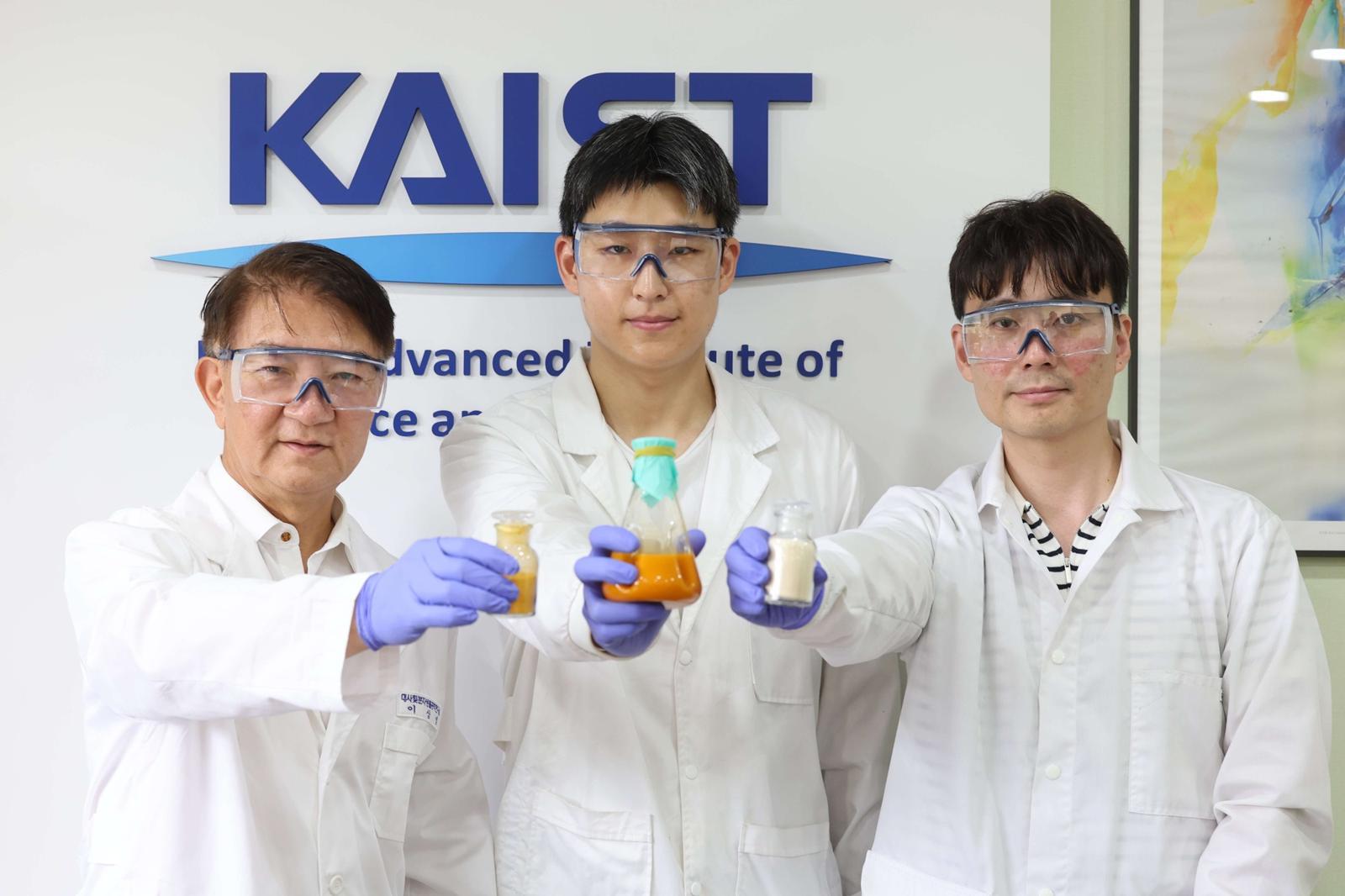
KAIST joint research team that has presented the conditions for successful industrialization of “microbial foods,” a next-generation protein source. From left: Distinguished Professor Sang Yup Lee of the Department of Chemical and Biomolecular Engineering at KAIST, PhD candidate Seok Young Jeong, and Sol Choi, CEO of SilicoBio. Courtesy of KAIST.
“Microbial foods,” which produce protein in fermenters instead of from cattle or pigs, are moving beyond the laboratory into the commercialization stage. A research team led by Distinguished Professor Sang Yup Lee of the Department of Chemical and Biomolecular Engineering at KAIST, together with co-researchers from SilicoBio, a faculty startup, announced on the 31st that they have published a paper in the international journal “One Earth” analyzing the conditions for industrializing microbial foods from the perspectives of manufacturing, markets, and regulation.
Microbial foods refer to using microorganisms themselves as food or producing proteins and food ingredients through fermentation. They require less land and water than livestock farming and emit fewer greenhouse gases, making them a next-generation protein source in the era of climate crisis. Market research firm Research Nester forecasts that the global microbial fermentation technology market will grow at an average annual rate of 5.7% to reach USD 6.234 billion (approximately KRW 83 trillion) by 2035.
The research team cited “manufacturing readiness” as the factor that will determine the success or failure of this market. This means that fermentation technologies demonstrated in laboratory flasks must be transferable to industrial facilities with capacities of tens of thousands of liters (L), while maintaining quality and economic viability for repeated production. As essential requirements, they identified stable sourcing of raw materials and strain development, large-scale process design, and capabilities for byproduct recycling.
The team also examined market and regulatory conditions. It found that consumers prioritize taste, texture, and safety over environmental friendliness, while companies and investors place emphasis on the predictability of country-specific approval procedures. In Korea, the Food Tech Industry Promotion Act came into effect in December last year, establishing an institutional foundation for the alternative protein industry ecosystem. Professor Lee said, “Rather than underlying technologies alone, how quickly an industrialization ecosystem is built to connect them to actual production and markets will determine future global competitiveness.”
Kim Jae-hyung
AI-translated with ChatGPT. Provided as is; original Korean text prevails.
ⓒ dongA.com. All rights reserved. Reproduction, redistribution, or use for AI training prohibited.