Provided by Superb AI
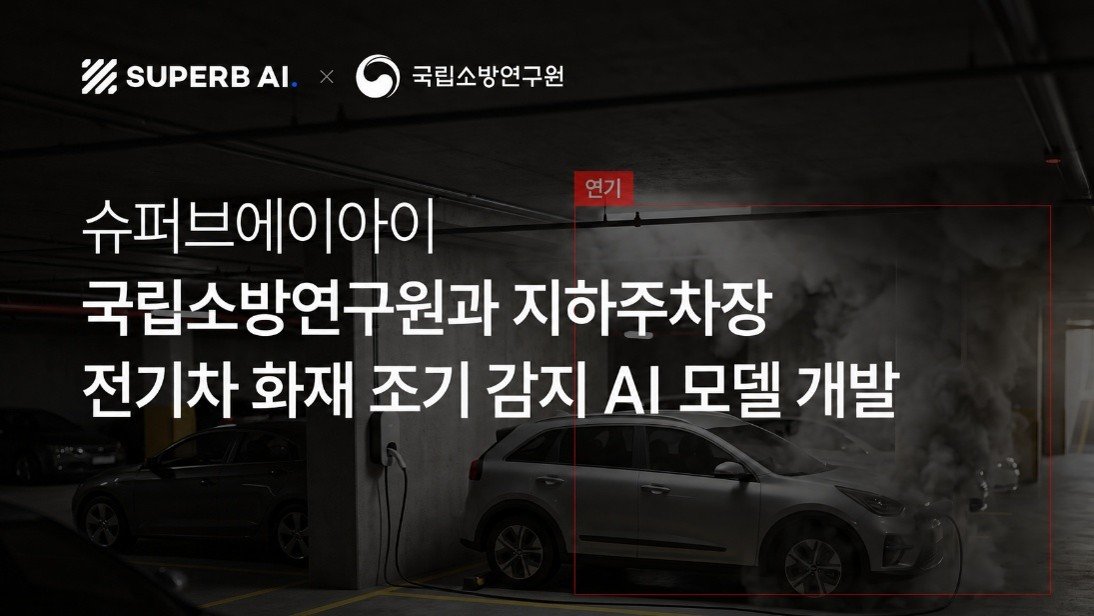
A domestic artificial intelligence (AI) company has partnered with a national research institute to develop an AI model that detects electric vehicle (EV) fires early in underground parking lots.
The model can be applied to existing closed-circuit (CC) TV systems. According to the developer, it shortens detection time by 65% and reduces the false alarm rate by 80% compared with existing fire detection methods.
On the 1st, vision intelligence company Superb AI announced this outcome through joint research with the National Fire Research Institute.
Underground parking lots where EVs are concentrated are considered particularly vulnerable to fires, as entry routes are limited, flames spread rapidly, and the likelihood of re-ignition is high.
According to statistics from the National Fire Agency, there were a cumulative 238 EV fire incidents through 2024, with nearly half occurring while vehicles were parked or charging.
However, the faint smoke generated in the early stage of lithium-ion battery thermal runaway has been difficult to capture with conventional detectors.
Smoke detectors activate only when smoke of a certain density reaches the installation point. Initial smoke generated under the vehicle often fails to meet this condition.
The later the detection, the greater the damage. Unnecessary evacuation and response costs caused by false alarms also followed.
● Detecting smoke under EVs and from long distancesSuperb AI designed and conducted the research with the National Fire Research Institute in four phases, each lasting six months. It first processed about 100,000 images of fire, smoke, and vehicle objects to build a training dataset.
In this process, real fire accident data were combined with experimental data from controlled environments, and rare cases that do not occur frequently were supplemented with synthetic data generated by generative AI.
A Superb AI representative explained, “Cases such as faint white smoke under vehicles, smoke spreading low and flat along the floor, and smoke that quickly dissipates without maintaining a clear shape occur only rarely.”
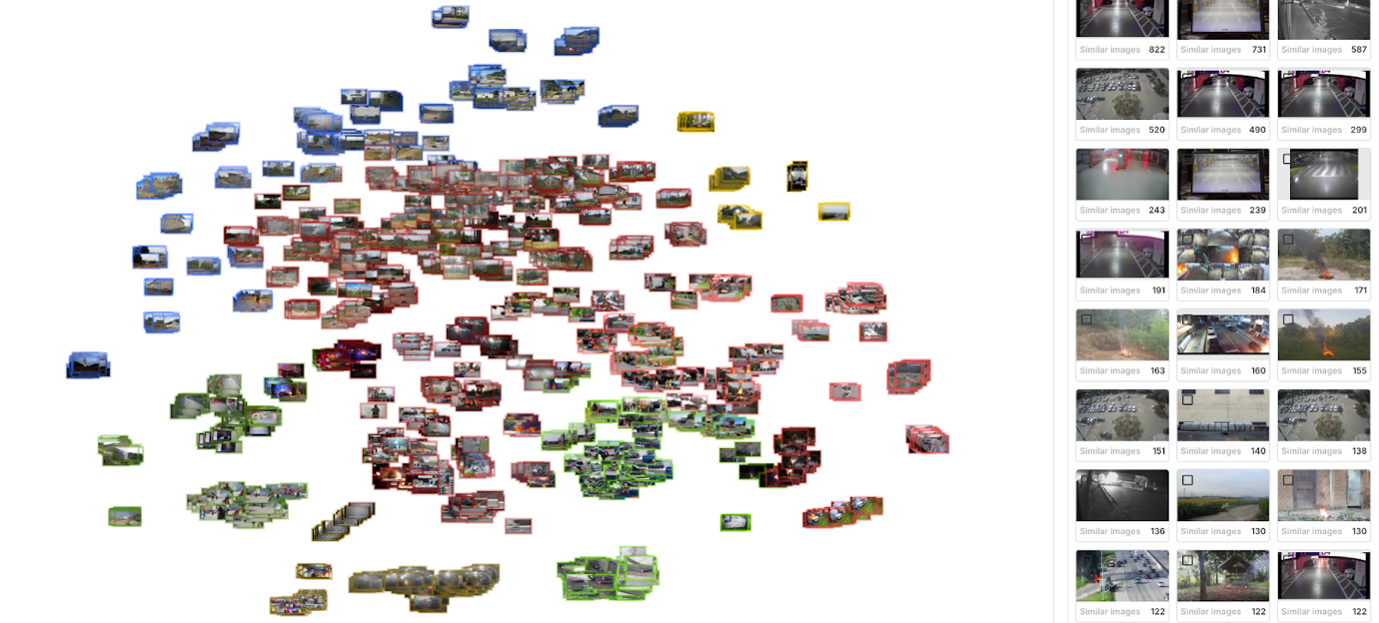
The company used the Scatter View function on its own platform for dataset quality management. This function places data on a coordinate plane by similarity to visually filter distributions and outliers. The distribution and patterns of fire and smoke data were checked.
Scatter View screen on the platform. Provided by Superb AI
The model is specially designed to recognize faint smoke in underground parking lots and under EVs, as well as smoke at long distances.
In the early stage of development, there were misrecognition cases such as identifying gray floors or people wearing dark clothing as smoke. The company has since refined the detection targets and recognition areas and augmented the data to improve accuracy.
Superb AI stated, “We trained and compared multiple models and selected the one with the best accuracy and speed within the scope of real-time processing,” adding, “It is a model validated with a focus on smoke recognition performance as well as open flames.”
The completed model was implemented as a real-time monitoring system running on edge devices. It analyzes video directly on site and can be layered onto existing CCTV infrastructure without modification.
When a fire is detected, an on-screen warning and audio alarm are triggered simultaneously, and the event history is stored in logs. Even without an external server, a PC on the same network can access the local web server to check detection status immediately.
● Field demonstration completed… Targets lightweight, mass-market deploymentThe model has undergone two rounds of field validation. In November last year, a demonstration test was conducted in an actual underground parking lot, and last month a demonstration test reproducing a real fire situation was completed.
The final fourth phase of the research is currently under way. The goal is to make the system lightweight enough for real-time operation on small edge devices and complete it as a deployable mass-market solution.
Once the research is completed, the results will be used to derive quantitative test criteria based on distance and time, and to establish performance standards for EV fire detection systems.
CEO Kim Hyun-soo stated, “This research is a case where the specific characteristics of on-site environments, which cannot be trained with open data, were addressed through a specialized dataset and synthetic data, and the resulting model was run in real time on edge devices,” adding, “From data construction to model development and field validation, the company will continue to drive AI adoption.”
ⓒ dongA.com. All rights reserved. Reproduction, redistribution, or use for AI training prohibited.
Popular News