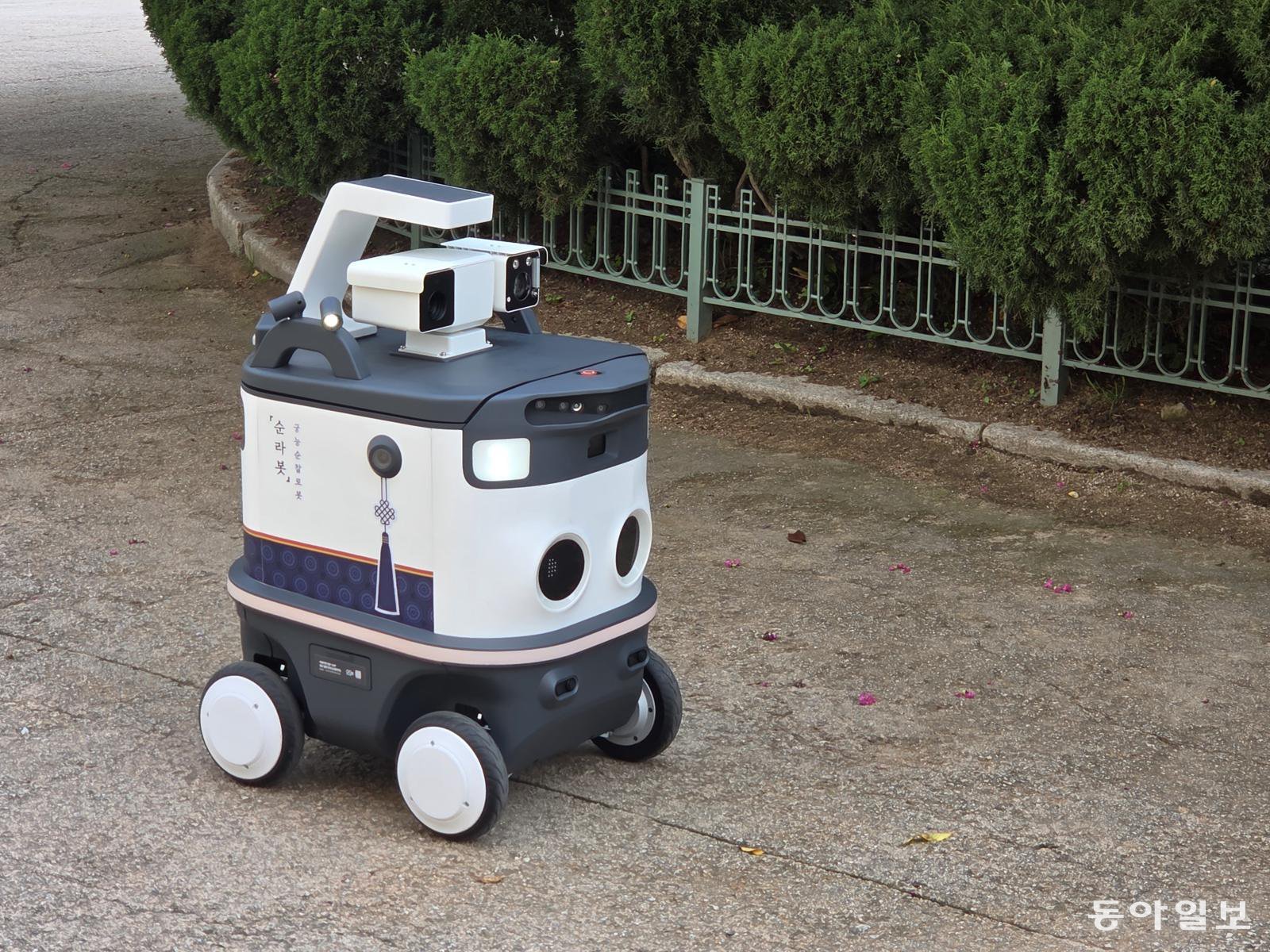
The artificial intelligence (AI) robot “Sunrabot,” deployed as a guardian of cultural heritage. The Sunrabot installed at Deoksu Palace is a four-wheel-drive model. Reporter Kim Do-yeon repokim@donga.com
On the 25th at Seooreung in Goyang, Gyeonggi Province.
A hypothetical situation was staged on the trail of this UNESCO World Heritage site: “A person has collapsed.” The artificial intelligence (AI) patrol robot “Sunrabot,” making its rounds, discovered the person and immediately sounded a voice alarm. “This is an emergency. A visitor has collapsed. Nearby visitors, please report to 119.” An alert was simultaneously transmitted to the control computer at the management office.
On this day at Seooreung, the Royal Palaces and Tombs Center of the Cultural Heritage Administration conducted a test of AI patrol robots that it is preparing to introduce for safety management at palaces and Joseon royal tombs. The name “Sunrabot” is derived from the “sunragun (巡邏軍),” the patrol guards who inspected the interior and exterior of the royal palace and capital during the Joseon Dynasty. Based on pilot operations at Changdeok Palace in February this year, on-site demonstrations are being conducted at Deoksu Palace and Seooreung from the 24th through 30 November.
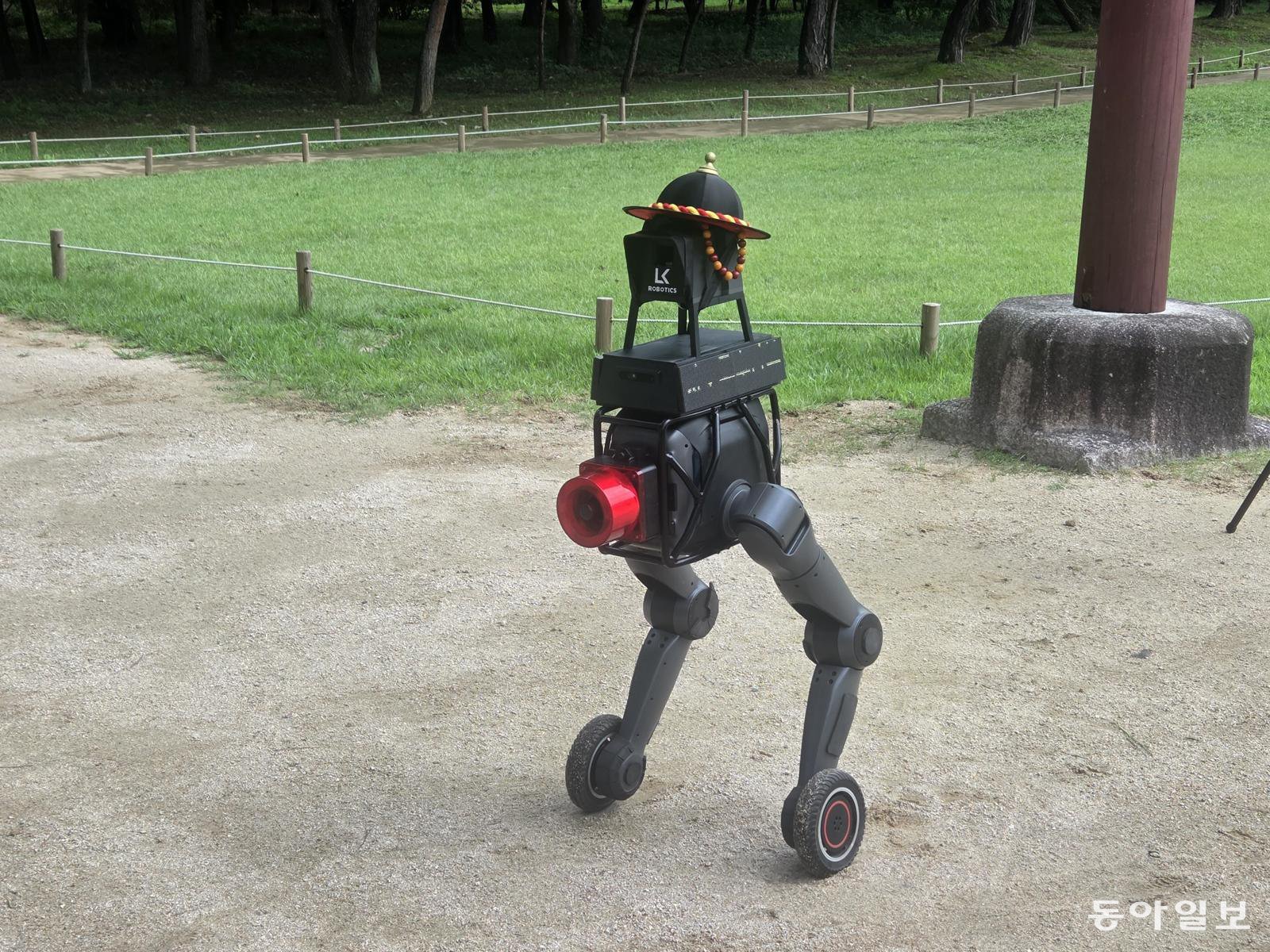
The Seooreung Sunrabot is a two-wheel wheel-legged model. The name Sunrabot comes from the sunragūn, who patrolled the palaces and inside and outside the capital during the Joseon Dynasty. Reporter Kim Do-yeon repokim@donga.com
The Seooreung Sunrabot, unlike conventional robots, is a “two-wheel wheel-legged” robot (a form in which wheels are attached to articulated legs). It drew attention as it adjusted its joints and maintained speed while moving along uneven dirt paths with height differences. It also moved smoothly without hesitation when crossing over a path laid with thick coconut mats.
This AI robot departs from the situation room and patrols a round trip of about 2.6 km, checking Myeongneung, Jaesil, Daebinmyo and other facilities three times during the day and three times at night. Kim Seung-hoon, CEO of LK Robotics, which developed the robot, explained, “It is a model capable of driving over 20 cm height differences and on slopes of up to 30 degrees.” However, its weak waterproofing makes it vulnerable to heavy rain, and the fact that it cannot automatically enter a charging mode and still requires human intervention are areas that need improvement.
By contrast, at Deoksu Palace, where the patrol route is relatively flat, the same four-wheel model used at Changdeok Palace has been deployed. The Deoksu Palace Sunrabot starts from Seokjojeon and patrols nearly all the halls, including Junmyeongdang and Junghwajeon, nine times a day.
According to the Cultural Heritage Administration, Sunrabot moves autonomously using LiDAR sensors, which recognize the surroundings with lasers, and “vision AI,” which analyzes video to determine its route. It is also equipped with standard and thermal imaging cameras to detect emergencies such as fires or intrusions in real time. When an abnormal situation is detected, the control room checks the site and responds. The Cultural Heritage Administration stated, “We will enhance the safety management system for national heritage by utilizing advanced technologies such as AI robots.”
ⓒ dongA.com. All rights reserved. Reproduction, redistribution, or use for AI training prohibited.
Popular News