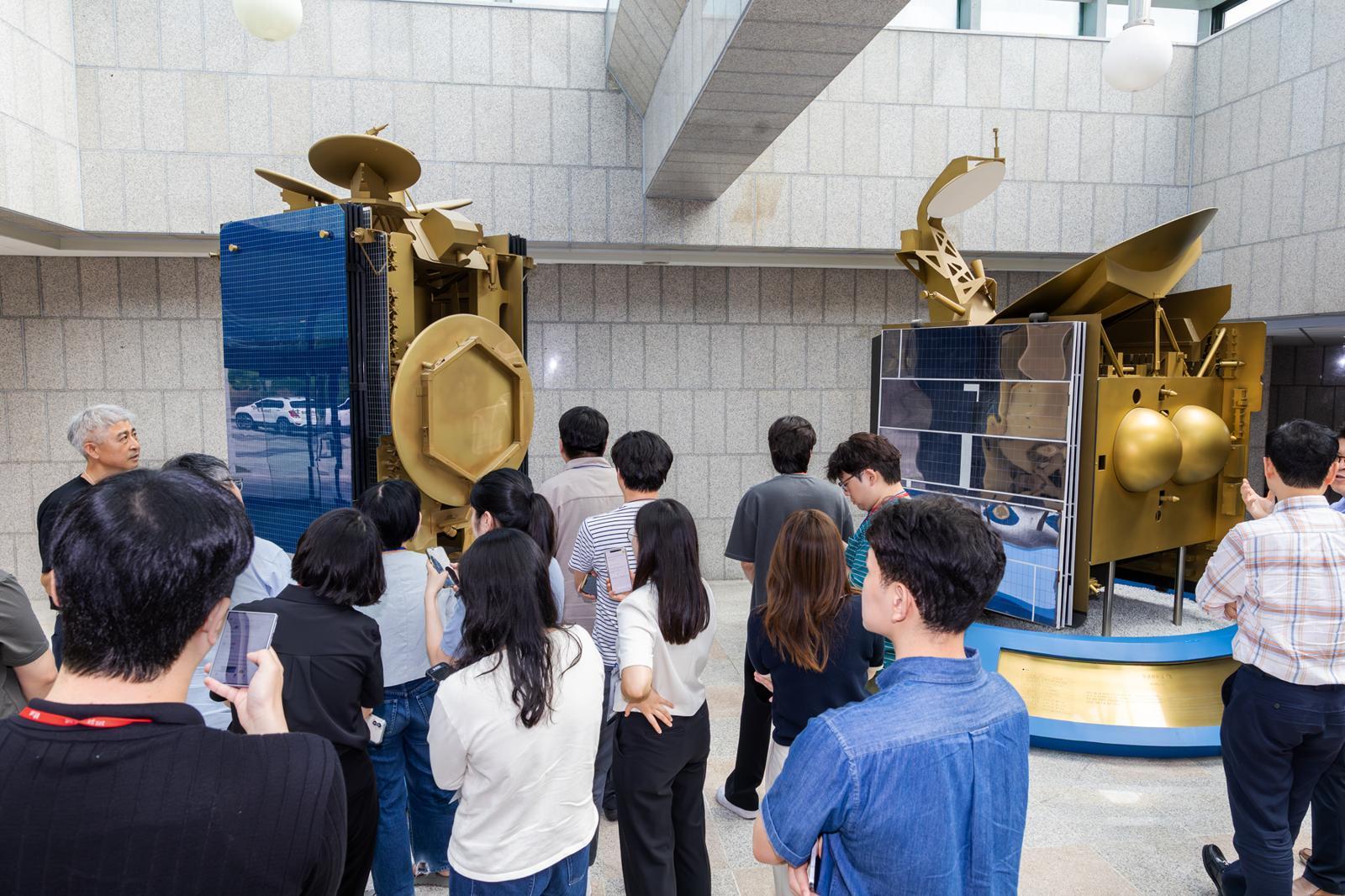
A large satellite is on display in the lobby of KT SAT’s Yongin Control Center. (Provided by KT)
On the first-floor satellite control room of the KT SAT Yongin Satellite Control Center in Yongin, Gyeonggi Province, on the 25th, dozens of large monitors lined the walls, displaying the satellites’ positions and orbits, as well as operating conditions such as battery voltage and temperature. Staff were monitoring changes in the orbits of satellites and space objects, recording any anomalies in real time.
This site is the control tower that manages and operates five Mugunghwa satellites 24 hours a day, 365 days a year. Using dedicated antennas, it sends commands to each satellite to adjust its orbit and verify its operational status. Kim Ki-young, head of the Satellite Consulting Team at KT SAT, said, “Communication satellites floating 35,786 km above the Earth are sensitive equipment that can develop problems even with minor variables,” adding, “The role of the satellite control center, which monitors satellite orbits year-round without a break, is crucial.”
● Safeguarding low Earth orbit networks with 32 years of control expertiseAs communication networks expand into space, control over satellite networks has emerged as a core element of national telecom sovereignty. With big tech companies such as Amazon and SpaceX racing to secure leadership in low Earth orbit (LEO) networks, KT SAT plans to develop control technologies and contribute to securing communication sovereignty by operating a Korean low Earth orbit satellite network, the so-called “K-LEO.”
Low Earth orbit satellites offer shorter communication latency and can connect blind spots in terrestrial networks, such as aircraft, ships, and remote islands. If LEO networks are entirely dominated by foreign companies, control over services and critical national data and traffic in times of war or disaster could be placed in the hands of overseas operators. KT SAT supplies SpaceX’s “Starlink” service domestically but does not yet operate its own low Earth orbit communication satellites.
This is why the company aims to extend its 32 years of geostationary orbit (GEO) control experience into LEO operational capabilities. Opened in 1994, the Yongin Satellite Control Center analyzes telemetry data to adjust satellite orbits and attitudes, which change under the gravitational influence of the sun and moon. It has dualized functions with the Daejeon Control Center for disaster preparedness, and it applied a domestically developed Flight Dynamics System (FDS), created jointly with ETRI, to Mugunghwa Satellite 7 and 5A.
● Mobilizing new technologies for a unified terrestrial–space 6G networkThe development of new automated technologies utilizing artificial intelligence (AI) is also a critical factor. Low Earth orbit satellites move quickly and cannot remain over a single area for long. Compared with geostationary satellites, each LEO satellite covers a smaller area, making it necessary to operate hundreds to thousands of satellites in concert. Different commands, connections, and mission plans must be entered for each satellite and managed simultaneously. If such tasks are handled manually, operations are likely to become slow and inaccurate. This is why not only existing control experience but also new technology development is required.
AI-based autonomous operation technology for satellite constellations is a representative example. It automates the distribution of commands, mission and maneuver plans, and software updates across numerous LEO satellites, assigning repetitive tasks to AI. KT SAT plans to further expand the use of AI to anomaly detection and collision avoidance in the future.
Another key objective is to preemptively develop the technologies needed for the “6G” era, in which terrestrial and space networks are integrated, and to lead the market. Last year, KT SAT verified “multi-orbit non-terrestrial network (NTN) handover” technology between the actually operating geostationary “Mugunghwa Satellite 6A” and a simulated LEO satellite communication network. This technology hands over connections so that communication is not interrupted even when switching between different satellite networks. It is essential to eventually integrate geostationary and low Earth orbit satellites and terrestrial networks into a single 6G network. Choi Sung-ho, Chief Technology Officer at KT SAT, said, “KT SAT will apply its unrivaled control capabilities to future satellite technologies and enhance the global standing of K-satellites.”
ⓒ dongA.com. All rights reserved. Reproduction, redistribution, or use for AI training prohibited.
Popular News