Seoul Asan Medical Center develops ‘AI platform’ for research
Also creates companion diagnostic technology ‘CATCH’
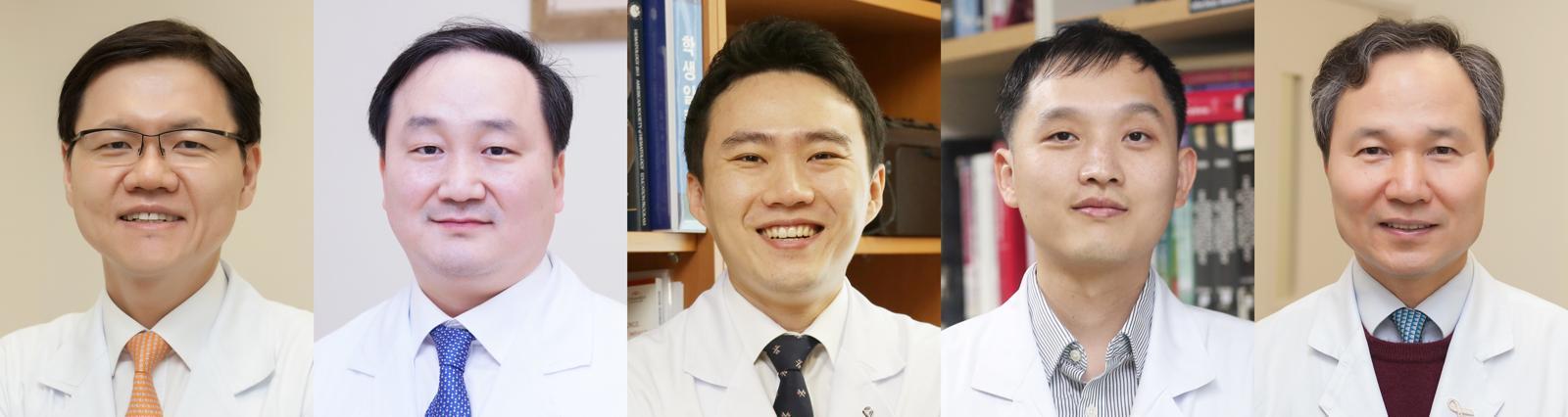
From left: Professor Myung Seung-jae, Department of Gastroenterology; Professor Oh Seung-joon, Department of Nuclear Medicine; Professor Yoo Chang-hoon, Department of Oncology; Professor Jung Byung-kwan, Department of Pathology; and Professor Son Byung-ho, Department of Breast Surgery, Asan Medical Center, Seoul.
Asan Medical Center in Seoul and a U.S. research team are set to develop a new treatment strategy for solid tumors that respond poorly to existing therapies by combining next-generation radiopharmaceuticals with artificial intelligence (AI)-based precision medicine technologies.
The research team led by Professor Myung Seung-jae (Gastroenterology), Professor Oh Seung-joon (Nuclear Medicine), Professor Yoo Chang-hoon (Oncology), Professor Jung Byung-kwan (Pathology), and Professor Son Byung-ho (Breast Surgery) at Asan Medical Center announced that it has been selected for the “2026 Research-Driven Hospital Korea–U.S. Innovation Outcome Creation R&D New Support Program” organized by the Ministry of Health and Welfare, and will begin developing an AI-based radiotherapeutic platform targeting treatment-refractory solid tumors.
The Research-Driven Hospital Korea–U.S. Innovation Outcome Creation R&D program is a national research and development initiative that supports joint projects between domestic research-driven hospitals and U.S. research institutions, with the aim of securing advanced medical technologies and generating outcomes such as international patents, clinical studies, and technology commercialization.
This project will leverage AI-based digital pathology analysis technology from Emory University in the United States, along with the pathology and clinical research capabilities of Case Western Reserve University and University Hospitals Cleveland Medical Center. Combined with Asan Medical Center’s extensive clinical and pathological datasets, the project aims to establish a precision medicine system covering the entire spectrum from therapeutic development and patient selection to prediction of treatment response.
Solid tumors such as gastric cancer, colorectal cancer, pancreatic cancer, and breast cancer form a complex tumor microenvironment that involves not only cancer cells but also surrounding fibroblasts, immune cells, and blood vessels. In particular, a heavily fibrotic tumor microenvironment can impede the penetration of therapeutics into cancer cells and increase treatment resistance. This is why new treatment strategies are needed for patients who show insufficient responses to conventional anticancer therapies.
The research will proceed along two main axes. First, using “Composite Targeting Radiotherapy Technology (C-TRACER),” the team will develop radiopharmaceuticals that simultaneously target cancer cells and the tumor microenvironment. The protein “CLDN18.2,” which is predominantly expressed in cancer cells, and “LRRC15,” which is upregulated in cancer-associated fibroblasts and other cells surrounding the tumor, will be used as respective therapeutic targets. Candidate compounds will be developed by conjugating these targets with therapeutic radioisotopes, and their tumor specificity, therapeutic efficacy, and safety will be evaluated.
At the same time, the team will develop “CATCH,” an AI-based companion diagnostic technology. AI will be used to integrate digital pathology images, spatial omics data that analyze the location-specific distribution of genes and proteins within tumor tissues, patients’ clinical information, and preclinical treatment outcomes. The goal is to quantify the expression of target proteins in tumors and the characteristics of the tumor microenvironment, select patients suitable for radiopharmaceutical therapy, and predict treatment response.
The researchers expect that linking radiotherapeutic development with AI-based patient selection technology into a single system will improve the efficiency of clinical development and reduce the risk of failure. Professor Myung Seung-jae will serve as principal investigator, and domestic companies including Dong-A APTec, Geninus, and Athis Biotech will participate in the project.
Professor Myung stated, “What differentiates this study is that it does not stop at developing new radiopharmaceuticals, but also uses AI to predict in which patients the treatment will be most effective,” adding, “By combining therapies that simultaneously target cancer cells and the tumor microenvironment with highly precise patient selection technologies, we aim to offer new opportunities to patients with solid tumors whose treatment options are limited.”
ⓒ dongA.com. All rights reserved. Reproduction, redistribution, or use for AI training prohibited.
Popular News