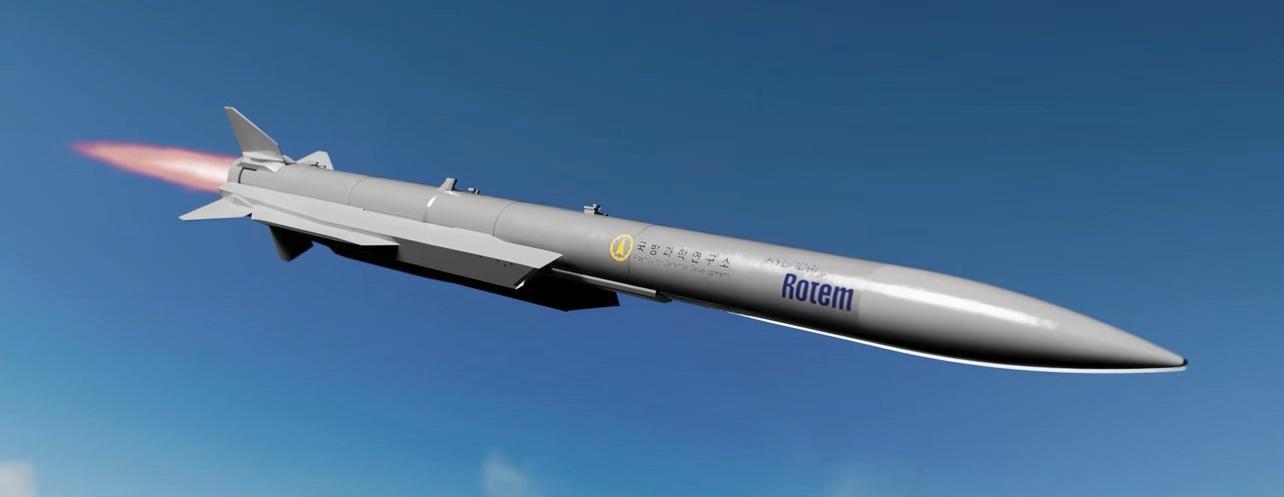
Concept image of a long-range air-to-air guided weapon. Provided by Hyundai Rotem
Hyundai Rotem is accelerating the development of next-generation guided weapon engines such as ducted ramjet engines and dual ramjet engines based on aerospace technology accumulated over more than 30 years. Having secured unrivaled technology in the development of ground weapon systems including tanks, armored vehicles, and unmanned platforms, Hyundai Rotem is now expanding its capabilities into aerospace businesses such as space launch vehicles and guided weapons.
The ducted ramjet engine under development is a core component of long-range air-to-air guided weapons. A ramjet engine generates thrust by burning fuel after compressing air with shock waves produced when the vehicle flies at high speed, without using a compressor or gas turbine. A ducted ramjet engine further enhances efficiency by creating a duct—an internal air passage—to control the airflow required during flight. Ducted ramjet engines are advantageous for long-range flight, maintaining maneuverability, and securing terminal strike capability.
Air-to-air missiles must hit their targets while maintaining thrust at high speed and responding to evasive maneuvers by enemy aircraft, making engine performance and technology critical. In particular, because thrust varies according to the amount of air ingested, an integrated design with the airframe structure is essential.
By entering dual ramjet engine development, Hyundai Rotem is also advancing its technology in the field of hypersonic engines. A dual ramjet engine is capable of switching between ramjet and scramjet (supersonic combustion) modes depending on speed and requires more advanced technology than a ducted ramjet engine. If the ducted ramjet engine is a modified form designed to handle the ramjet more precisely, the dual ramjet allows the flight vehicle to change its operating mode according to conditions.
Currently utilizing the specialized engine test center in Seosan, South Chungcheong Province, Hyundai Rotem plans to invest about KRW 300 billion by 2034 to build an integrated aerospace production base in Muju, North Jeolla Province.
Last year, Hyundai Rotem won a project from the Agency for Defense Development to develop methane engines for reusable launch vehicles, becoming the first in Korea to embark on methane engine development. Methane engines generate less soot during combustion, are easier to maintain, have lower propellant costs, and offer high efficiency, making them suitable for reusable launch vehicles.
A Hyundai Rotem official said, “Based on aerospace technology and know-how accumulated over decades, the company will enhance its business capabilities and continue research and development to achieve results in market competition.”
Ju Seong-ha
AI-translated with ChatGPT. Provided as is; original Korean text prevails.
ⓒ dongA.com. All rights reserved. Reproduction, redistribution, or use for AI training prohibited.