Standard Science Research Institute’s ‘quantum gravimeter’ study
Measurement via repeated atom trapping and dropping
Prototype implementation and validation by 2032
ETRI pursuing quantum microscope development… first module targeted by end-2027
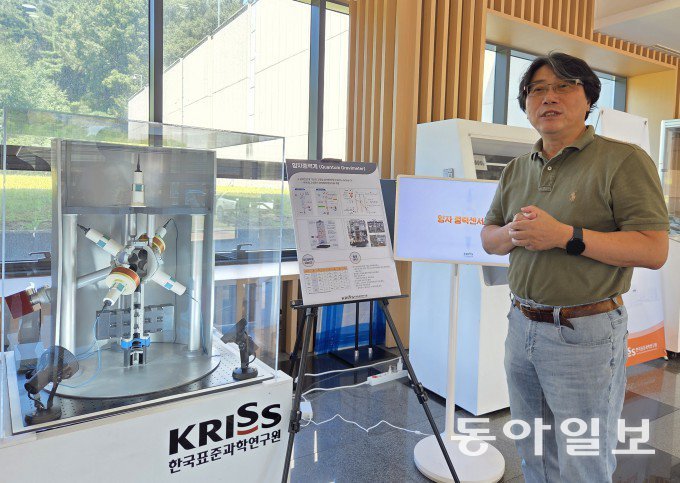
On the 7th, at the main campus of the Korea Research Institute of Standards and Science (KRISS) in Daejeon, Kwon Taek-yong, head of the Atomic Quantum Sensing Group at KRISS, explains the principle of a quantum gravimeter. Daejeon = Lee Byung-gu, Dong-A Science reporter 2bottle9@donga.com
Korean scientists are conducting research to apply quantum technology—garnering attention mainly for its use in next-generation computers and encrypted communications—to the development of a “quantum gravimeter” for submarine position correction and to ultra-precise microscopes. In particular, if the construction of a nuclear-powered submarine currently being promoted by Korea is realized and a quantum gravimeter is applied, it is expected to significantly strengthen national defense and security by enabling long-duration underwater operations.
According to the scientific community on the 20th, the Atomic Quantum Sensing Group at the Korea Research Institute of Standards and Science is pursuing development of a quantum gravimeter with the goal of implementing by 2032 a prototype suitable for actual submarine deployment. At the laboratory level, the group has already achieved world-leading sensitivity. The Electronics and Telecommunications Research Institute (ETRI) is conducting research to commercialize a “quantum microscope” that provides higher resolution than an optical microscope.
● Quantum gravimeter, a strategic technology drawing U.S. attention
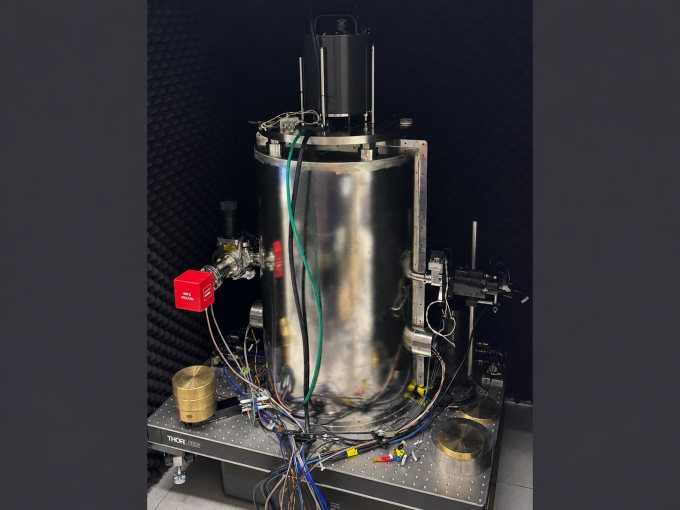
Quantum gravimeter of KRISS applying cesium (Cs) atoms and the atomic fountain method. Provided by KRISS
When a quantum gravimeter is applied to submarines, they can determine their position and course using a so-called “gravity map” without satellite signals. Kwon Taek-yong, head of the Atomic Quantum Sensing Group at KRISS, met at the KRISS main campus in Daejeon, said, “The two main reasons a submarine must surface are fuel supply and position correction,” and explained, “If a nuclear-powered submarine, which has solved the fuel issue, is also equipped with a quantum gravimeter, it will be able to carry out missions underwater for a very long time.”
In June this year, U.S. President Donald Trump instructed relevant departments to deploy, within five years, quantum sensors that apply quantum technology to replace the Global Positioning System (GPS) and similar systems. In wartime, satellite signals can be disrupted, so sensors and communication technologies that do not rely on satellites are considered critical strategic technologies.
In particular, because satellites cannot transmit signals to the seafloor where submarines operate, submarines use an inertial navigation system with accelerometers and other devices while sailing underwater. This system calculates how far the submarine has moved from its initial reference position based on its speed and direction of travel. The challenge is that small errors in inertial navigation calculations accumulate as movements are repeated.
Kwon said, “Because of the errors accumulated in inertial navigation calculations, situations arise where submarines have to surface,” and added, “A quantum gravimeter is a technology that enables submarines or vessels to measure gravity and compare it with the Earth’s gravity distribution map to obtain absolute position information.”
A quantum gravimeter measures gravity precisely by using the quantum mechanical properties of atoms. When atoms cooled to ultralow temperatures by lasers are dropped, the atomic wave is split into two paths and then recombined, generating an interference signal that reflects the difference in travel distance between the two atomic waves. Because the interference signal varies according to gravitational acceleration, gravity can be determined by back-calculating from the measured signal.
Conventional absolute gravimeters measure gravity by dropping an object, such as a prism, in a vacuum and using a laser to observe changes in its position over time. Because impacts occur during free fall and the drive components wear out, there are limits to repeated measurements and achieving high accuracy.
A quantum gravimeter can perform continuous measurements by repeatedly trapping and dropping atoms. The gravimeter built by the KRISS team can measure at a rate of about twice per second and has in fact been operating continuously for more than two years. Kwon explained, “It can currently detect minute changes corresponding to about one billionth of the Earth’s gravity,” adding, “It can even identify gravity changes caused by construction bricks piled up in front of the research institute building.”
The most recently developed quantum gravimeter uses cesium (Cs) atoms instead of conventional rubidium (Rb) atoms and applies an “atomic fountain” method, which improves measurement precision by launching atoms upward and measuring them as they fall back down instead of allowing simple free fall. Because quantum gravimeters are technologies directly linked to national security, they are difficult to import from overseas. Kwon said, “If quantum gravimeters become sufficiently miniaturized in the future, they could be mounted on drones to detect structures such as underground bunkers.”
Atomic clock technology, which Korean scientists have honed over the past 30 years, has provided the foundation for the quantum gravimeter development program. In addition to defense, quantum gravimeters can be used in basic science fields such as measuring the gravitational constant and detecting gravitational waves, as well as in resource exploration based on subsurface density changes, monitoring magma movement, and detecting sinkholes and underground cavities.
● Quantum microscope: clearer images with less light ETRI researchers are conducting high-speed and miniaturization studies to commercialize a “quantum microscope” that achieves higher resolution and sensitivity than a conventional optical microscope while using less light.
Optical microscopes have a clear limit on observable size due to light diffraction. Super-resolution microscopes that overcome this have constraints in imaging sensitive biological samples such as living cells because they require high light intensity or prior labeling processes.
A quantum microscope uses two photons as a single bundle to achieve an effect equivalent to using light of a shorter wavelength, thereby overcoming physical limits and improving spatial resolution. It can obtain high-resolution images without cutting or processing samples.
ETRI is differentiated from competing groups in terms of equipment usability. Ko Young-ho, head of the Quantum Sensor Research Laboratory at ETRI, said, “We have implemented an optical system, which otherwise must be installed on a large optical table, as a modular prototype about 30 cm in size.”
The current challenge is to increase measurement speed while maintaining resolution. Ko said, “We plan to implement a first modular unit with proprietary high-speed technology by the end of 2027 and then, over about two years, enhance its performance to a level suitable for practical use in laboratories.”
ⓒ dongA.com. All rights reserved. Reproduction, redistribution, or use for AI training prohibited.
Popular News