Makemake tackles hair and skin stress from harmful substances in water
Dry, brittle hair after swimming… makes its mark with technology that removes 98% of residual chlorine
Targets niche markets it can dominate and develops related technologies with public funding
Wins the ‘Oscars of beauty’ and immediately starts exporting… “We’ll become a brand recognized globally”
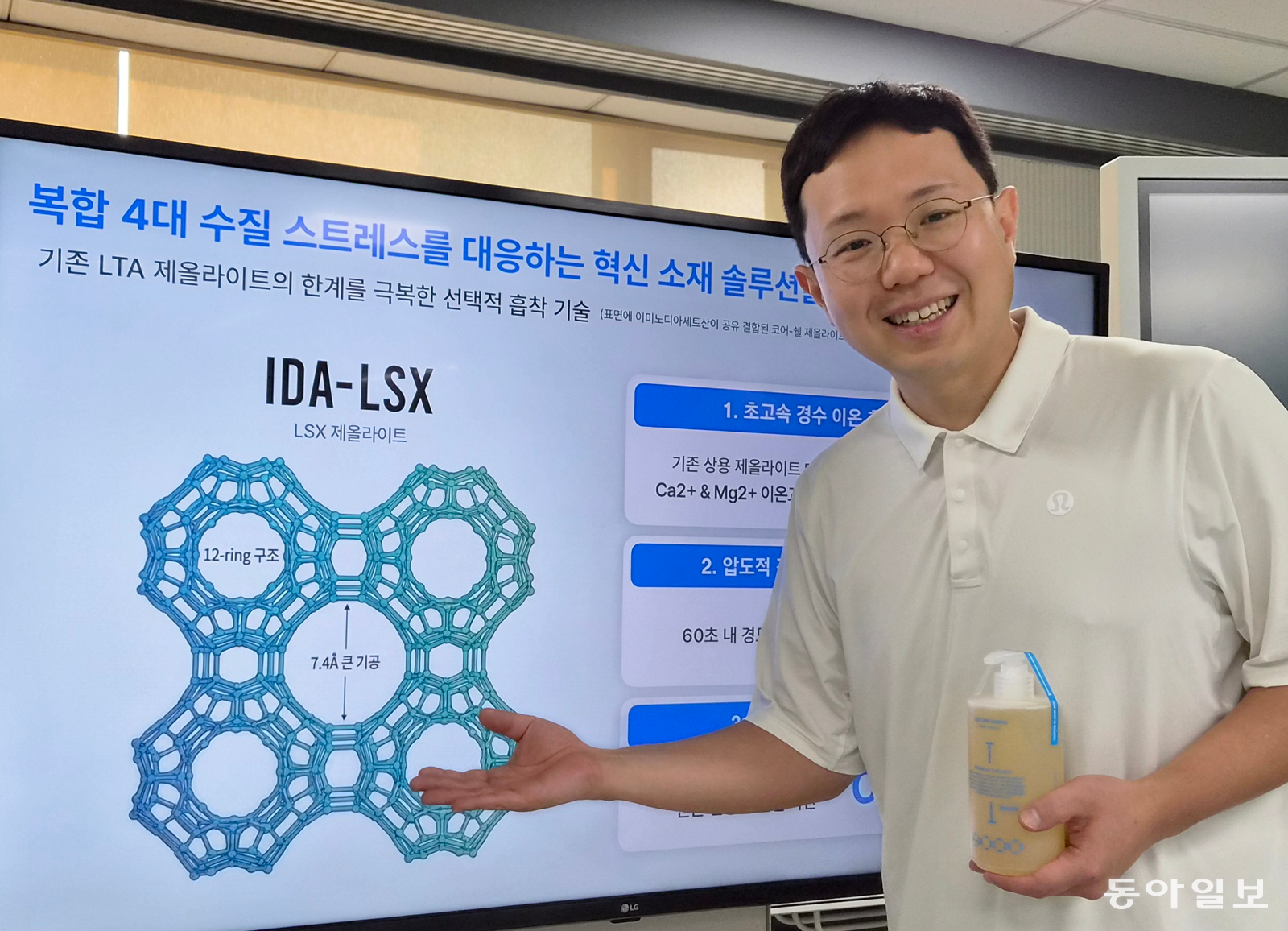
On the 5th, Makemake CEO Kwak Hyo-seop explains the company’s technology for capturing harmful substances in water based on its own zeolite at its office inside D.CAMP in the Front1 building in Mapo District, Seoul. Kwak said, “It is rewarding to hear feedback from consumers who say their hair feels softer after using our shampoo following swimming.” Photo by reporter Heo Jin-seok, jameshur@donga.com
Swimming pools have a distinctive smell. It is commonly described as a bleach smell, but strictly speaking it is the odor of “chloramine,” a compound created when disinfectant (chlorine) reacts with ammonia nitrogen in human secretions. Chloramine breaks down the protein structure of hair and irritates the skin. This is why hair becomes dry and brittle after swimming and, in severe cases, even fingernails can crack. People with atopic dermatitis tend to avoid swimming pools for this reason.
Makemake (CEO Kwak Hyo-seop), located in the Front1 building in Mapo District, Seoul, is a beauty-tech startup seeking to solve this problem. The company internally defines skin, scalp, and hair damage caused by pool water, seawater, and hard water as “water stress” and addresses it with innovative materials.
Meeting at the company’s head office on the 5th, CEO Kwak Hyo-seop (40) said, “Makemake started with products that reduce hair and skin damage caused by pool water and aims to provide water stress solutions to consumers worldwide.” He continued, “Korea has a lot of soft water, so people usually only notice water-related problems when swimming or enjoying the beach. But globally, there is a lot of hard water containing high mineral content and water with metal ions from aging water pipes. The global market is vast.”
● Technology that tackles water’s enemies at once
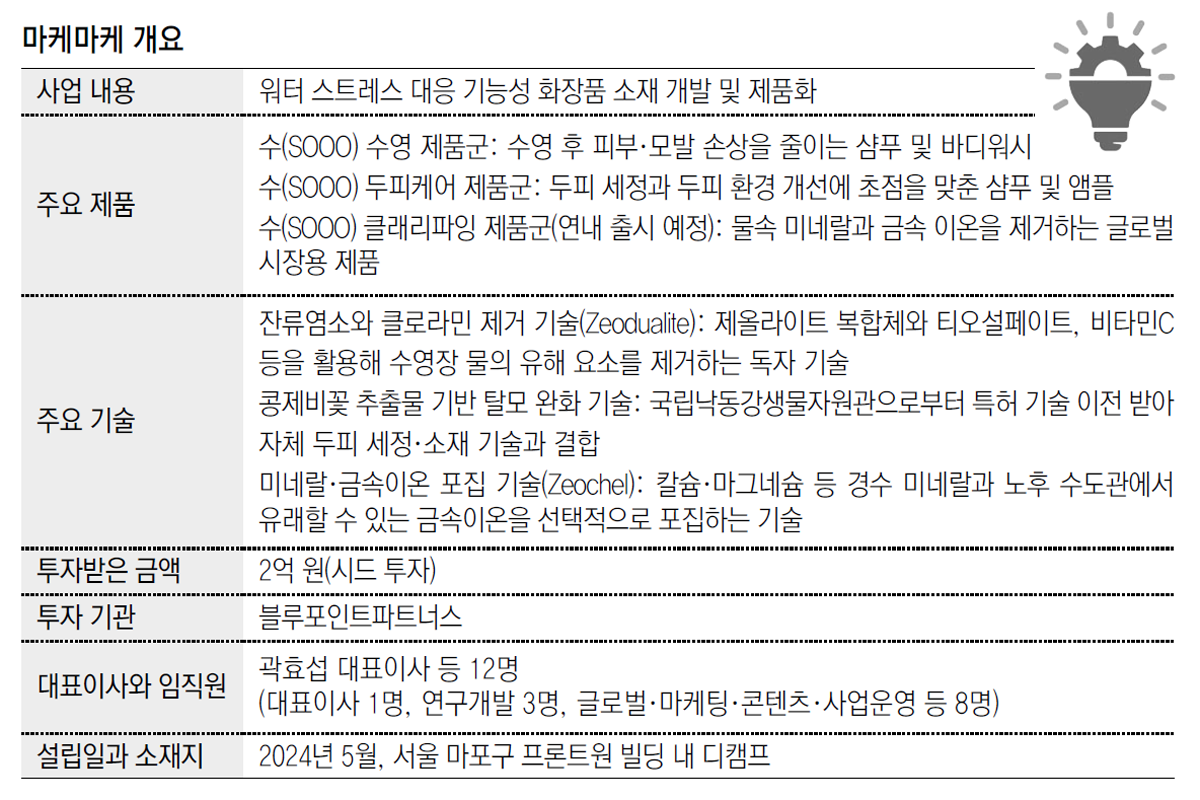
Makemake’s core material “Zeodualite” is a composite based on the mineral zeolite. Zeolite is a crystalline aluminosilicate mineral with regularly arranged micropores of molecular size. By complexing zeolite with thiosulfate (sodium thiosulfate) and vitamin C, the company removes residual chlorine (free residual chlorine and chloramine). Kwak said, “Testing commissioned to the Korea Testing & Research Institute showed that we eliminated up to 98% of residual chlorine. We have registered a domestic patent and filed for a global patent.”
Conventional swimming shampoos have used thiosulfate or vitamin C alone as the chlorine-removing ingredient. However, thiosulfate has a sulfur odor that negatively affects product fragrance, and vitamin C is unstable, leading to formulation breakdown. Kwak said, “We applied a technology that stably complexes both ingredients with zeolite, securing both effectiveness and formulation stability.”
In May this year, the company developed a second material, “Zeochel,” and filed a patent. It incorporates a spatial separation patent technology that allows a single material to remove hard-water minerals such as calcium and magnesium and metal ions such as copper separately. Hard-water minerals are adsorbed and removed by the zeolite, while metal ions such as copper are firmly captured by “molecular tweezers” on the material’s surface through a chelating mechanism. Products using Zeochel for the global market are scheduled to launch in November. Designed as multifunctional products that remove not only residual chlorine but also metal ions and minerals all at once, they are intended for more frequent daily use than swimming shampoos.
● Finding the market first, then building the technology
Makemake’s founding story is textbook. The team first identified a market and then developed the technology. Startup capital came from actively leveraging government support funds.
Kwak founded the company in 2024. Before launching the startup, he spent 13 years in consumer goods distribution and e-commerce. He worked on business planning in the strategy office at TMON and helped operate Potdeuk, a dishwashing startup that washes 600,000 pieces of tableware a day and is the top player in its segment.
The startup began with a conversation among three people. Kwak, COO Byun Dong-gyu, whom he met in TMON’s strategy office, and CDO Park Chang-myeong, with whom he had also worked, formed the initial founding trio. Park has designed products that have won all three of the world’s major design awards: Red Dot, iF, and IDEA. They concluded that to compete in the global consumer goods market, it was necessary to have proprietary materials and technology, not just brand and design. Accordingly, Kwak recruited a relative who is a chemistry expert as CTO in the early stage. The CTO holds a Ph.D. in science with a major in chemistry and has over 15 years of research experience in nano and inorganic chemistry, including work as a researcher at the École Polytechnique Fédérale de Lausanne (EPFL) in Switzerland. Kwak said, “Our approach is to first define market demand and then develop materials and technologies that match it.”
How did they find the market? Kwak first selected the K-beauty market, where capital is concentrating, within the consumer goods sector he knows well. He knew that functional products have high profitability and that K-beauty is recognized in global markets for strong performance at reasonable prices. The challenge was the presence of many global conglomerates. The team therefore looked for a niche where a startup could enter and enjoy a monopolistic position. The water issue in swimming pools stood out. Among the various segments of K-beauty, hair care was relatively less competitive.
They dug into the data. Kwak said, “Korea had a swimming population of 8 million and 3,000 swimming pools. We also considered that, after the Sewol ferry disaster, more students began learning swimming in schools. The swimming shampoo market appeared to be a blue ocean.”
After establishing the corporation in May 2024, the company was selected for the Youth Startup Academy of the Ministry of SMEs and Startups and used its support funds to develop Zeodualite in-house. Zeochel was developed through programs such as the Ministry of SMEs and Startups’ Deep Tech Youth Startup Academy and the Ministry of Oceans and Fisheries’ Blue Startup support project. Kwak said, “To secure initial funds for R&D, we aligned the R&D objectives of government support programs with our product roadmap, and we are connecting the outcomes to products, patents, and exports.”
● Global response and the K-beauty wave
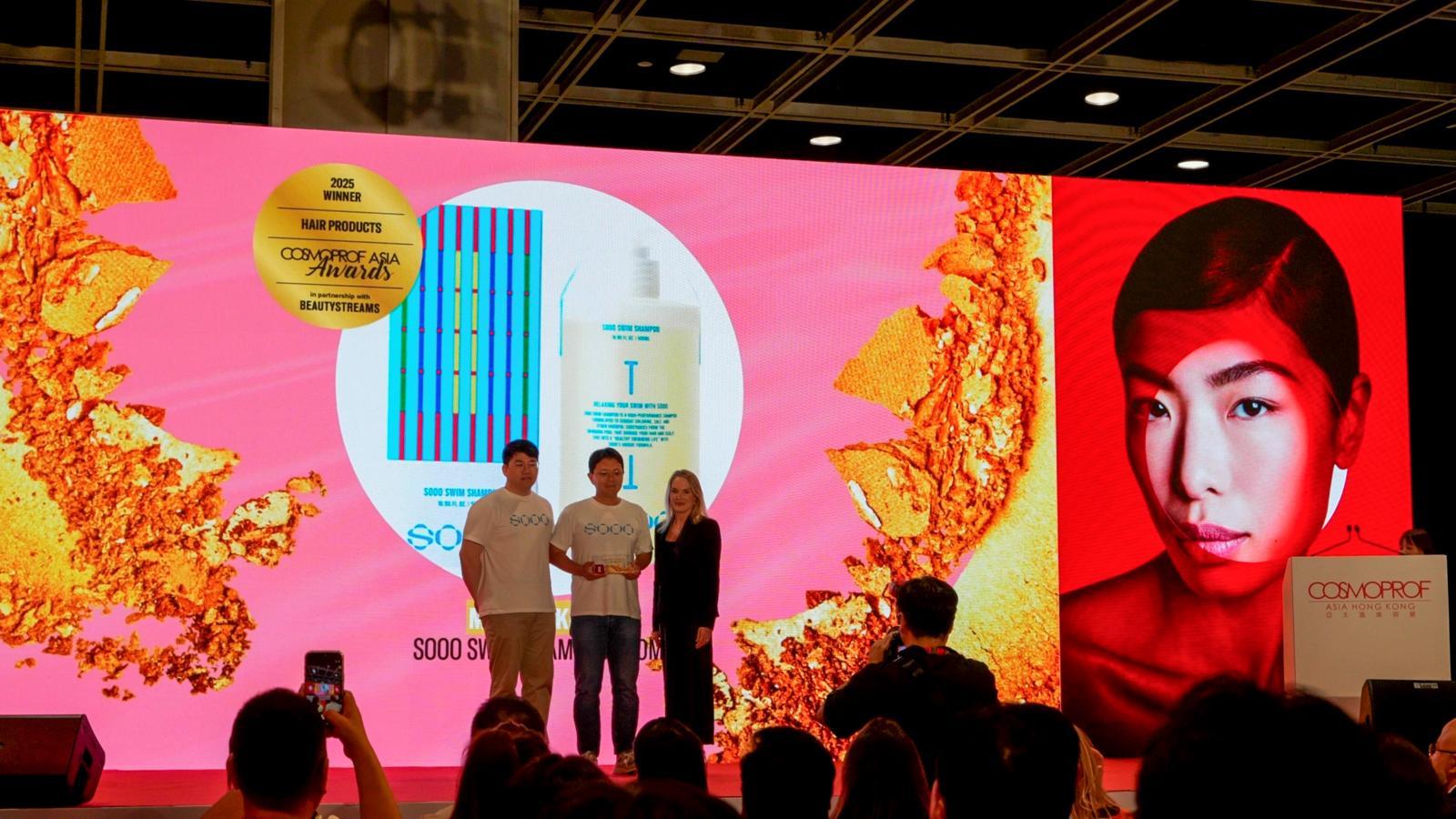
Makemake’s swimming shampoo, which won the grand prize in the hair care category at Cosmoprof Asia Hong Kong, one of the world’s three largest beauty fairs, in November 2025. Provided by Makemake
In its second year of operation, 2025, the company recorded sales of KRW 5 billion, including KRW 500 million from exports. This year’s target is KRW 12 billion. Winning the grand prize in the hair care category at Cosmoprof Asia Hong Kong, one of the world’s three major beauty fairs, in November 2025 became a turning point in its growth. It was highly unusual for a young Korean brand to receive the grand prize at a fair featuring 4,000 brands. Kwak said, “Hair care is a category overwhelmingly dominated by Japanese and European brands, so the fact that a Korean brand won caught the eyes of buyers,” adding, “It was like winning an Oscar with our first film.” Immediately after the award, buyers from around the world visited Makemake’s booth, and a succession of export deals was concluded with four countries: the United States, Brazil, Türkiye, and the United Arab Emirates (UAE).
Brazil is the country with the largest export volume. It is the world’s fourth-largest hair care market. Local buyers showed interest in the chelating ingredients listed on the product’s ingredient label. Based on aggregated consumer feedback, they provided the assessment that the product is “effective in removing metal ions from tap water.” This helped with subsequent product development.
In June this year, the company signed a contract with Silicon2, a distribution specialist that takes K-beauty brands overseas. Domestically, its products have entered Olive Young, The Hyundai Seoul, and KakaoTalk Gift, and the company has also received approval for an official opening of a store on Amazon’s North America Brand Registry.
The challenges are significant. The global hair care market is dominated by multinationals such as L’Oréal, Unilever, and P&G. In June 2025, L’Oréal acquired indie brand Color Wow to strengthen its premium hair care portfolio and is already offering “Metal Detox” products for hard water.
Makemake’s strategy is to differentiate itself as the only multifunctional product that simultaneously removes not only residual chlorine and chloramine in swimming pools, but also metal ions and minerals. Kwak said, “The price at which our products are sold in Korea is extremely reasonable within the functional product segment in the U.S. market,” adding, “Even taking logistics costs into account, we have ample competitiveness.”
Makemake estimates the global water stress care market at about KRW 3 trillion. The company recently launched a scalp-care product called SCALPTURE and is carrying out research under the TIPS (Tech Incubator Program for Startup) private-led early startup support program to extract antioxidant ingredients from the green alga Ulva pertusa found on the beaches of Jeju Island. Kwak said, “We will expand from swimming-related items to a brand that resolves water stress and ultimately grow into a longevity brand that supports a healthy life.”
ⓒ dongA.com. All rights reserved. Reproduction, redistribution, or use for AI training prohibited.
Popular News