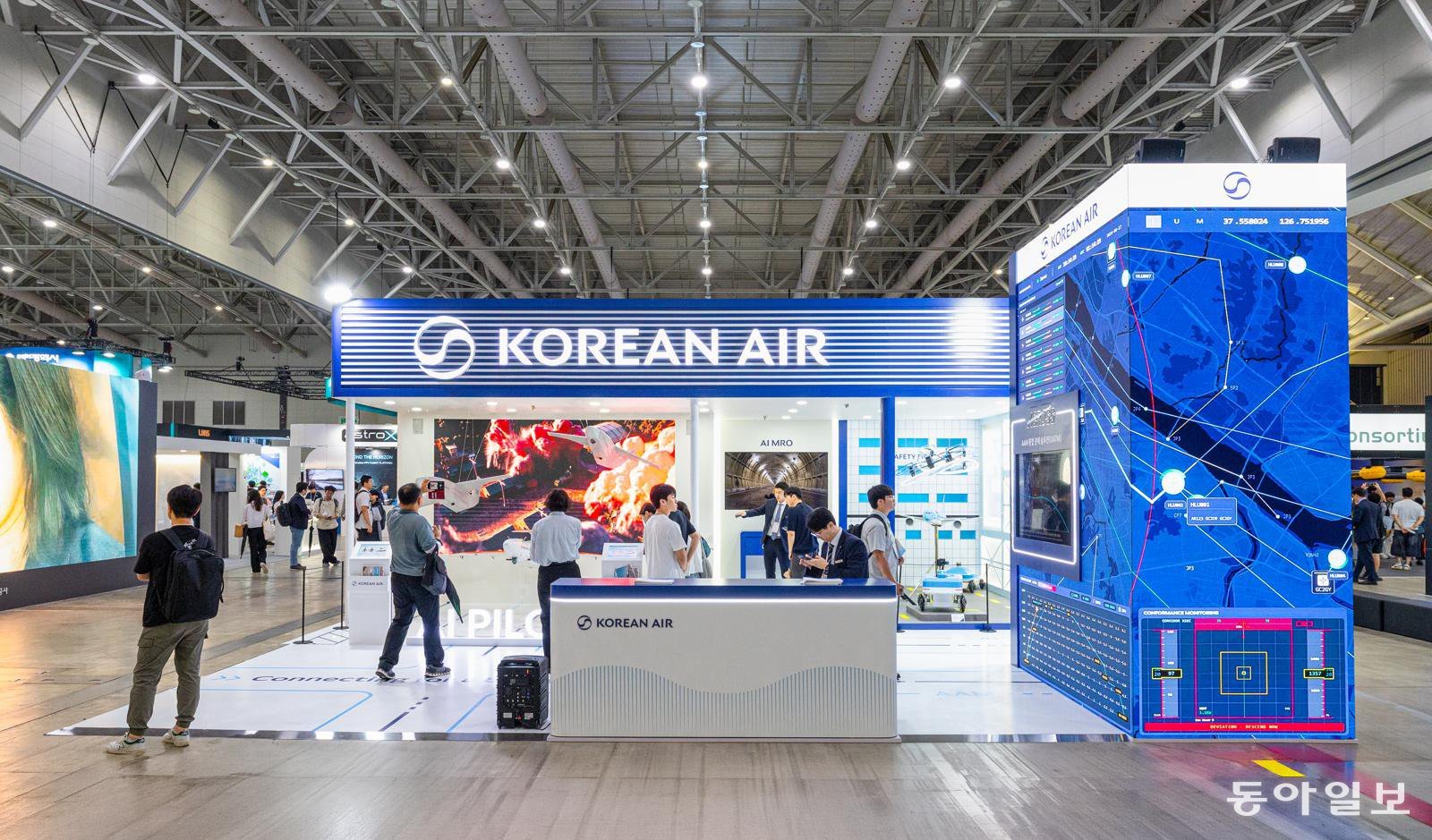
Visitors at Korean Air’s exhibition booth at the “2026 Korea Drone·UAM Expo” in July this year. Provided by Korean Air
Korean Air is moving to develop next-generation unmanned aerial vehicles (UAVs) in which artificial intelligence (AI) independently perceives and assesses the surrounding environment to carry out missions. Going beyond conventional UAVs that are directly piloted by humans, the company aims to develop “physical AI” UAVs in which AI determines flight routes and mission execution methods, and multiple UAVs cooperate with one another.
Physical AI refers to AI that perceives the real world through sensors and mechanical devices and moves physically. Korean Air is currently conducting demonstrations by applying core technologies—mission autonomy and swarm flight—to actual UAV platforms.
Mission autonomy technology enables a UAV to establish detailed operational plans and execute missions on its own when only the mission objective is designated, without human operators directly controlling each aircraft. Swarm flight technology allows multiple UAVs to share information such as each other’s position and speed to avoid collisions and maintain formation.
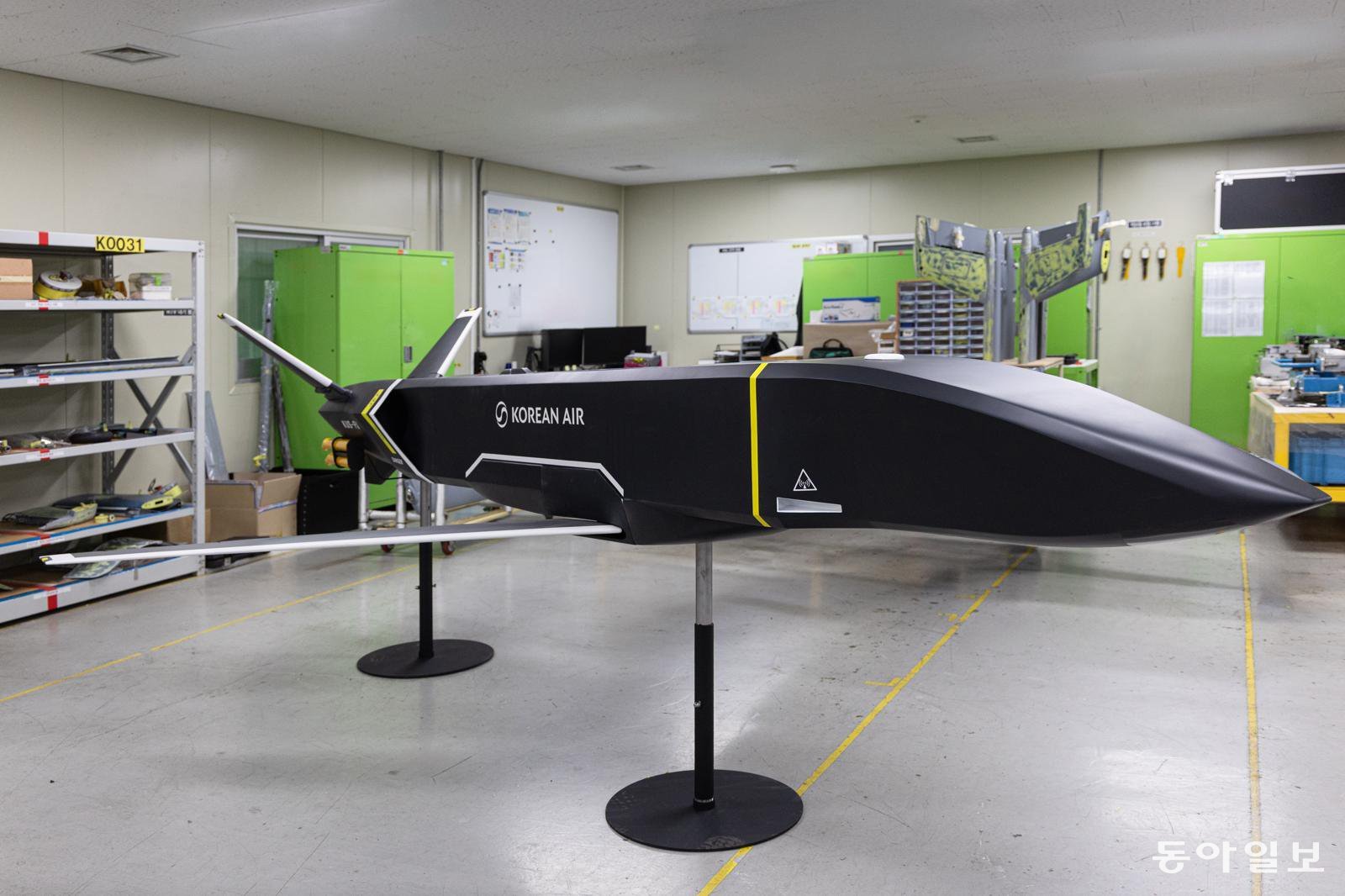
Mock-up of the small cooperative UAV (KUS-FX) under development by Korean Air. Provided by Korean Air
Representative UAVs under development by Korean Air include the small cooperative UAV (KUS-FX), a subsonic unmanned target drone, and small and medium-sized strike UAVs. The KUS-FX is approximately 4 meters in length and incorporates AI-based mission autonomy functions and automated swarm flight technology. It is being developed with a view to realizing a manned-unmanned teaming system in which multiple UAVs cooperate with each other or conduct operations jointly with manned aircraft.
The greatest advantage of physical AI UAVs is that they can be used for operations that are difficult for humans to perform, such as long-endurance flight and missions in high-risk areas. Autonomous navigation technology that uses terrain information to locate targets, even in electronic warfare environments where communications or GPS signals are cut off, is also a target for application.
In addition, Korean Air signed a memorandum of understanding (MOU) in October last year with Archer, a US advanced air mobility company, for entry into the defense advanced air mobility market and technological cooperation. The main focus of the collaboration is to develop a military air mobility platform by combining Archer’s electric vertical take-off and landing (eVTOL) aircraft design technology with Korean Air’s capabilities in military aircraft conversion and UAV system integration.
A Korean Air official said, “The company plans to build a future mobility ecosystem in which various platforms and AI are organically connected around aviation, and to lead the creation of new markets.”
Ji Hee-soo
AI-translated with ChatGPT. Provided as is; original Korean text prevails.
ⓒ dongA.com. All rights reserved. Reproduction, redistribution, or use for AI training prohibited.