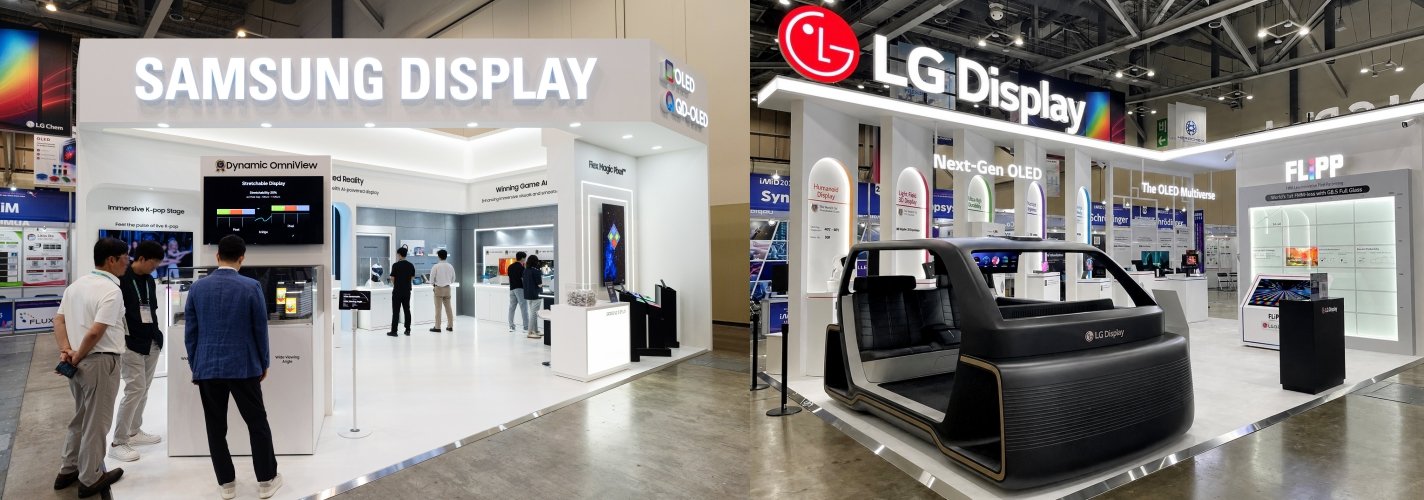
Samsung Display unveils wide-view curved panel with enhanced brightness LG Display introduces new OLED process eliminating metal plates
Samsung Display and LG Display each unveiled world-first technologies at the 26th International Meeting on Information Display (IMID 2026), held at BEXCO in Busan for four days from the 18th of this month. Samsung Display introduced next-generation form factor technologies such as foldable and stretchable displays, while LG Display presented for the first time a new process technology for manufacturing organic light-emitting diode (OLED) panels without a metal mask.
On the 19th, Samsung Display announced that it had unveiled for the first time its Wide View Display incorporating wide viewing angle technology. In currently commercialized foldable displays, the brightness of the curved areas on both sides of the fold is only about 40% of that at the center when viewed head-on. The Wide View Display is a technology that resolves this brightness drop in the curved sections.
The company also showcased the world’s largest 20-inch Wide Stretchable Display. It operates by connecting two stretchable panels so that they function as a single screen, more than doubling the screen size compared with existing products. For laptops, it exhibited a 16-inch self-emissive display that, for the first time among such displays, achieves a refresh rate of 300 Hz. Refresh rate is the number of times per second the screen is updated; the higher the number, the smoother the display of fast motion without stuttering.
LG Display unveiled “FLiPP,” a new OLED manufacturing process that eliminates the metal mask, claiming it as a world first. The conventional method involved coating red, green, and blue emitting materials one by one onto a fine metal mask (FMM) with microscopic holes and then detaching it. Instead of this metal mask, FLiPP applies a photolithography process used in semiconductor production: red, green, and blue pixels are sequentially deposited and fixed across the entire substrate, and then only the unnecessary portions are removed using ultraviolet (UV) light.
This process reduces defects caused by the metal mask, and eliminates the empty spaces between pixels previously occupied by the mask, increasing luminous efficiency by about 55%. Under the same conditions, compared with the conventional method, FLiPP can either increase brightness by 1.6 times, extend lifetime by 2.4 times, or reduce power consumption by 13%.
Lee Min-a
AI-translated with ChatGPT. Provided as is; original Korean text prevails.
ⓒ dongA.com. All rights reserved. Reproduction, redistribution, or use for AI training prohibited.