[2026 A Farm Show Start-up & Return-to-Farming Hometown Love Expo]
Automated video-based sorting, robot-arm transport
Processing volume doubles and quality improves
Plans to expand from 60 to 300 sites by 2030
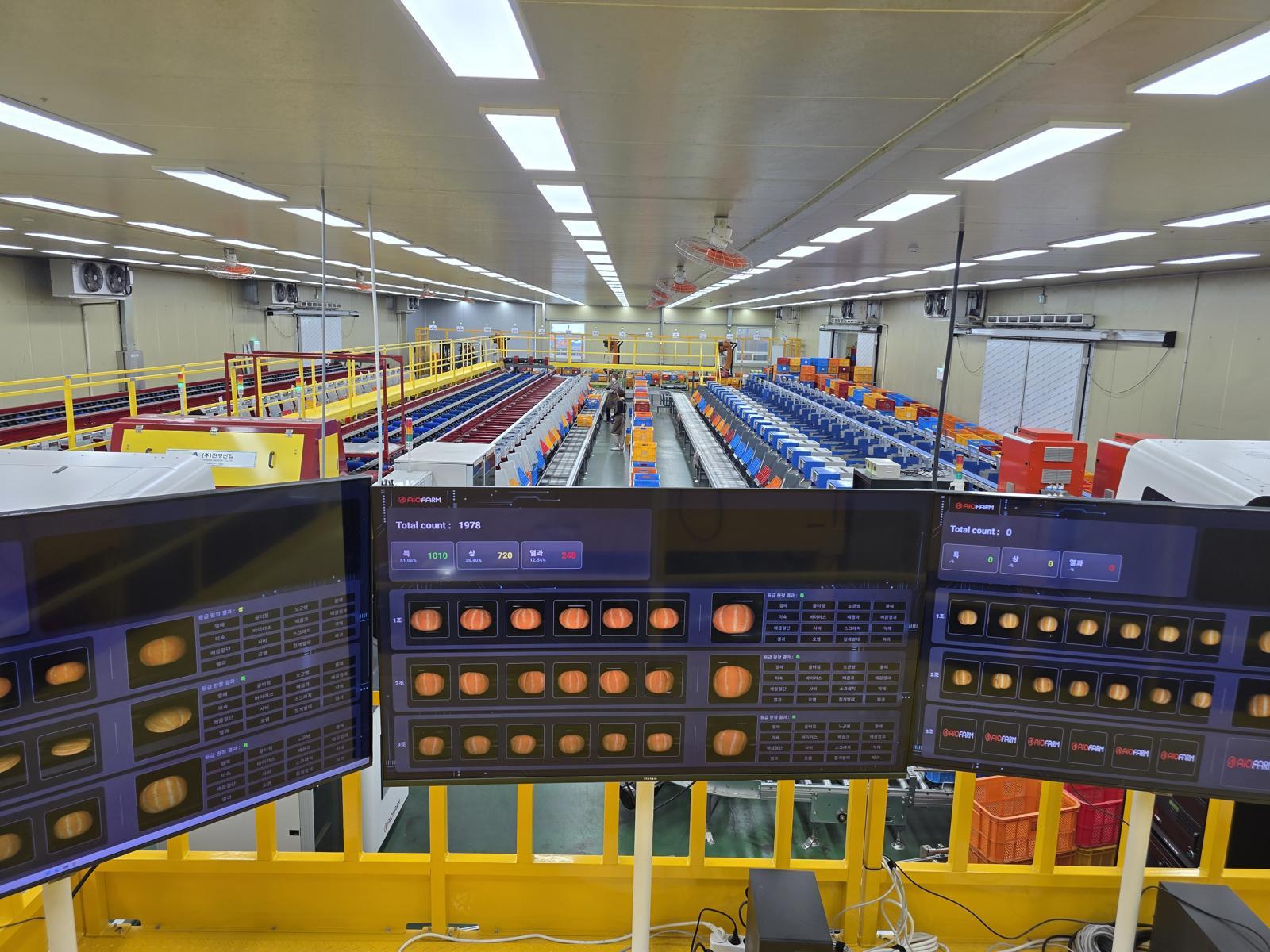
View of an artificial intelligence (AI) video-based automatic sorting system in operation on a monitor installed at the Agricultural Products Processing Center (APC) of Wolhang Nonghyup in Seongju-gun, North Gyeongsang Province. Provided by the Ministry of Agriculture, Food and Rural Affairs.
Wolhang Nonghyup in Seongju-gun, North Gyeongsang Province, introduced a smart system in 2024 at its Agricultural Products Processing Center (APC), where sorting, processing, and packaging of agricultural products take place. Artificial intelligence (AI) automatically sorts agricultural products based on video images, and robotic arms autonomously move and load boxes of produce.
After replacing human sorting and loading operations with the smart system, required labor has fallen by more than 50%, while processing speed has increased. At Wolhang Nonghyup’s APC, which mainly handles oriental melons, the volume processed in an 8-hour day has risen from 80 tons to a maximum of 160 tons, roughly doubling. The quality of the melons sorted in this way has also improved. Because AI sorting manages quality more accurately than the human eye, quality control has become more precise.
Smart APCs that automate processes using sensors and robots and are equipped with data-based analytical systems are spreading. According to the Ministry of Agriculture, Food and Rural Affairs on the 18th, the number of smart APCs established by item in producing regions reached 60 as of the end of last year. The ministry plans to expand the number of smart APCs to 300 by 2030.
At smart APCs, automating commercialization processes such as sorting and packaging enables more efficient operation with fewer personnel. Another advantage is the ability to automatically register and analyze various data—from individual farms’ production information to sorting, storage, and shipment volumes by buyer—thereby optimizing workflows.
At Hanbando Nonghyup in Yeongwol-gun, Gangwon Province, which introduced a smart APC in June last year, the time required for incoming processing of agricultural products was reduced from the previous 3–5 minutes to 1 minute. The number of workers handling this process decreased from three to one.
The AI sorting system at smart APCs increases accuracy and thereby enhances trust in the quality of agricultural products. Because quality is initially screened at the production site, sorting is a core process of APCs. Kim Myoung-kwan, deputy director at the Distribution Policy Division of the Ministry of Agriculture, Food and Rural Affairs, said, “Farmers receive prices according to the grade of agricultural products determined by sorting, so they strive to improve quality. Consumers also prefer high-sugar, high-quality products, which makes the sorting process extremely important.”
Unmanned smart APCs operated on a data-driven basis are also expected to appear soon. AOFarm, a startup developing agricultural AI technology, plans to commercialize a data-based unmanned smart APC at Muan Nonghyup in Miryang-si, South Gyeongsang Province, in the first half of next year (January–June).
Gwak Ho-jae, CEO of AOFarm, which developed the AI sorting system for Wolhang Nonghyup, said, “At present, processes are not fully linked in terms of automation—for example, humans still move the produce that has been sorted by AI—so data continuity is limited,” adding, “If all processes are automated, it will not only further reduce labor but also secure high-quality data that can be utilized in the distribution stage.”
ⓒ dongA.com. All rights reserved. Reproduction, redistribution, or use for AI training prohibited.
Popular News