“Hundreds of sample units were scrapped and rebuilt”
‘2026 LG OLED evo’ TV
Lowered blue light emission by 0.1 percentage points in a year to earn world-first certification
Chinese LCDs remain in the 2% range… gap is still large
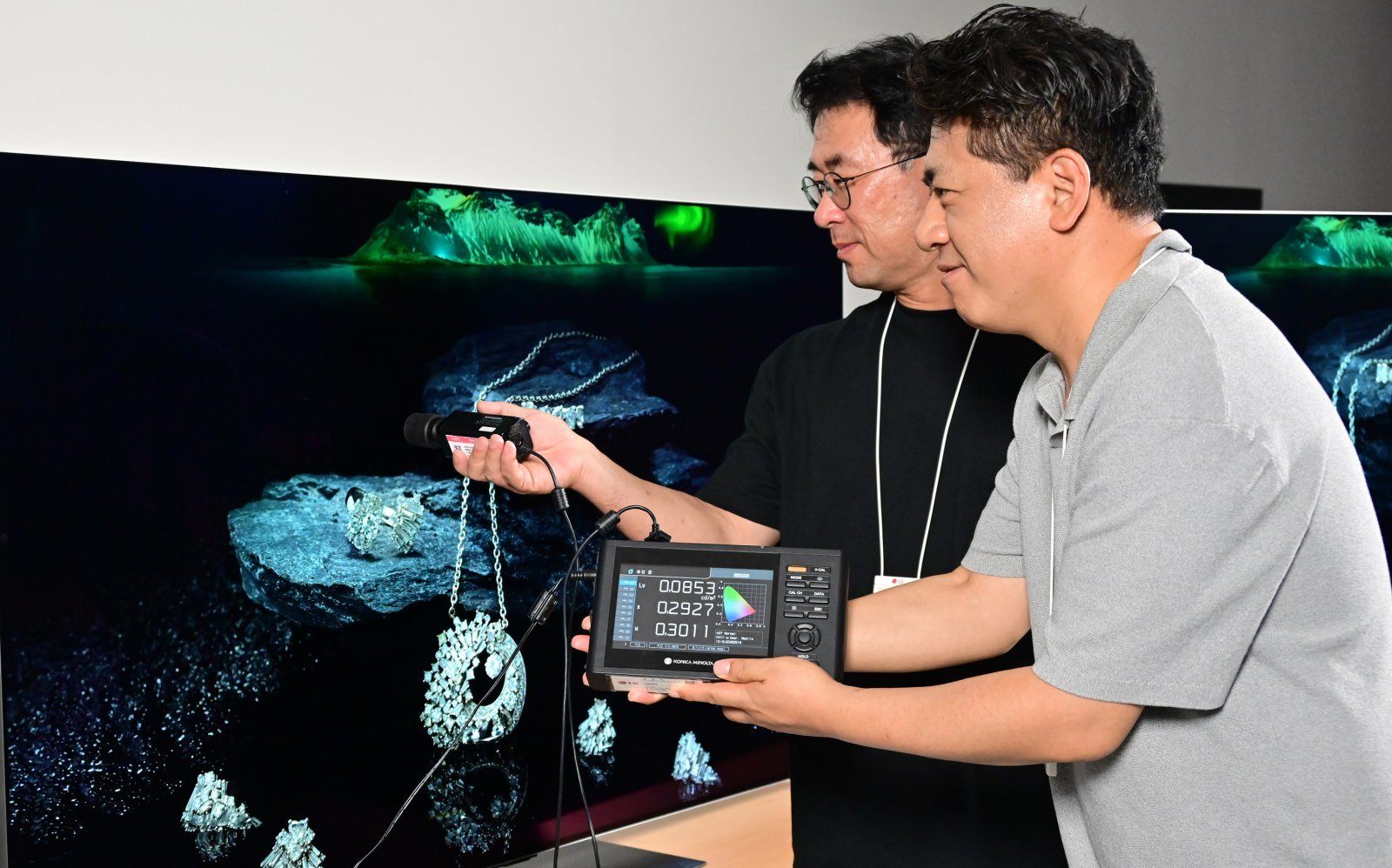
Researchers from the Display Picture Quality Development Team at LG Electronics’ MS Business Headquarters measure the reflectance of the 2026 TV new model “LG OLED evo” at LG Electronics’ Digital Park in Pyeongtaek, Gyeonggi Province, on June 24 this year. Provided by LG Electronics
“Even if they take it apart piece by piece, they will not be able to copy it.”
At LG Electronics’ Digital Park in Pyeongtaek, Gyeonggi Province, recently, Lee Myung-young, research fellow at LG Electronics, pointed to the “2026 LG OLED evo (G6)” TV and made this remark. The confidence was that even if competitors in China and elsewhere stripped off the display coating, they would not be able to replicate the minute differences in thickness.
This TV is the first in the world to obtain the “Reflection Free Premium” certification from global certification body Intertek. This means it has reduced reflectance while almost completely preserving picture quality. Reflectance is the ratio of light reflected from the screen. The lower the reflectance, the less viewers’ faces or room lighting are reflected on the screen when watching dark scenes in a brightly lit room, and the contrast is more distinctly maintained.
A demonstration comparing reflectance was conducted with several TVs placed in a room lit by bright fluorescent lamps. In practice, on the G6, even the starlight in a space video appeared vividly, while on other TVs the blacks looked somewhat washed out.
The key was a 0.1 percentage point difference in reflectance. The screen reflectance of LG Electronics’ G6 is just 0.5%.
The reflectance of the G5, the product released last year, was 0.6%. It is a small difference, but it reportedly took a year and a half just to lower this by 0.1 percentage point. Lee said, “If the mixture is even slightly off, the result changes, so we produced and destroyed hundreds of sample units and made them again.”
In fact, with materials that simply absorb light, it is difficult to reduce reflectance below 1%. The limitation is that the remaining light bounces off like a mirror. LG therefore adopted a strategy of eliminating even the remaining light. It uses three layers of coating so that incoming light waves collide and cancel each other out, similar to the principle by which two waves meet and the surface becomes calm. The tiny amount of remaining light is scattered finely to eliminate mirror-like reflection, and this is controlled by the amount of microscopic glass beads mixed into the coating. The optimal blend was found by repeatedly breaking and remaking hundreds of samples.
According to Lee, the reflectance of Chinese liquid crystal display (LCD) TVs is in the 2% range, while domestic competitors’ products are around 1%. It is an area in which China has yet to catch up. Thanks to such technological capabilities, Korea continues to maintain a dominant position in the organic light-emitting diode (OLED) and ultra-premium TV markets. According to market research firm Omdia, although Korea (28.7%) lagged behind three major Chinese companies (32.1%) in the overall TV market due to China’s low-price offensive, in the first quarter (January–March) of this year LG Electronics’ share of global OLED TV sales was 47.7% and Samsung Electronics’ was 38.9%, for a combined share of 86.6%.
LG’s 0.5% reflectance technology has also been validated in Hollywood. Major studios in the U.S. film industry place LG OLED TVs next to professional monitors and use them as the standard for “what consumers will see at home.”
The issue is that the competition to lower reflectance is gradually reaching its limit. Lee cited artificial intelligence (AI) as the next main battleground in the premium TV quality race. Going forward, the brightness sensor built into the TV will read the surrounding brightness 60 times per second to render blacks in the way most comfortable for the human eye, and the TV will automatically distinguish whether the content is sports, movies, or news and adjust color and contrast processing in real time accordingly.
ⓒ dongA.com. All rights reserved. Reproduction, redistribution, or use for AI training prohibited.
Popular News