Partnership signed with Japan’s TDK on the 28th for next‑generation physical AI solutions
Combining optical technology with inertial and position sensors
First next‑generation vision module debut set for 2027
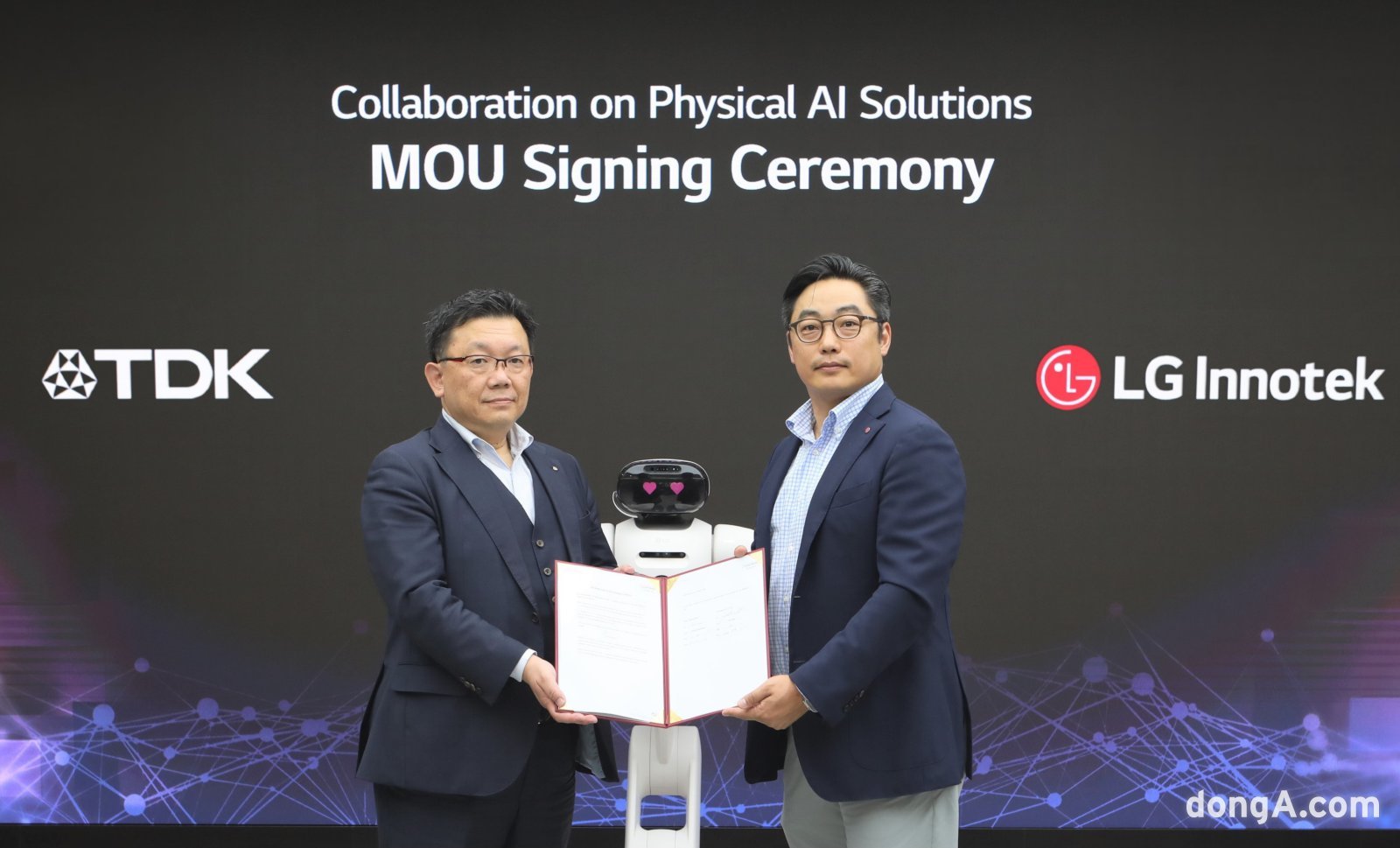
Min Jon, CTO of LG Innotek (right), and Shuichi Hashiyama, CTO of TDK, pose for a commemorative photo at the “Memorandum of Understanding (MOU) Signing Ceremony for Collaboration on Physical AI Solution Development” held at LG Innotek’s headquarters in Magok, Gangseo-gu, Seoul. Provided by LG Innotek
LG Innotek is significantly expanding its business scope beyond optics-based vision sensors into the field of tactile components for robots.
LG Innotek announced on the 28th that it has formed a strategic partnership with Japan’s TDK, a global comprehensive electronic components company, for a technological alliance in the field of Physical AI.
Under this alliance, the two companies plan to jointly develop advanced sensor solutions that are core to robot operation, such as next-generation vision sensing modules and tactile sensing modules, by combining LG Innotek’s ultra-precise optical design capabilities with TDK’s sensor lineup.
TDK, headquartered in Tokyo, Japan, is a global components manufacturer that has focused on nurturing its sensor business for more than 20 years. It has built a diverse portfolio of fundamental technologies essential for Physical AI, including inertial measurement units (IMU) as well as position, pressure, and temperature sensors.
As a first task, the two companies will embark on preliminary research to integrate TDK’s inertial and position sensors and acoustic microphones into LG Innotek’s vision sensor system. The concept is to go beyond simple visual image data collection and maximally enhance robots’ spatial recognition capabilities by processing changes in position, vibration, and acoustic data in combination.
In particular, when TDK’s inertial sensors are integrated, it will be possible to correct, in real time, screen shake that occurs when a robot walks or controls assistive devices, thereby securing more precise visual data. Finished robot manufacturers will also be able to receive scattered individual sensors as a single, integrated module, thereby simultaneously improving product completeness and production efficiency.
An LG Innotek official explained that the application potential of the integrated modules to be derived from collaboration with TDK, which possesses a wide variety of sensor technologies, is highly scalable, adding that the company plans to commercialize an integrated vision module with built-in inertial sensors by 2027.
At the same time, the two companies will also proceed in parallel with the development of tactile sensing modules that serve as the “skin” of robots. Targeted for completion by 2027, the tactile modules will be applied to robot fingers, joints, and the overall body to determine whether physical contact has occurred and to measure the precise intensity of applied pressure.
Because these components must have an ultra-thin and flexible structure, the manufacturing process is extremely challenging, yet they are considered key high value-added items for the realization of next-generation intelligent robots. LG Innotek plans to apply its signal processing and modularization technologies, while TDK will incorporate its ultra-precise sensing technologies, which have been verified in the home appliance and automotive sectors, to introduce tactile components optimized for work environments.
Going forward, the two companies plan to expand their cooperation across the broader Physical AI domain, including intelligent algorithms that analyze and process sensor-detected data in real time.
Noboru Saito, President and CEO of TDK, said he was pleased to form a partnership with LG Innotek, which possesses top-tier sensing technologies, and stated that by combining TDK’s core technologies with LG Innotek’s manufacturing capabilities, the companies will introduce innovative products that will change the market paradigm.
Moon Hyuk-soo, CEO of LG Innotek, noted that in the robotics industry, multi-sensing technology that integrates multiple types of detection devices is emerging as a key issue, and emphasized that, leveraging the alliance with TDK, LG Innotek will lead the ecosystem for core robot components and firmly establish leadership in the Physical AI market through collaboration with various global companies.
Currently, based on its differentiated competitiveness with in-house sensing technologies such as cameras, LiDAR, and radar, LG Innotek is continuously expanding its robotics and autonomous driving collaborations with global big tech companies including Boston Dynamics.
ⓒ dongA.com. All rights reserved. Reproduction, redistribution, or use for AI training prohibited.
Popular News