Korea New Light Source Accelerator breaks ground in Ochang
KRW 1.1 trillion project to be completed by 2029
Circular accelerator 100 times brighter than third-generation machines
Capable of capturing even minute structures and defects
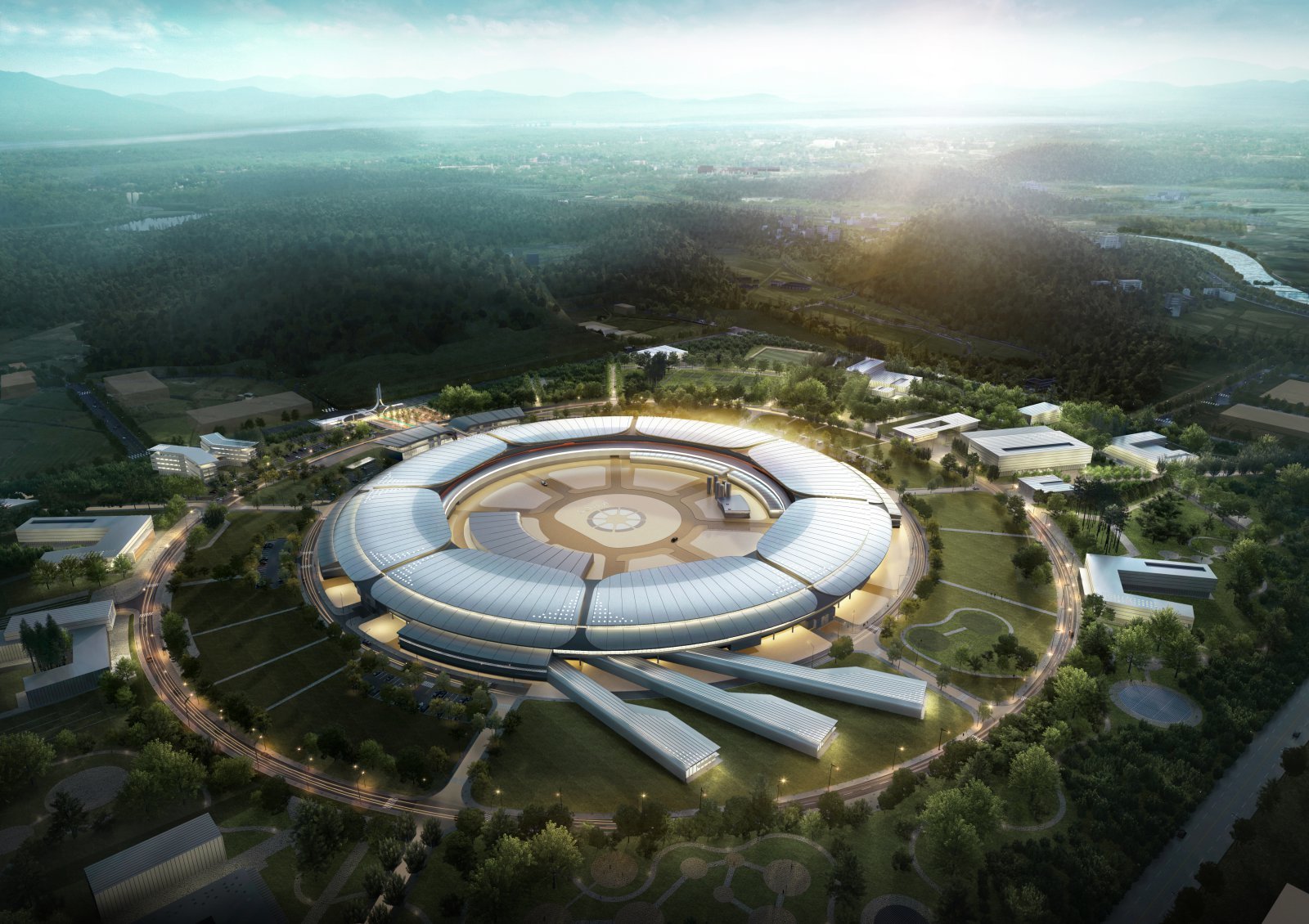
Artist’s rendering of the “Korea Saebit Light Source” to be built in Ochang-eup, Cheongju, Chungcheongbuk-do, by the end of 2029. This research facility will use synchrotron radiation, which is brighter than the Sun and has shorter wavelengths, to examine microscopic defects in semiconductors and batteries. Provided by the Korea Basic Science Institute (KBSI)
On the 27th, at a site in the Ochang Technopolis Industrial Complex in Cheongju, Chungcheongbuk-do. It is now a vast empty lot of exposed yellow earth, but by 2029, three years from now, it is set to be transformed into a core hub for research on semiconductors, new drugs, and advanced materials. This is because a fourth-generation synchrotron radiation accelerator with a circular storage ring of approximately 800 meters in circumference will be constructed there. The Ministry of Science and ICT and the Korea Basic Science Institute announced on the 27th at the groundbreaking ceremony for the Korea Saebit Light Source that a total project cost of KRW 1,164.3 billion will be invested.
The Saebit Light Source, which broke ground that day, is essentially a “giant microscope” that can look inside semiconductors, batteries, and drug candidates. A device that accelerates small particles is called an accelerator; a synchrotron radiation accelerator speeds up electrons and makes them circulate along a circular orbit called a “storage ring,” generating extremely bright light known as synchrotron radiation. When this light is directed at materials, it allows precise observation of internal structures and changes without cutting or breaking the material, much like how computed tomography (CT) or magnetic resonance imaging (MRI) scans allow hospitals to see inside the human body.
A synchrotron radiation accelerator can detect not only invisible microscopic structures and defects, but also the very moments when materials undergo change, making it a key infrastructure for advanced industrial research. For example, when a semiconductor chip fails, it is often difficult with conventional analytical equipment to determine which microscopic structure caused the problem, or why the performance of an electric vehicle battery declines as it is repeatedly charged. Using synchrotron radiation, however, it is possible to examine the interior of a finished product in three dimensions without destroying it.
Synchrotron radiation accelerators are also used in new drug development. Pharmaceutical companies use synchrotron radiation to precisely analyze the three-dimensional structures of disease-related proteins and design therapeutic candidates that fit them exactly. “Tamiflu,” widely known as a treatment for pandemic influenza, is a representative example that was developed based on research analyzing the structure of an influenza virus protein using synchrotron radiation.
Although there is already a third-generation circular synchrotron radiation accelerator (PLS-II) in Pohang, Gyeongsangbuk-do, the Saebit Light Source is a fourth-generation circular accelerator that produces light 100 times brighter. Shin Seung-hwan, Director of the Multi-purpose Synchrotron Radiation Accelerator Construction Project, explained, “It will generate brighter light than third-generation machines, reducing experiment times and enabling the detection of smaller defects.”
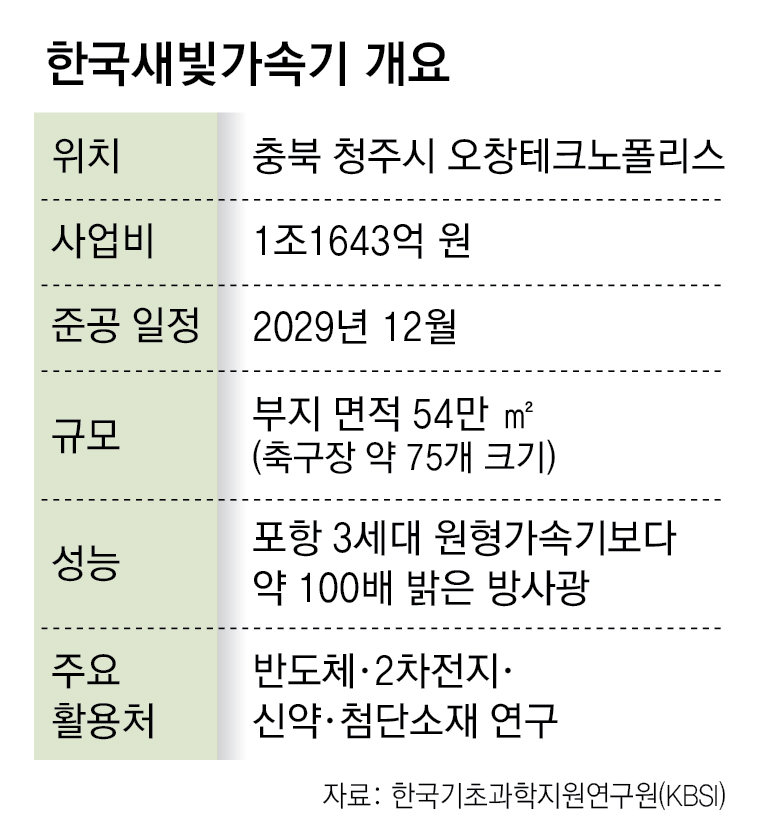
The government plans to build 10 “beamlines,” the experimental facilities of the Saebit Light Source, by completion, and later expand this to more than 40. In particular, three of the initial beamlines will be prioritized for industrial use, with the aim of directly linking the facility to the semiconductor, secondary battery, and bio industries. Director Shin said, “We expect to collaborate with relevant companies such as Samsung Electronics and SK hynix.” The government also plans to systematize the experimental data produced by the Saebit Light Source so that artificial intelligence (AI) can learn from it, and to explore ways of utilizing it in cutting-edge industrial research such as physical AI.
As competitiveness in advanced industries increasingly depends on how finely materials can be analyzed, not only Korea but also countries around the world are building new state-of-the-art synchrotron radiation accelerators or extensively upgrading existing facilities. Japan began operation of its latest circular synchrotron radiation accelerator “NanoTerasu” in 2024, while China has completed construction of its fourth-generation circular synchrotron radiation accelerator HEPS and is moving into full-scale operation. Once the Saebit Light Source is completed in 2029, Korea will join the competition in fourth-generation circular synchrotron radiation accelerators at the world’s highest level.
Koo Hyuk-chae, First Vice Minister of Science and ICT, said, “The construction of this accelerator will enhance the performance of semiconductors and secondary batteries and help accelerate the development of bio-based new drugs.”
ⓒ dongA.com. All rights reserved. Reproduction, redistribution, or use for AI training prohibited.
Popular News