Mega long-term contracts expected to ease the “downturn cycle”
Lee Jae-yong: “With Korea–U.S. cooperation, we can tackle many more tough challenges”
Chey Tae-won: “The figures we announced today are not unrealistic”
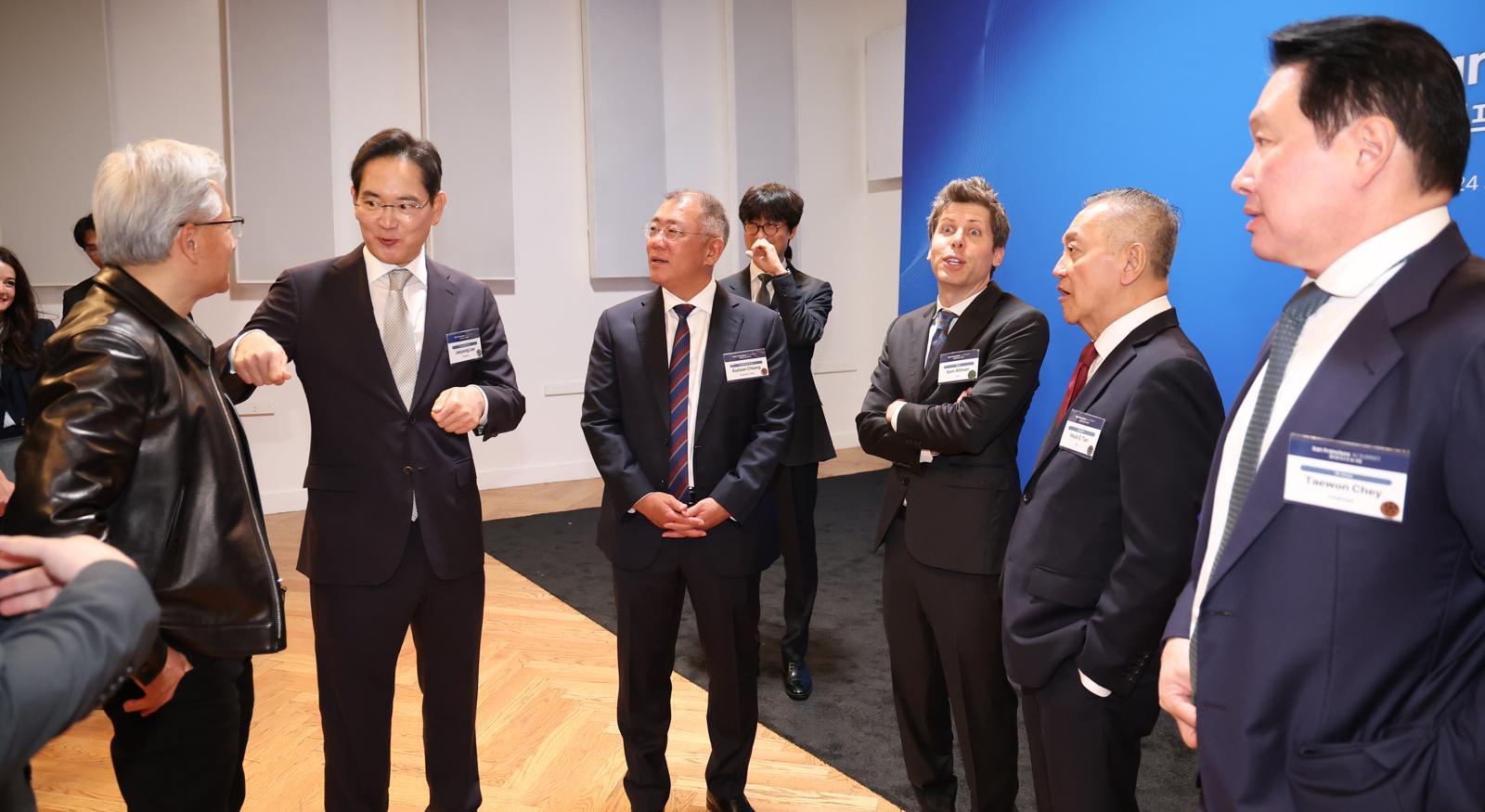
Jensen Huang, NVIDIA CEO; Lee Jae-yong, Samsung Electronics Chairman; Chung Eui-sun, Hyundai Motor Group Chairman; Lee Hae-jin (back), Naver Executive Chairman of the Board; Sam Altman, OpenAI CEO; Hock Tan, Broadcom CEO; and Chey Tae-won, SK Group Chairman, talk prior to the San Francisco AI Summit held at The Midway in San Francisco on the 24th (local time). 2026.07.25 San Francisco = Newsis
Major South Korean conglomerates, including Samsung Electronics, SK Group, and Hyundai Motor Group, unveiled ultra-large-scale artificial intelligence (AI) infrastructure and semiconductor·mobility partnerships totaling USD 950 billion (approximately KRW 1,390 trillion) with global big tech companies such as NVIDIA and Broadcom at the “AI Summit” in San Francisco. Observers assessed that South Korean companies, which had long remained in the role of traditional hardware manufacturers or component suppliers, are now being reaffirmed as “irreplaceable core partners” capable of resolving bottlenecks in the global AI infrastructure and physical AI ecosystem.
●
Diversifying Korea–global big tech collaboration in the AI era Large-scale partnerships by South Korean conglomerates were revealed en masse on the occasion of the “AI Summit” held at the Fairmont Hotel in San Francisco, United States, on the 24th (local time).
First, Samsung Electronics signed a USD 200 billion (approximately KRW 290 trillion) strategic memorandum of understanding (MOU) with Broadcom in the memory and foundry (semiconductor contract manufacturing) sectors over five years through 2030. Under the agreement, Samsung will supply HBM4, a next-generation high-bandwidth memory (HBM), and will contract-manufacture Broadcom’s next-generation communication semiconductors using its sub-2-nanometer (nm; 1 nm is one-billionth of a meter) cutting-edge foundry processes. Analysts said this reflects the competitiveness of Samsung as an integrated semiconductor company that can provide one-stop support across memory, foundry, and advanced packaging.
SK Group signed a comprehensive letter of intent (LOI) for cooperation worth a total of USD 500 billion (approximately KRW 730 trillion) with NVIDIA. The group plans to secure a long-term supply of HBM4 for NVIDIA’s next-generation AI accelerator “Vera Rubin,” and procure NVIDIA AI accelerators to embark on the construction of large-scale AI data centers. The USD 500 billion figure encompasses not only SK hynix’s memory supply volume, but also the budget SK will allocate to purchase NVIDIA GPUs for AI data centers. SK Group additionally signed agreements totaling USD 250 billion (approximately KRW 365 trillion), including a memory supply contract with Microsoft and expanded AI infrastructure and data center collaboration with Anthropic, Amazon, and others.
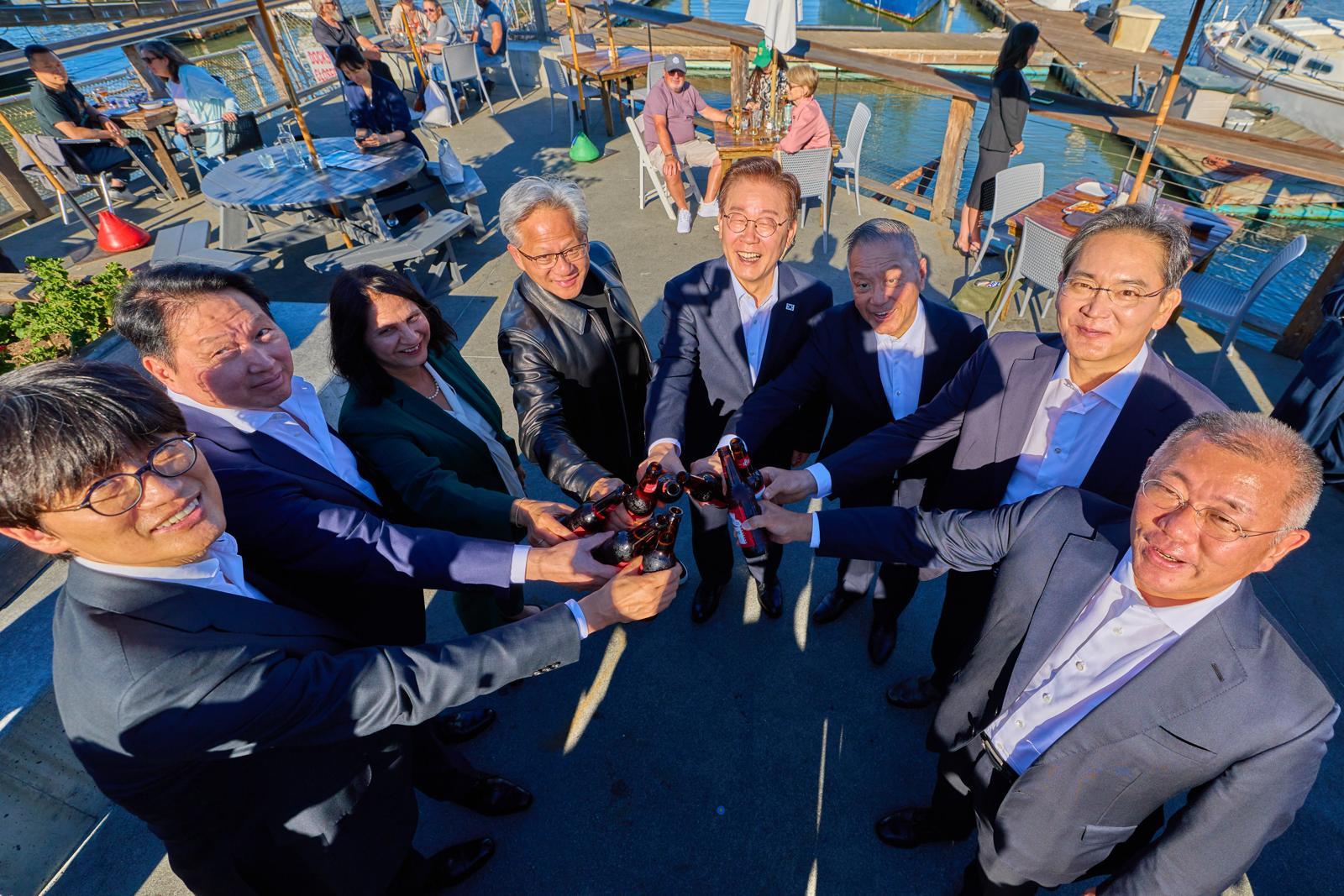
President Lee Jae-myung makes a toast with participants at a global AI leaders’ dinner held at The Ramp Restaurant in San Francisco, United States, on the 24th (local time). From left: Lee Hae-jin, Naver Executive Chairman of the Board; Chey Tae-won, SK Group Chairman; Rani Borkar, Microsoft President of Hardware; Jensen Huang, NVIDIA CEO; President Lee Jae-myung; Hock Tan, Broadcom CEO; Lee Jae-yong, Samsung Electronics Chairman; and Chung Eui-sun, Hyundai Motor Group Chairman. (Pool coverage) 2026.7.25 News1
Hyundai Motor Group also announced plans to procure 50,000 units of NVIDIA’s “Blackwell” graphics processing unit (GPU) for AI servers to build AI infrastructure including a robot application center and an AI technology center. The group additionally presented its “future blueprint,” stating that it will collaborate with Waymo, Alphabet’s autonomous driving subsidiary, to further advance autonomous driving technology, and establish a partnership with Google DeepMind to enhance humanoid robot technologies. Hyundai Motor Group Chairman Chung Eui-sun added, “Hyundai Motor Group’s physical AI vision is to realize ‘urban intelligence,’ in which entire urban infrastructure is organically connected, evolving from the intelligence of individual devices such as automobiles and robots.”
Global big tech companies such as NVIDIA and Microsoft are rushing to partner with South Korean firms because Korea has emerged as an irreplaceable country in the AI supply chain. Korea is not only the global leader in high-performance memory semiconductors, which are in severe shortage in AI deployments, but also holds a solid manufacturing portfolio spanning automobiles and energy, leaving global players with little choice but to cooperate with Korea to target the physical AI market. Seo Yong-gu, professor of business administration at Sookmyung Women’s University, said, “Among manufacturing countries worldwide, Korea is the only nation that both produces memory and encompasses the manufacturing sector as a whole,” adding, “In the past, meetings between heads of Korean conglomerates and global big tech CEOs were a signal that collaboration would take place; this time, the announcements have become somewhat more concrete.”
●
Diminished downturn cycles for K-semiconductors… accelerating Korea–U.S. ‘AI value chain alliance’ The industry in particular is focusing on the fact that the cooperation plan between Samsung and Broadcom spans a five-year period, evaluating that “long-term collaboration” has reorganized Korea’s semiconductor industry structure—historically plagued by chronic boom-and-bust “market cycles”—into a stable growth model centered on “long-term supply contracts.” In addition to initial infrastructure build-out demand, the expected continuous generation of regular replacement demand as chips deployed in future AI data centers become outdated is projected to establish semiconductors as a predictable “core cash cow.” As a result, analysts say that concerns over a “semiconductor peak-out” (decline after reaching a peak), which have been raised in domestic and overseas markets, will be largely alleviated.
SK Group Chairman Chey Tae-won, referring to his series of meetings with NVIDIA CEO Jensen Huang and Broadcom CEO Hock Tan at the AI Summit, stated on the day, “The figures announced today are by no means inflated but are grounded in reality.”
The strengthening of Korea–U.S. cooperation in the AI era and Korea’s role as a solid partner were also underscored once again. Samsung Electronics Chairman Lee Jae-yong said in his AI Summit address, “If the strengths of Korea and the United States are combined into one, we can innovate faster, grow larger, and solve more complex challenges,” emphasizing the establishment of a Korea–U.S. AI ecosystem.
ⓒ dongA.com. All rights reserved. Reproduction, redistribution, or use for AI training prohibited.
Popular News