“Beta battery” generates power without recharging… First demonstration by joint team including the Korea Electrotechnology Research Institute
Radiation-resistant silicon carbide is key… Expected use as a power source for space and deep-sea sensors
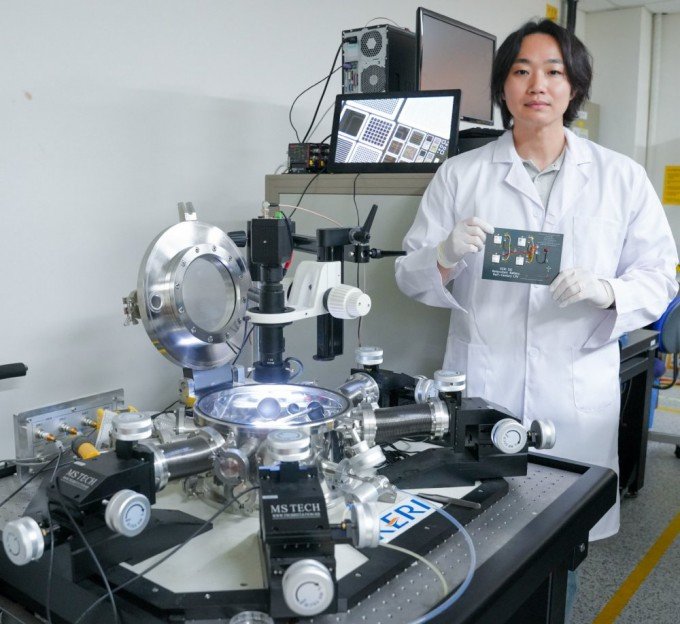
Beta battery demonstration equipment based on silicon carbide (SiC) semiconductors and Senior Researcher Seo Jae-hwa of the Next-Generation Semiconductor Research Center at the Korea Electrotechnology Research Institute (KERI). He is holding the first domestically developed and demonstrated beta battery prototype, which was directly manufactured by KERI. Provided by KERI.
A “beta battery” that can generate power for more than 50 years without recharging or replacement by using a radioactive isotope has been demonstrated for the first time in Korea. The technology is expected to be used to supply long-term power to remote sensors operating in extreme environments such as outer space, the deep sea, and polar regions, where sunlight does not reach and human access is difficult.
The Korea Electrotechnology Research Institute (KERI) announced on the 26th that the research team led by Senior Researcher Seo Jae-hwa of the Next-Generation Semiconductor Research Center, together with a team led by Professor Yoon Young-joon of Kyungpook National University, had fabricated a beta battery based on a silicon carbide (SiC) semiconductor and successfully verified its performance using actual radioactive material. The research results were published on 29 March in the International Journal of Energy Research.
A beta battery is a device in which a semiconductor absorbs “beta rays” – the flow of electrons emitted when radioactive material decays – and converts them into electricity. The principle is similar to that of a solar cell, which uses sunlight as an energy source. By using radioactive material, a beta battery can generate power regardless of weather or temperature even in environments where sunlight does not reach, such as outer space or the deep sea.
Existing beta battery technologies have low efficiency in collecting electrical energy. In addition, Korea lacks the infrastructure to safely handle radioactive materials and measure performance, making technology demonstration difficult.
The research team used silicon carbide, which offers better performance than conventional silicon in withstanding high temperatures and strong radiation, as the core material. They designed a semiconductor structure that maximizes power generation efficiency so that beta rays can efficiently generate charge.
For the actual radioactive technology demonstration, the team used nickel-63, a radioactive isotope that emits beta rays. Nickel-63 has a half-life of about 100 years, meaning its radiation intensity decreases very slowly.
The team secured nickel-63 that had passed safety standards and established the first dedicated beta battery measurement facility in Korea. When they tested whether actual power was produced, they found that about 160 μW (microwatts; 1 μW is one-millionth of a watt) of power was generated per 1 cm² of active area. This output performance is more than 60,000 times higher than previously reported experimental results in Korea.
The team also produced a prototype that used the generated power to light a low-power organic light-emitting diode (LED). They confirmed that under ideal conditions, in which the radioactive material is coated thinly, uniformly, and without gaps on the semiconductor surface, the power generated could be more than 4,200 times higher than the current domestic output target per basic cell.
Taking into account the half-life of nickel-63, the team explained that for devices with low power consumption, operations could continue for more than 50 years without battery replacement, and in theory the energy scale would allow operation for up to 100 years. They added that if the battery size is increased and integration processes stacking multiple cells are applied, output is expected to rise further.
The team also developed design optimization technology using artificial intelligence (AI). They built a model capable of predicting the output and voltage of the beta battery with an accuracy of 98–99%.
Durability tests were conducted under conditions simulating the space radiation environment. By quantifying the performance retention when 15 MeV (mega-electron-volt) high-energy protons were directly irradiated onto the device, the team obtained data for applying the technology to actual space missions. An electron volt is a unit of energy possessed by particles such as photons and electrons. A level of 15 MeV corresponds to an extreme environment akin to withstanding a “radiation downpour” that continuously bombards a spacecraft in outer space.
Senior Researcher Seo stated, “A beta battery is an ultra-long-life power source that can steadily supply small amounts of electricity for decades without maintenance in locations difficult for humans to access,” adding, “It will become a key power source that enables defense unmanned surveillance sensors and emergency beacons in space and the deep sea to operate autonomously for more than 50 years.”
ⓒ dongA.com. All rights reserved. Reproduction, redistribution, or use for AI training prohibited.
Popular News