Establishment of new “RX Business Promotion Office” in organizational reshuffle
Integration of dispersed hardware and product planning functions
“Physical AI is the key to future industries”… Full-scale entry into the global ‘robot industry’ power game
Seen as a signal for mass production and commercialization
Getty Images
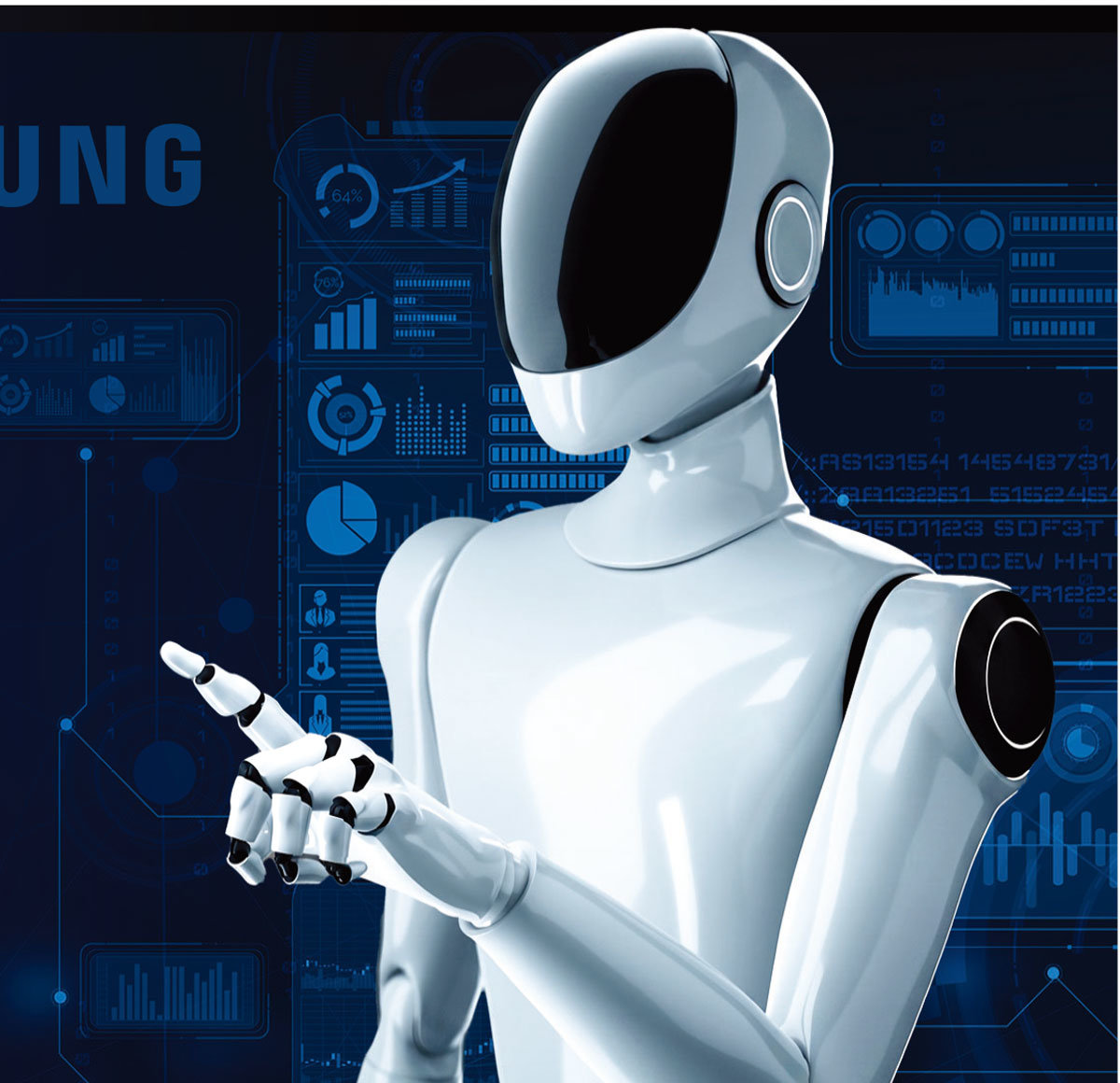
Samsung Electronics has established a dedicated control tower reporting directly to the CEO to foster its robotics business, which it views as a next-generation core growth engine.
On the 21st, Samsung Electronics announced an organizational restructuring that creates the “RX (Robotics eXperience) Business Promotion Office” under President Roh Tae-moon, CEO and Head of the Device eXperience (DX) Division. The intention is for the RX Business Promotion Office to integrate and drive all aspects of commercialization, including dispersed hardware as well as AI and software core technology development, mid- to long-term strategy formulation, and product planning.

This organizational change is interpreted as a signal that Samsung Electronics’ robotics business, which had so far focused on advanced research and infrastructure building, has entered a full-fledged “mass production and commercialization” phase. Samsung Electronics launched commercialization efforts in early 2021 with the “Robotics Commercialization Task Force (TF),” and in December of the same year elevated this TF to a permanent “Robotics Business Team.” In 2024, it acquired management control of Rainbow Robotics, a domestic collaborative robot company, and established the Future Robotics Task Force under the CEO to enhance its robotics technology competitiveness. The launch of the RX Business Promotion Office is seen as reflecting the company’s intention to pool the technologies and capabilities it has built over the past five years and introduce fully developed products to the market.
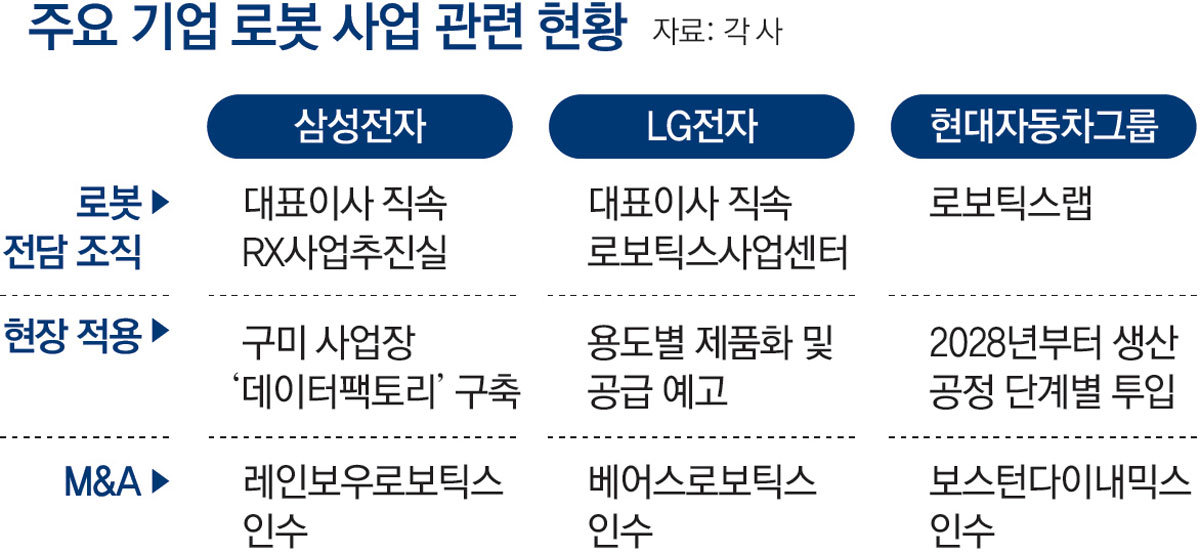
Samsung Electronics plans to use the Seoul R&D Campus in Seocho-gu, Seoul, as its base, and to accelerate on-site data collection and robot intelligence by building a “data factory” at its Gumi plant. It has also recruited a significant number of outside experts. These include Executive Vice President Lee Dong-gun, who led robotics business strategy at Hyundai Motor Group; Professor Kim Hyun-jin of the Department of Aerospace Engineering at Seoul National University, a leading scholar in intelligent autonomous systems; and Professor Kim Eui-kyeom of the Department of Mechanical Engineering at Ajou University, an authority in robotic hands, all of whom have joined to strengthen competitiveness.
Samsung Electronics plans to convert all of its factories into “AI autonomous factories” by 2030 and to preemptively deploy humanoid robots on production lines. Based on the data accumulated there, it aims to expand its business scope from B2B (corporate clients) to B2C (general consumers).
The reason Samsung Electronics is mobilizing company-wide capabilities for the robotics business is that “physical AI,” which combines artificial intelligence (AI) and robotics, is regarded as a key driver that will transform future industrial paradigms. It is cited as an essential condition for resolving labor shortages caused by demographic changes while maximizing production efficiency.
Beyond Samsung Electronics, major conglomerates such as Hyundai Motor Group and LG Electronics are also rushing to establish dedicated robotics organizations and expand investment, intensifying the race for dominance in the “robotics industry,” seen as a core future revenue source. LG Electronics implemented a one-point organizational restructuring effective July 1, creating the “Robotics Business Center” reporting directly to the CEO. Hyundai Motor Group is accelerating the convergence of mobility and robotics by pursuing the acquisition of the entire remaining 9.65% stake in Boston Dynamics held by SoftBank. It is transferring its advanced research unit “Robotics Lab” under the Advanced Vehicle Platform (AVP) Division to seek synergies in AI and autonomous driving technologies, while also beginning full-scale process verification by actually deploying the humanoid robot “Atlas” at its new plant (HMGMA) in Georgia, USA. The plan is to start with parts sequencing operations from 2028 to establish reliability, and then expand its work scope to high-difficulty parts assembly processes from 2030.
Hwangbo Je-min, Professor at the Department of Mechanical Engineering at KAIST, said, “Korean companies are proactively creating new organizations and investing in anticipation of the opening of a large-scale robotics market,” and added, “To commercialize humanoid robots, it will be necessary to further strengthen research and development (R&D) to supplement insufficient technological elements such as ‘robotic hands’ and ‘sensors.’”
ⓒ dongA.com. All rights reserved. Reproduction, redistribution, or use for AI training prohibited.
Popular News