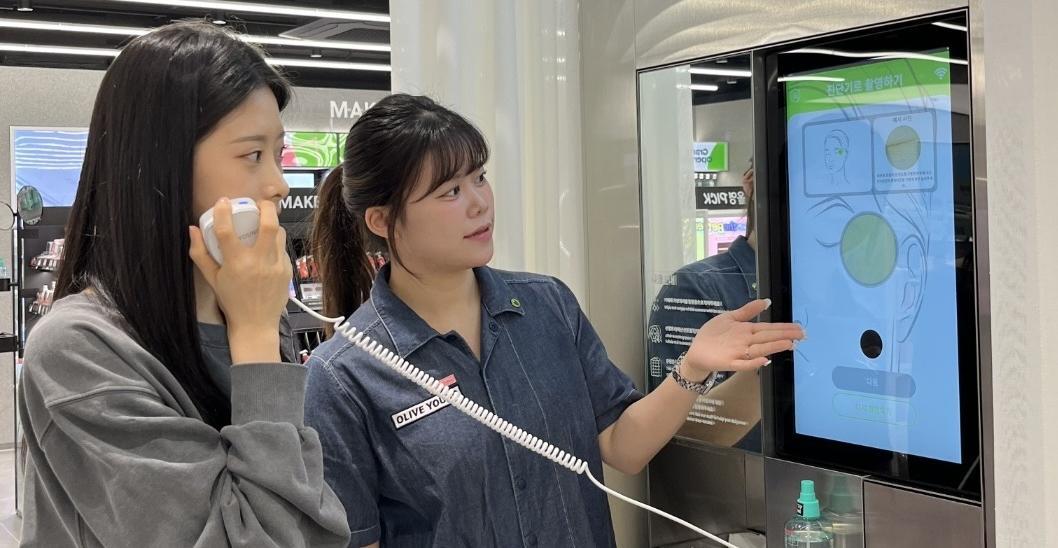
A visitor to a CJ Olive Young store uses the skin type analysis device “Skin Scan Pro.” This is an example of a “zero-click” service, in which artificial intelligence (AI) immediately recommends products suited to the consumer’s skin, eliminating the need for the consumer to compare products one by one. With the spread of zero-click, there are projections that consumers’ purchasing patterns will change significantly. Provided by CJ Olive Young
“Recommend a 2-night, 3-day trip to Jeju. Make the course suitable for a family of three with a child. Plan it around restaurants and cafés so that we can rest every two hours.”
The number of people using artificial intelligence (AI) to plan their trips is increasing. They ask for schedules tailored to personal preferences—such as restaurants in the morning and tourist attractions in the afternoon—and they use AI like a personal assistant to check travel routes and transportation. This is not limited to travel. AI’s influence is also steadily growing in everyday purchasing decisions, such as which insurance policy to take out or which air purifier to buy.
This shift shakes the foundations of corporate marketing. In the past, companies tried in every possible way to secure touchpoints so they would be prominently exposed in consumers’ “search” results. They operated trial user groups, distributed products for free, and managed user reviews. The more posts there were about a product, the greater the likelihood it would appear in search results. It was the era of “search optimization.”
By contrast, companies today are focused on how to ensure their products appear in answers when consumers pose questions to AI. For example, when a consumer requests, “Recommend a moisturizing cream suitable for someone with dry skin in humid weather,” the company’s product must be included among the five options AI presents. This is called “answer optimization.”
This trend, in which AI makes suggestions before consumers search for anything, and in which “clicks” for search are drastically reduced across digital life, is referred to as “zero-click.” How, then, can companies survive in the zero-click era?
First, they strive to be exposed to consumers even before a search is made. A representative example is exposure via social networking services (SNS). Many have had the experience of casually scrolling through Instagram and suddenly seeing a product that they previously showed interest in or searched for, quietly appear in the recommended feed. If a user recently searched for book-café-style furniture, the Instagram algorithm naturally exposes related products based on visual preferences and hashtags. By following the feed, the user suddenly finds themself on a purchase screen. Shopping begins without even consciously recognizing the need.
Second, they enhance search results by reflecting consumers’ situations and context. Food tech platforms such as Baedal Minjok and Yogiyo reduce the burden of decisions like “What should I eat?” by strengthening personalized push notifications. For example, when conditions such as “rainy Friday evening, near the office” overlap, AI automatically recognizes the situation and sends a notification. It might recommend a “udon restaurant frequently ordered from” and attach a discount coupon. The order sequence—starting with choosing a cuisine category—has been completely altered. Attractive menu suggestions have already arrived, and clicks happen far more easily and quickly.
Third, they induce consumers to explore directly on their own platforms rather than via AI. CJ Olive Young has introduced an AI-based skin analysis device called “Skin Scan Pro” in its stores. When the device measures factors such as skin moisture, pigmentation, and sensitivity, AI interprets the results and immediately proposes the most suitable product line. There is effectively no longer any need to compare and deliberate over products by brand. The purchase conversion rate among customers who used this service was 73%, significantly higher than the 53% for those who did not. Beauty select shop Chicor is also offering a similar service. Using an AI-based measurement device, it precisely analyzes scalp characteristics such as dryness, sensitivity, and sebum levels, and then manufactures customized shampoo and serum on the spot based on the results.
Lastly, in the zero-click era where companies must compete with AI search, the value of “information sources” increases further. This is because more consumers are asking AI to “show the basis for your claim” and demanding sources, rather than accepting AI’s answers as they are. As a result, AI also strives to reference expert opinions when providing answers. Accordingly, whether a company’s products and services appear in expert interviews, columns, and contributed articles can influence the perceived credibility of AI’s responses.
As the zero-click era arrives, it is time to ask the question again. In an age of “choice without choice” created by technology, how should companies respond, and how can they maintain their initiative? Companies that hold convincing answers to this question will be the ones that survive in marketing competition in the AI era.
ⓒ dongA.com. All rights reserved. Reproduction, redistribution, or use for AI training prohibited.
Popular News