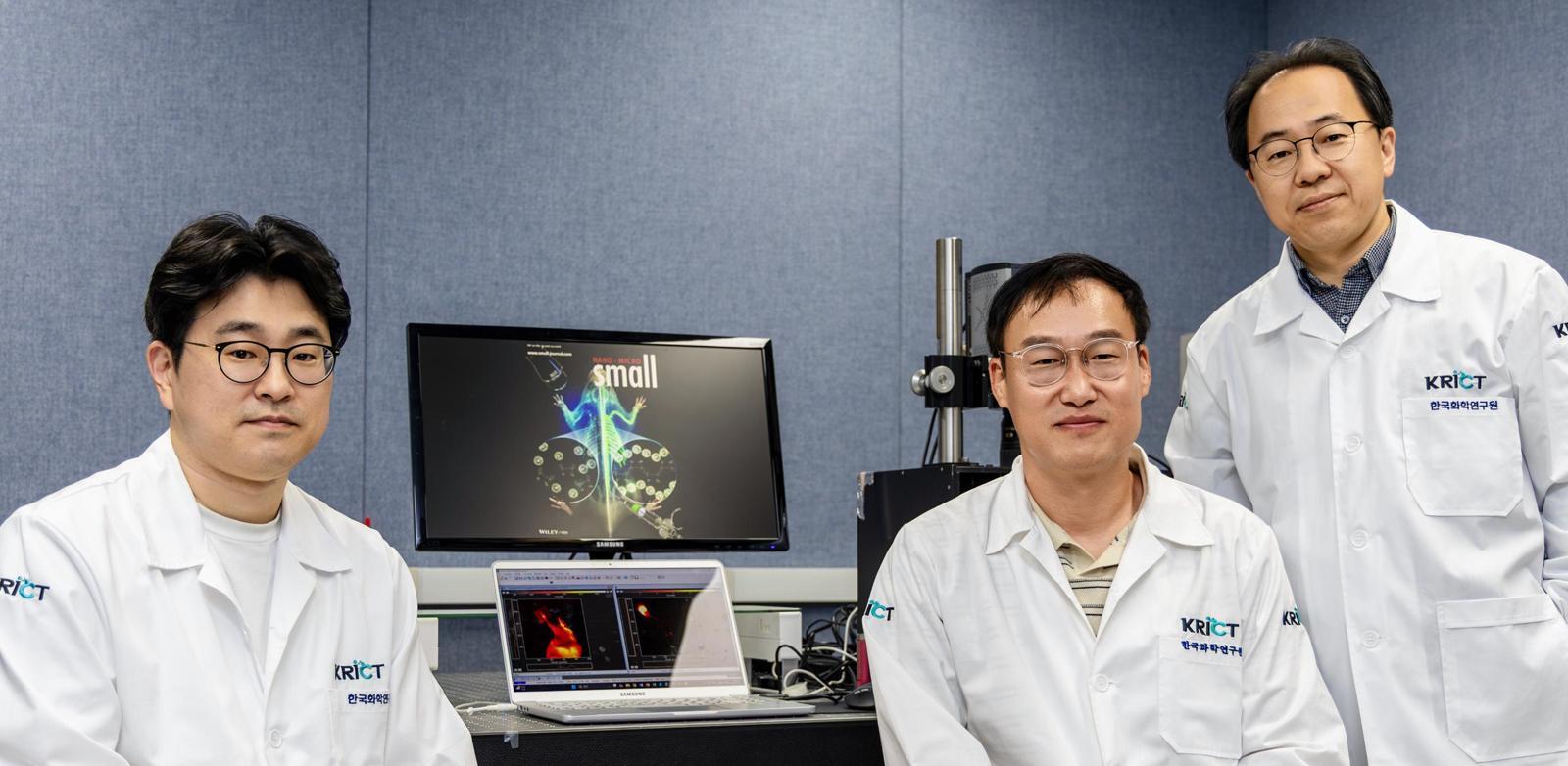
From right, KRICT’s Nam Sang-hwan principal researcher, Park Young-il principal researcher, and researcher Choi Min-seok. Provided by KRICT
Korea Research Institute of Chemical Technology (KRICT) announced on the 21st that it has developed a next-generation near-infrared fluorophore capable of maintaining fluorescent signals stably even during long surgical procedures. The research team led by Dr. Park Young-il and Dr. Nam Sang-hwan at KRICT, in collaboration with Prof. Park Sung-jin’s team at the Georgia Institute of Technology, redesigned the near-infrared fluorescent dye indocyanine green (ICG) into a polymer structure and developed a fluorophore with enhanced photostability.
Near-infrared (NIR) medical imaging is a technology used in diagnosis and precision surgery. Near-infrared light penetrates human tissue more deeply than visible light because it experiences relatively less loss due to absorption by water and hemoglobin in the body. When this property of near-infrared light is combined with fluorescent dyes, it enables imaging of biological tissues at depths of up to several centimeters.
ICG is a representative near-infrared fluorescent dye approved by the U.S. Food and Drug Administration (FDA). Since its FDA approval in 1959, it has been used for more than 60 years in a wide range of diagnostic and surgical applications, including sentinel lymph node mapping in breast cancer, hepatocellular carcinoma resection, and biliary tract visualization.
However, ICG can undergo “photobleaching,” in which its fluorescence rapidly fades when exposed to light for extended periods. As a result, imaging accuracy can decline during long surgeries. Attempts have been made to encapsulate ICG in microparticle capsules or nanostructures, but these approaches have limitations due to complex manufacturing processes and the risk of fluorescent material leaking out.
The KRICT research team addressed this issue by linking ICG molecules to polymer chains. By fixing the fluorescent moieties from both sides, they achieved prolonged fluorescence. Experimental results showed that the fluorophore developed by the team exhibited photostability more than four times higher than that of conventional ICG. The researchers plan to systematically demonstrate its safety and efficacy through preclinical studies, including toxicity assessment and pharmacokinetic research. Dr. Park said, “It is significant that polymerizing ICG molecules has succeeded in slowing the rate at which the chromophore is destroyed by light,” adding, “There is also potential for expansion into various next-generation fluorescent diagnostic materials, including anti-counterfeiting and security applications.”
Lee Jeong-hoon
AI-translated with ChatGPT. Provided as is; original Korean text prevails.
ⓒ dongA.com. All rights reserved. Reproduction, redistribution, or use for AI training prohibited.