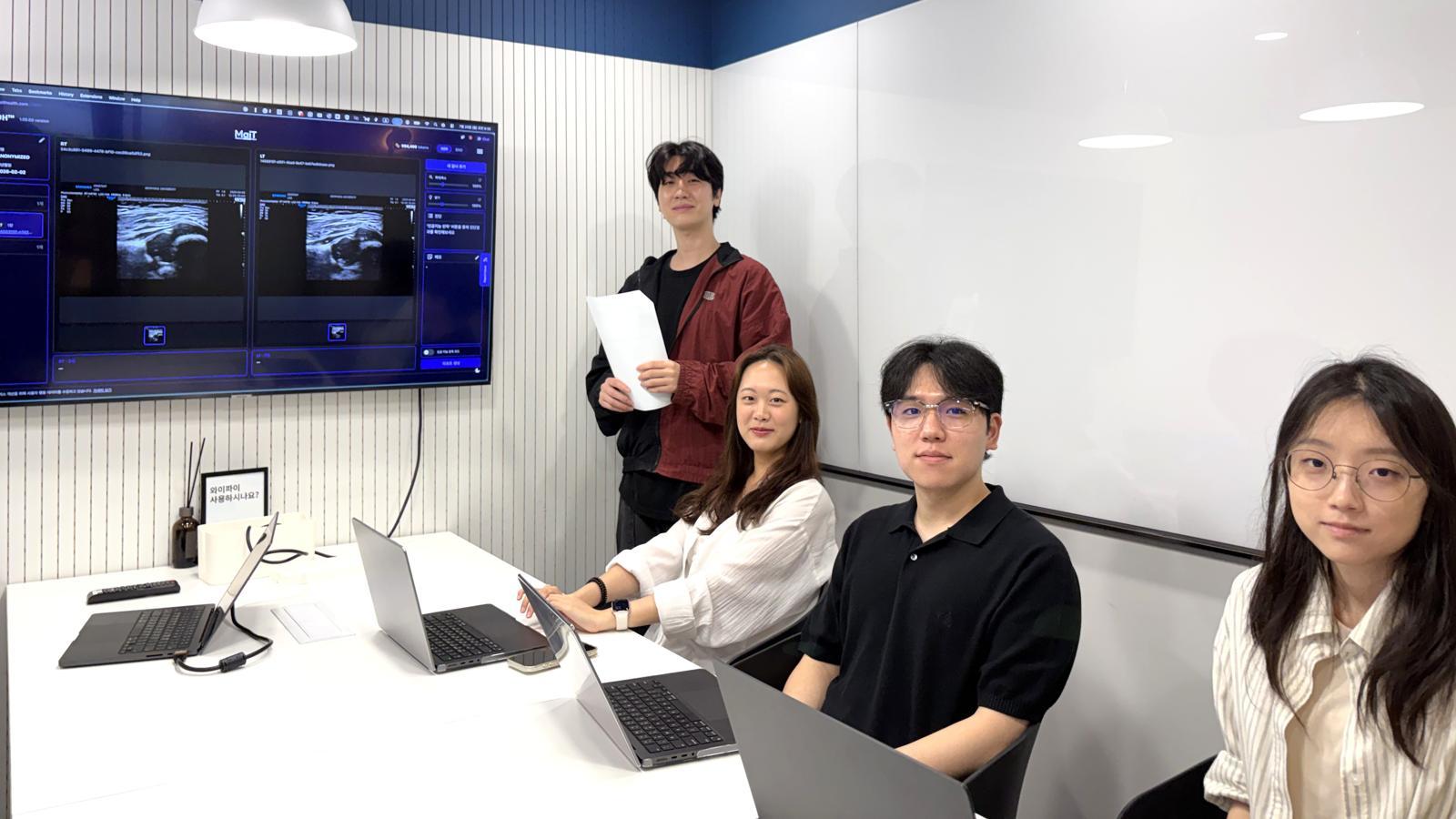
Staff members at the corporate research institute of MaiT in Seocho-gu, Seoul, on the 21st. Courtesy of MaiT
There are not few cases in which children with congenital hip disorders miss the optimal timing for treatment because it is difficult to see a specialist. There are only about 10 pediatric orthopedic specialists in university hospitals nationwide. If detected early, the condition can be treated relatively simply, but if diagnosis is delayed, surgery may be required and it can lead to gait disorders and chronic pain.
Medical artificial intelligence (AI) startup MaiT, based in Daegu, was launched to address such structural problems in the medical field. The company name is an abbreviation of “Medical AI Team.” It reflects the founding philosophy of bringing together experts in medical AI to develop technology that assists clinicians in diagnosis. The goal is to supplement the shortage of specialists and standardize diagnostic results that can vary by clinician, thereby providing a consistent level of medical service regardless of region or hospital size.
Founded in 2022, MaiT develops AI diagnostic support software that analyzes musculoskeletal disorders. Starting with developmental dysplasia of the hip (DDH) in infants and young children, the company is expanding its product lineup to include flatfoot, hallux valgus, bowlegs (O-shaped leg deformity), knock-knees (X-shaped leg deformity), and analysis of leg length and alignment.
The area the company first focused on is hip disorders in infants and young children. For these conditions, the position and angles of bones and joints must be measured precisely on ultrasound images. There are few experienced specialists, and results can vary depending on imaging conditions and the reader’s level of experience.
MaiT’s AI automatically detects and marks the bones and regions needed for diagnosis on ultrasound or X-ray images. It then calculates key metrics such as hip angles and leg alignment and even generates a diagnostic report. Medical staff review the AI-analyzed results and make the final judgment. Rather than replacing physicians, the system reduces repetitive measurement and analysis tasks to support clinical practice.
The solution also improves diagnostic speed and consistency. The AI sensitivity of the infant hip diagnostic solution is 97.2%. Image analysis that previously took 15 to 30 minutes can be completed within one minute, and the actual AI computation takes about one second. It runs on standard computers without expensive graphics processing units (GPUs), reducing the adoption burden for small and mid-sized hospitals and regional medical institutions.
By cutting the time clinicians spend on reading images and taking measurements, more patients can be treated. In particular, at regional medical institutions without pediatric orthopedic specialists, AI analysis results can be used as reference material for clinical decision-making. The company expects this to help protect the golden time for diagnosis that could otherwise be missed due to specialist shortages and long waiting times.
Another strength of MaiT is its medical data. In collaboration with 16 major hospitals in Korea, the company has secured more than 6 million medical images from over 20,000 patients. In addition to infant hip ultrasound and X-ray images, MaiT is accumulating data on foot disorders, lower limb alignment, and gait to improve AI performance. Specialists cross-validate the data to manage the reliability of analysis results.
This technology is already entering real-world clinical settings. By integrating its software into Samsung Medison ultrasound equipment, the company has conducted application trials on patients at Keimyung University Dongsan Hospital. It is working with DK Medical Systems to install the solution on X-ray equipment and is also collaborating with Infinitt Healthcare and Techheim to expand its hospital supply network. Since 2024, the company has been participating for two consecutive years in the global venture startup incubation program of the Daegu Center for Creative Economy & Innovation.
The company is also preparing to enter overseas markets. It is pursuing U.S. Food and Drug Administration (FDA) clearance and European medical device certification (CE-MDR). It plans to soon launch joint research and clinical validation projects with medical institutions in Southeast Asia, including Singapore. MaiT is also working with Rady Children’s Hospital in San Diego, United States, to broaden its global clinical base.
Kim Young-hwan, head of the Strategy Team, said, “Treatment outcomes for musculoskeletal disorders can vary greatly depending on the timing of diagnosis and the experience of the medical staff,” and added, “By standardizing the diagnostic process through AI and reducing the burden on clinicians, we will help create an environment in which patients can receive quality care regardless of region or the size of the medical institution.”
ⓒ dongA.com. All rights reserved. Reproduction, redistribution, or use for AI training prohibited.
Popular News