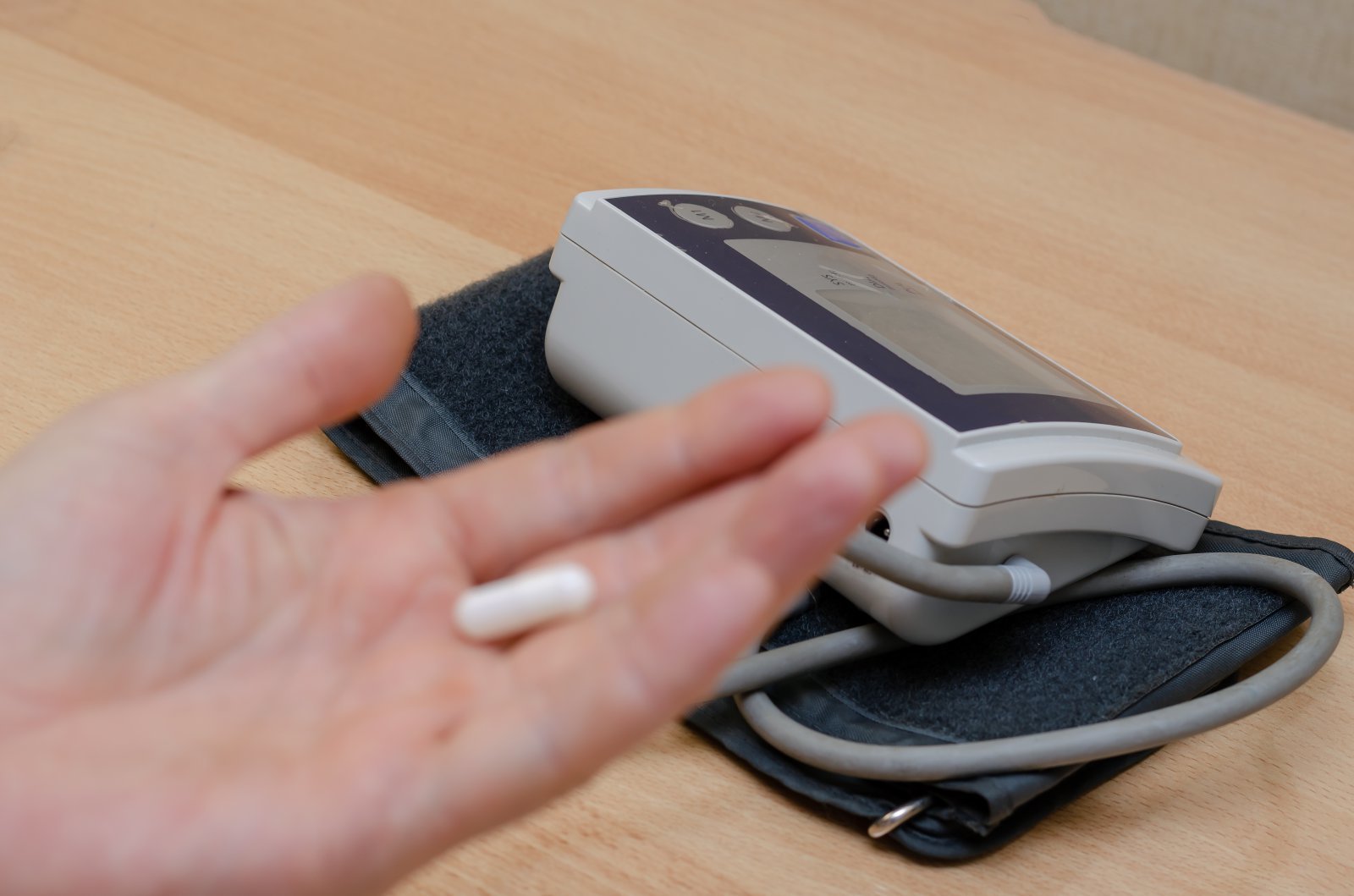
Antihypertensive medications and a blood pressure monitor used for hypertension treatment. A domestic research team has confirmed the efficacy and safety of an ultra–low-dose triple combination therapy. Getty Images Bank
A domestic research team has become the first in the world to demonstrate through a phase 3 clinical trial that a single pill combining three antihypertensive drugs at ultra–low doses delivers superior blood pressure control compared to conventional monotherapy. By reducing the burden of taking multiple medications while securing both efficacy and safety, the study suggests the potential for a shift in hypertension treatment practices.
On the 15th, a research team led by Professor Sung Keechul of the Division of Cardiology at Kangbuk Samsung Hospital and Professor Lee Mooyong of the Division of Cardiology at Dongguk University Ilsan Hospital announced that they had confirmed the efficacy of a single-pill combination therapy in which amlodipine, losartan, and chlorthalidone are combined at ultra–low doses.
Hypertension affects approximately one in three adults in Korea, but it is regarded as a disease with low treatment persistence due to the burden of having to take multiple drugs over a long period. To address this limitation, the research team reduced the dose of each of the three drugs to about one-third of the standard dose and formulated them into a single pill.
The team then conducted an 8-week phase 3 clinical trial at more than 20 hospitals nationwide involving patients with mild to moderate hypertension whose systolic blood pressure ranged from 140 to 180 mmHg.
The results showed that the ultra–low-dose triple combination therapy produced a significantly superior blood pressure–lowering effect compared with standard-dose losartan monotherapy, one of the most widely used antihypertensive agents. Its efficacy was similar to that of amlodipine monotherapy, another standard treatment.
● Why hypertension treatment is shifting to “combination therapy”This study has drawn attention because it suggests the possibility of simultaneously improving both “efficacy” and “treatment burden,” long-standing challenges in hypertension management.
In the field of hypertension treatment, there has recently been increasing focus on a combination therapy strategy that uses drugs from multiple classes from the outset. This approach can lower blood pressure more rapidly while reducing drug doses and therefore the risk of adverse effects. In fact, domestic and international clinical practice guidelines are gradually shifting toward recommending combination therapy over monotherapy for some patient groups.
Antihypertensive drugs lower blood pressure through different mechanisms: dilating blood vessels, inhibiting hormones that raise blood pressure, or increasing the excretion of sodium and water from the body. The combination therapy in this study applied a strategy of combining small doses of drugs with different mechanisms to maintain efficacy while reducing the risk of side effects.
The research team also reported favorable findings regarding safety. Fewer than 1% of patients experienced serious adverse events after drug administration, and no cases were reported of leg edema and other adverse reactions that relatively commonly occur with calcium channel blockers.
The study is also significant in that it indicates that combining small doses of multiple drug classes, rather than simply increasing the number or dose of drugs, can potentially enhance both efficacy and convenience of administration.
Professor Sung stated, “This is the first phase 3 clinical trial to demonstrate that a triple combination of ultra–low-dose components can be used safely while providing superior efficacy compared with existing standard monotherapy,” adding, “It is expected to improve medication convenience and help raise the currently stagnant hypertension control rate.”
However, as this study was conducted over 8 weeks, it remains to be seen whether the same efficacy and safety will be maintained over several years of real-world use in patients.
The findings have been published in the latest issue of the Journal of the American College of Cardiology (JACC; IF 22.3), one of the most prestigious journals in the field of cardiology.
Related paperhttps://doi.org/10.1016/j.jacc.2025.12.028
ⓒ dongA.com. All rights reserved. Reproduction, redistribution, or use for AI training prohibited.
Popular News