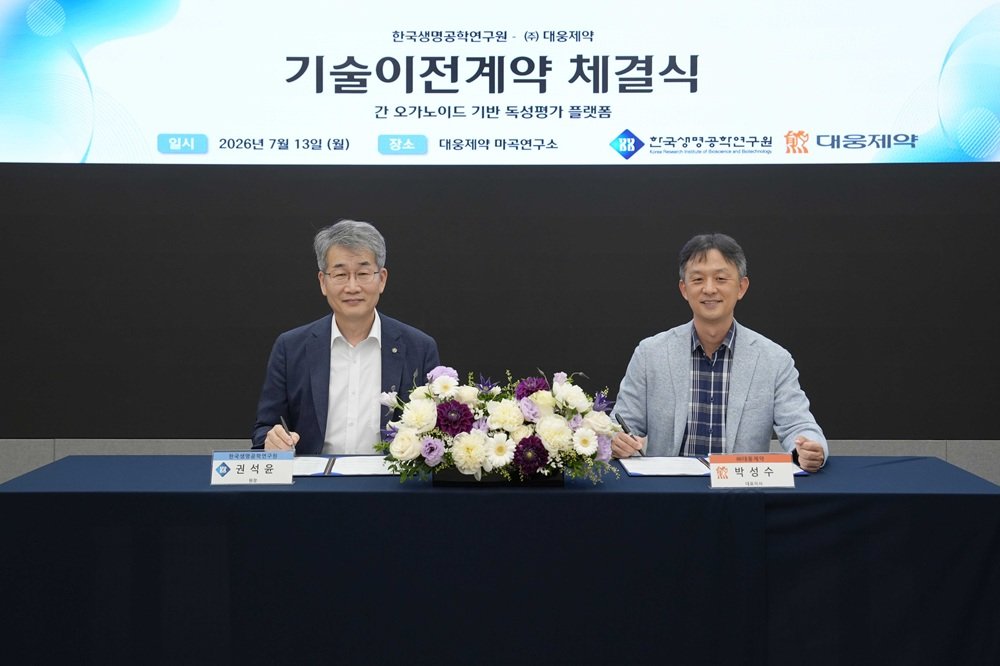
Kwon Seok-yoon, President of the Korea Research Institute of Bioscience and Biotechnology (left), and Park Sung-soo, CEO of Daewoong Pharmaceutical, pose for a commemorative photo after signing a technology transfer agreement for liver organoid production and drug evaluation at the Magok Research Center. Provided by Daewoong Pharmaceutical
Daewoong Pharmaceutical announced on the 15th that it has signed a technology transfer agreement with the Korea Research Institute of Bioscience and Biotechnology (KRIBB) to introduce “liver organoid production and drug evaluation technology.”
Liver organoids are organ-like models that partially reproduce the structure and function of the human liver by three-dimensionally culturing stem cells and other cells. They are used to evaluate liver toxicity and drug responses of new drug candidates.
The technology introduced by Daewoong Pharmaceutical is the “3D human liver organoid production and toxicity evaluation platform” developed by the research team of Dr. Myung-Jin Son at KRIBB.
In the conventional drug development process, toxicity has been evaluated using two-dimensional liver cells cultured on flat surfaces or animal models. However, there have been criticisms that, because their structure and function differ from those of the actual human liver, they have limitations in accurately predicting toxicity that appears in clinical stages.
The liver organoids developed by KRIBB are characterized by reproducing not only human liver tissue but also the intrahepatic bile duct structure through which bile acids move. This allows simultaneous observation of the effects of candidate substances on both hepatocytes and bile ducts, according to the explanation.
They can be cultured over long periods and repeatedly expanded, and their functions are maintained even after freezing and thawing, enabling use in mass production and repeated testing.
This technology has been adopted as a project for developing test guidelines by the Organisation for Economic Co-operation and Development (OECD) and as a new international standard project by the International Organization for Standardization (ISO), and is currently undergoing expert review procedures. Once these procedures are completed, it may be used as a toxicity evaluation standard utilizing liver organoids.
Daewoong Pharmaceutical plans to apply this technology to non-clinical liver toxicity evaluation of new drug candidates. The aim is to screen out substances with a high likelihood of toxicity before entering clinical trials, thereby reducing the risk and cost of development failure.
It also seeks to respond to the global trend, led by the U.S. Food and Drug Administration (FDA) and other regulatory authorities, to reduce reliance on animal testing and expand the introduction of alternative test methods using cells and organoids.
Park Sung-soo, CEO of Daewoong Pharmaceutical, said, “We have secured a research platform capable of precise evaluation of new drug candidates,” adding, “We will apply liver organoid technology to actual drug development processes to enhance research efficiency.”
Kwon Seok-yoon, President of the Korea Research Institute of Bioscience and Biotechnology, said, “Organ-mimicking technologies developed by public research institutes can now be used in new drug development in industry,” and added, “We will continue follow-up research and further advance the technology.”
ⓒ dongA.com. All rights reserved. Reproduction, redistribution, or use for AI training prohibited.
Popular News