Developing a diagnostic model at Eunpyeong St. Mary’s Hospital
Detecting pneumoperitoneum on abdominal CT images
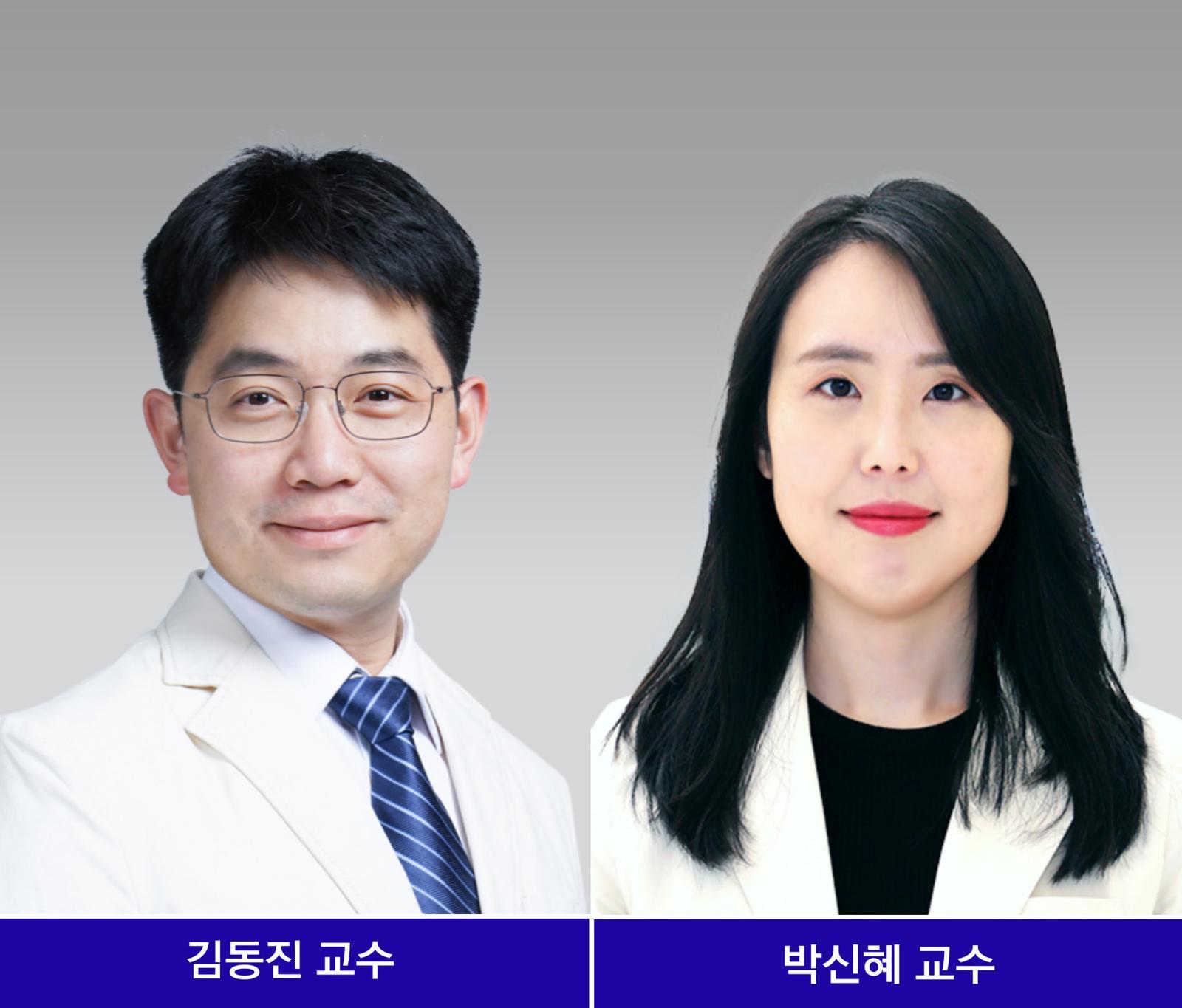
Professors Kim Dong-jin and Park Shin-hye.
Gastrointestinal perforation, in which a hole forms in the gastrointestinal tract, is a representative surgical emergency that requires prompt surgery. However, the key imaging finding of perforation, “free air,” is often present only in a small amount or concealed around the liver, leading to a significant number of missed cases even in emergency departments. A domestic research team has developed an artificial intelligence (AI) diagnostic support model that automatically detects free air on abdominal computed tomography (CT) images, which is expected to improve the accuracy of emergency care.
Eunpyeong St. Mary’s Hospital announced that a research team led by Professor Kim Dong-jin of the Department of Surgery (Professor Park Shin-hye, Researcher Kim Sang-wook of the University of Toronto, Researcher Lee Joong-hyup, and Professor Ha Ye-min of Bucheon St. Mary’s Hospital) has developed an AI model that automatically detects free air, the key finding of gastrointestinal perforation, on abdominal CT. The study results were published in the international surgical journal “International Journal of Surgery.”
Gastrointestinal perforation is a condition in which ulcers of the stomach or duodenum, or inflammation, progress and create a hole in the organ. Although medical advances have reduced its incidence, the mortality rate and risk of complications remain high, making early diagnosis and rapid decision-making regarding emergency surgery crucial. When perforation occurs, air inside the gastrointestinal tract leaks into the peritoneal cavity, creating free air, which is regarded as the most important CT imaging finding suggesting perforation. However, minute free air is difficult to detect, and diagnosis in emergency departments has been limited by dependence on the experience and skill of medical staff.
The research team developed an AI model called “FA-NET (Free Air Net)” that automatically segments free air regions by training it on CT images from 127 patients who underwent surgery for gastric ulcer perforation between April 2019 and April 2022. They then further trained the model with CT images from 76 patients with appendicitis, a condition whose imaging findings can resemble free air and cause confusion, and applied a “negative training” technique to reduce false positives, thereby completing an advanced model named “FA-NET-NT.”
FA-NET-NT achieved a Dice score of 0.87 for accuracy, and in image-level analysis it showed a sensitivity of 85% and a specificity of 96%. In subsequent validation on 215 new patients, it detected gastric ulcer perforation with a sensitivity of 95–96% and distinguished it from other diseases such as appendicitis, pancreatitis, and cholecystitis with a specificity of 82–92%.
To assess its feasibility for real-world clinical application, the research team also conducted a multicenter validation involving 237 patients at external hospitals with different CT equipment manufacturers and imaging protocols. As a result, the sensitivity for gastric ulcer perforation remained at 95%, and the model showed high specificity for other conditions, including appendicitis (88%), pancreatitis (88%), cholecystitis (82%), and intestinal obstruction (80%), confirming stable performance across diverse medical environments.
Professor Kim stated, “The aim of this AI model is not to replace clinical judgment, but to serve as a ‘second set of eyes’ that double-checks free air findings that are easily missed in emergency situations,” adding, “It is expected to help emergency departments, especially at night or on holidays when specialist staffing is limited, make rapid decisions on whether surgery is necessary.” He continued, “Follow-up studies are planned, including multicenter prospective clinical trials and comparative studies with radiology specialists, to enable application in actual clinical practice.”
Meanwhile, Professors Kim and Park received the Best Oral Presentation Award at the 2024 annual international conference of the Korean Society of Gastrointestinal Surgery for this study, and in 2025 they again received the Best Oral Presentation Award from the same society for their research on robot-assisted minimally invasive esophagectomy.
ⓒ dongA.com. All rights reserved. Reproduction, redistribution, or use for AI training prohibited.
Popular News