Biometric vision AI scans and maps in 0.1 seconds, enabling chest incision and body bisection procedures
Vision AI–based robotic grippers that detect crop ripeness and harvest automatically
To debut at “AFPRO 2026,” opening on the 15th
“After reading an article reporting that slaughterhouse workers were quarantined en masse due to COVID-19, causing damage amounting to several KRW hundred billion because work came to a halt, it became clear that slaughter automation was absolutely necessary.”
In an interview with this newspaper on the 10th, Park Jae-hyun, CEO of ROBOS, a biometric vision artificial intelligence (AI) robotics company, described in these terms what led him to embark on developing slaughter automation robots during his tenure at Hyundai Robotics. What he focused on was the fact that slaughtering is a process that relies solely on human hands and skilled intuition.
● AI identifies biometric coordinates that are hard to standardize
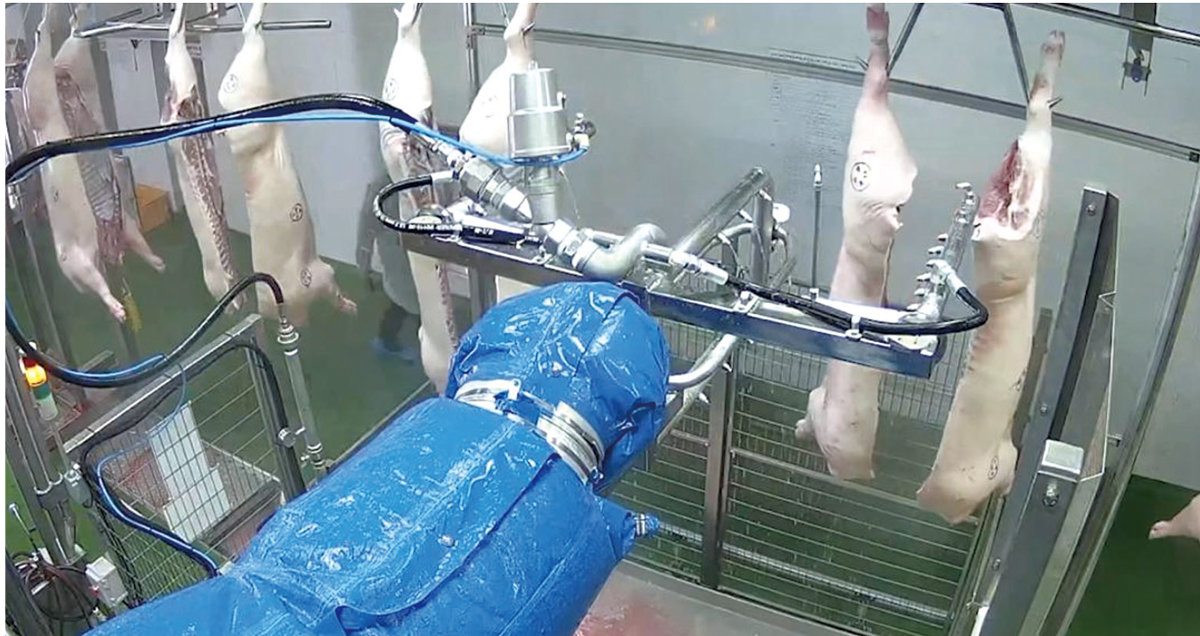
ROBOS’s biometric vision AI robot carries out the washing process during pig slaughter. Provided by ROBOS
ROBOS’s slaughter robot operates by scanning the carcasses of pigs and cattle with LiDAR (Light Detection and Ranging, a sensor that detects object shapes by measuring the time it takes reflected light to return), creating 3D stereoscopic images, designating cutting coordinates, and then bisecting them with a robotic knife.
The most difficult task in this process is designating the coordinates. Unlike automobile or home appliance assembly, each cow and pig differs in size and shape, and postmortem rigidity can cause spinal distortion and other deformations, making it impossible to specify coordinates based on standardized rules alone.
In response, ROBOS developed a non-standard biometric recognition AI trained on 250,000 data points such as the positions of pig bones and muscles, enabling real-time tracking of anatomical locations. The time required from shape scanning to cutting coordinate calculation is about 0.1 seconds. The robot moves in sync with the carcass, which moves slowly along the conveyor, and performs slaughtering rapidly.
ROBOS is also developing a dual-arm humanoid robot for more delicate operations such as evisceration and deboning. This robot likewise uses ROBOS’s non-standard biometric recognition AI to identify the size and shape of the carcass, then grips and pulls the target to carry out its work.
● Advanced AI technology showcased at AFPRO 2026 AX Special Exhibition
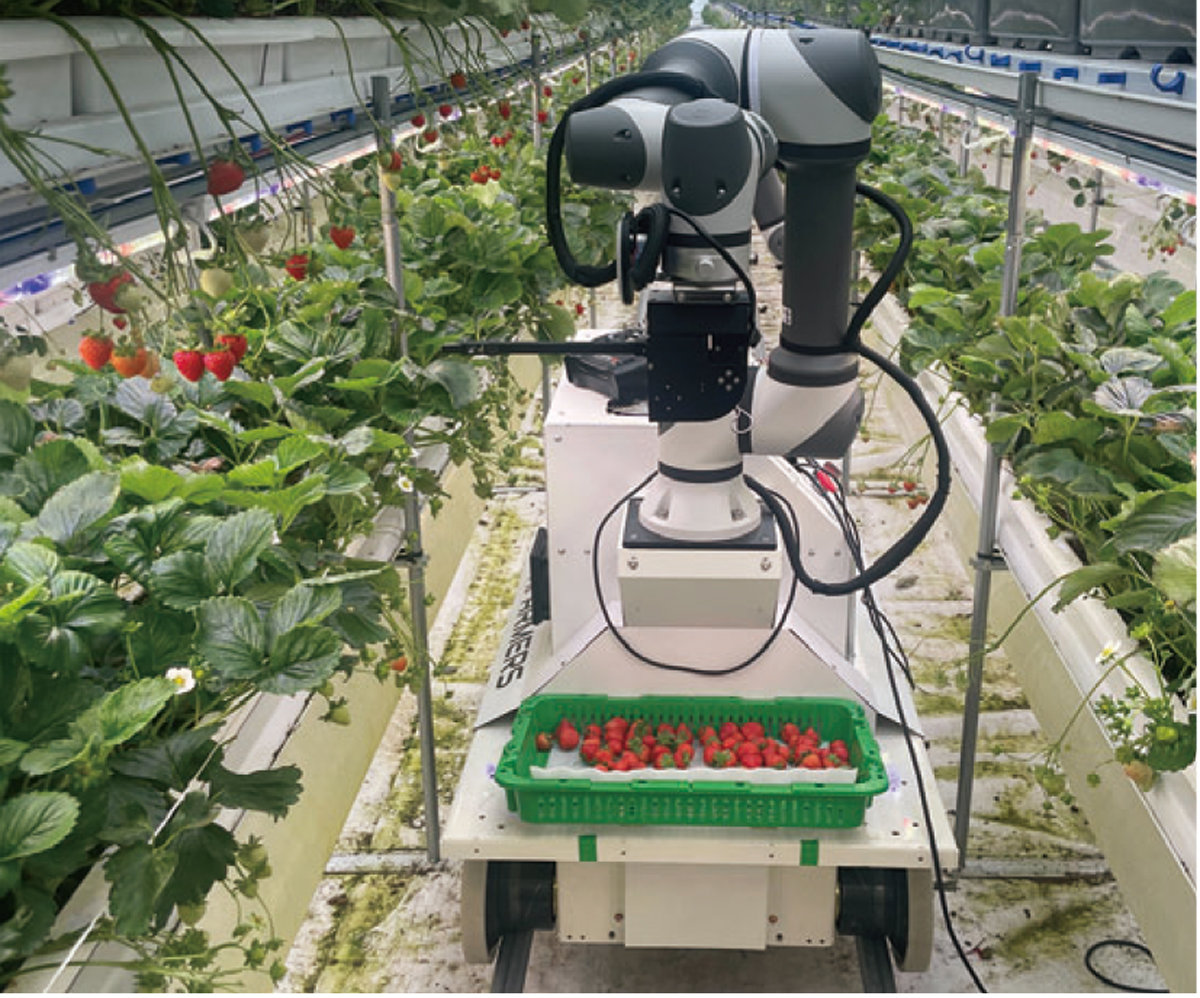
MetaFarmers’ harvesting robot “Omni Farmer” picks ripe strawberries. Provided by MetaFarmers
ROBOS’s humanoid robot will be unveiled for the first time at the “2026 Agrifood Tech Startup Fair (AFPRO 2026),” which will be held for three days from the 15th at Hall C of COEX in Gangnam District, Seoul. Now in its fourth year, AFPRO is the largest agrifood startup fair in Korea, with more than 200 innovative startups participating in fields such as AgTech (Agricultural Technology), FoodTech, and Green Bio that will lead the future agrifood industry.
In particular, this year features a newly established “AX (AI Transformation) Special Exhibition,” themed “The Future of Agrifood Technology Expanding through Physical AI.” This pavilion will exhibit AI products from 25 companies selected for the “Rapid Commercialization Support Project for AI Applied Products in the Agrifood Sector,” including not only ROBOS but also AO Farm, which uses AI vision to automatically sort agricultural products.
MetaFarmers’ general-purpose dual-arm robot, which harvests ripe strawberries and tomatoes, is also one of the main exhibits at the event. MetaFarmers, spun off in 2022 from a laboratory of the Department of Mechanical Engineering at Seoul National University, implemented an automated harvesting system by combining AI vision with a gripper (the robotic hand component that grasps objects). Named “Omni Farmer,” this robot uses an AI-based vision recognition system to determine crop maturity and perform harvesting at the optimal time, and it is equipped with functions to autonomously monitor and report on crop growth conditions and pest and disease occurrence.
The Ministry of Agriculture, Food and Rural Affairs, which is hosting the event, stated, “This year’s fair marks the opening of the era of ‘Physical AI,’ in which robots and AI are actually deployed in agricultural and livestock production sites,” adding, “We will actively support commercialization and market development so that innovative companies that address chronic labor shortages and productivity issues in the field through technology can grow.”
At AFPRO 2026, a variety of programs will be held, including a business briefing session for global accelerators, a seminar on strategies for entering emerging markets co-hosted with the United Nations Industrial Development Organization, a youth talk concert on agrifood venture startups, and one-on-one consultations with experts in various fields.
ⓒ dongA.com. All rights reserved. Reproduction, redistribution, or use for AI training prohibited.
Popular News