[Toward a 100-Year Company] Leospace Co., Ltd.
Developing Optical Payloads and Optical Communication Terminals
Aiming for In-Orbit Demonstration by 2029
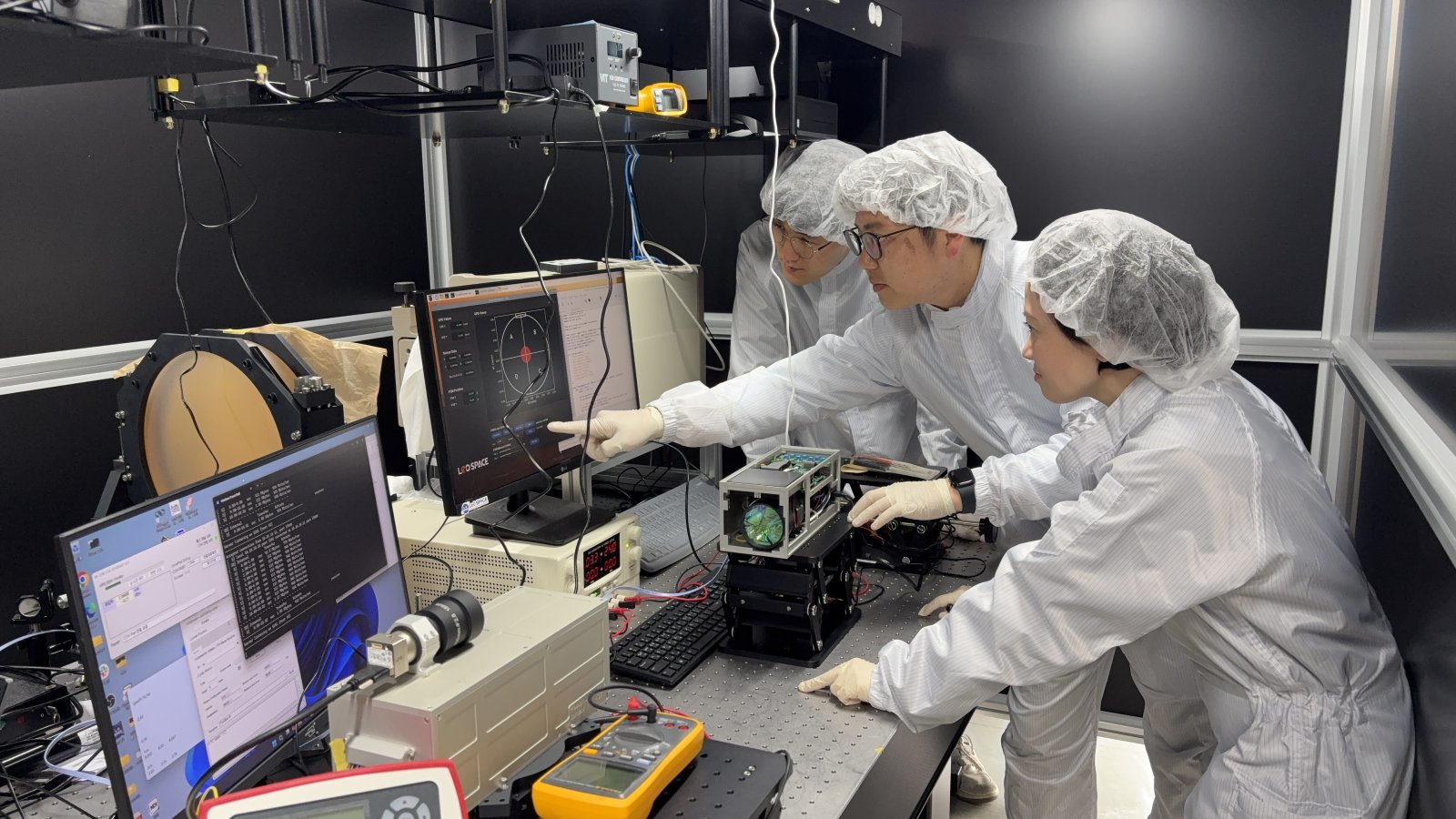
Leo Space Co., Ltd. experiment photo. Courtesy of Leo Space
The center of gravity in the space industry is shifting. The era when competitiveness was defined by how many satellites could be launched is ending; the decisive factor now is how precisely data can be generated in space and how quickly it can be connected.
As the landscape transitions from satellite manufacturing to the space data industry, the core technologies responsible for “what the satellite sees” and “how that data is connected” have emerged as new opportunities. Leo Space Co., Ltd. is a domestic space optics startup that is simultaneously targeting both of these areas.
Not import substitution but “technology sovereignty”… Localization of space opticsLeo Space develops both optical payloads for ultra-small and small satellites and laser optical communication terminals for space. If satellite cameras are the “eyes” that observe the Earth, laser optical communications are the “neural network” that connects the data quickly and securely. The company’s strength lies not in single components but in its end-to-end integrated capability to design, manufacture, and precisely align optical systems and to verify them under harsh space conditions (launch vibration, cryogenic temperatures, space radiation).
The National Aeronautics and Space Administration (NASA) evaluates laser optical communication as a next-generation space communication technology capable of transmitting 10 to 100 times more data than existing RF (radio frequency) communications. The competitiveness of ultra-small satellites hinges on securing both precision optical payload technology that implements the resolution, multispectral performance, and swath of electro-optical/infrared (EO/IR) cameras, and optical communication terminal technology that efficiently transmits high-volume data. This is why Leo Space CEO Lee Hyeong-kwon emphasizes the localization of these two core technologies.
He said, “Localization is not simply import substitution; it is a matter of technology sovereignty and mission sovereignty.” If the eyes and neural network depend on foreign countries, then even if satellites are available, their core missions are subject to export controls and international political conditions. Leo Space has collaborated with institutions such as the Korea Astronomy and Space Science Institute (KASI) and the Electronics and Telecommunications Research Institute (ETRI), and is currently leading the development of the optical payload for Jinju City’s ultra-small satellite “JinjuSAT-2,” building up in-orbit demonstration experience.
Expansion of the global satellite communication market and growth opportunities for Korea’s space industryThe market is expanding rapidly. The World Economic Forum (WEF) and McKinsey project that the global space economy will grow from USD 630 billion (approximately KRW 949 trillion) in 2023 to USD 1.8 trillion (approximately KRW 2,711 trillion) in 2035. The satellite payload market alone is expected to jump from USD 6.3 billion (approximately KRW 9.4915 trillion) in 2025 to USD 11.7 billion (KRW 17.6272 trillion) in 2030, while the Earth observation satellite market is forecast to roughly double.
In particular, the optical/laser satellite communication market is expected to grow by 20.4% annually. In an era when constellations of satellites are launched in bulk, as with Starlink, inter-satellite communication has become essential, and as the Russia–Ukraine war has demonstrated the strategic value of satellite communication networks, demand from late-developing spacefaring nations is also increasing rapidly.
In Korea, the base is broadening as well: the number of institutions participating in aerospace activities rose to 927 in 2024, and the value of activities in the space sector reached around KRW 4.4 trillion. Leo Space aims to first build reliability and a track record of demonstrations through domestic demand, then step onto global supply chains.
Lee said, “We are not a component company; we are a company that resolves the two technological bottlenecks of the space data economy—creating data and transmitting data.”
KRW 50 billion revenue by 2030… Aiming for a 100-year company through “flight heritage”The company’s goals for the next 5–10 years are clear: to become Korea’s leading space optics and optical communication company and to enter the global supply chain. If ongoing projects—such as seawater observation along the southern coast, freshwater management, and lunar orbit communication satellites—proceed as planned, the company is eyeing revenue of more than KRW 50 billion by 2030. The foundation is capital.
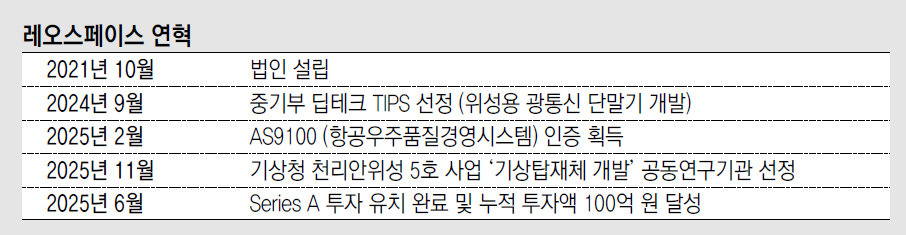
Last month, the company raised KRW 8 billion in Series A funding, bringing cumulative investment to KRW 10 billion, including strategic investments from Contec and AP Satellite. This has been achieved in just over four years since its founding. The funds will be used to shorten the timeframe for in-space demonstration of its laser optical communication terminals and to enhance its payloads. The workforce will expand from 23 to around 30 by year-end, and the company plans to establish its own manufacturing facilities within the year.
The structure in which Leo Space is responsible for payloads and optical communications, Contec for ground stations and operations, and AP Satellite for satellite communications is cited as a rare New Space collaboration model in Korea. The gateway to becoming a 100-year company is “flight heritage,” meaning a record of operating in space. After ground verification and space simulation tests, the company aims to demonstrate inter-satellite laser optical communication in orbit by 2029.
Lee said, “For Korean startups to go global, people must remain, the technology must go into space, and the government must become the first customer,” identifying talent, in-orbit demonstration, regularization of launches, and early-stage markets as policy priorities.
“Verification over hype, honest technology comes first”
[Interview] Lee Hyeong-kwon, CEO of Leo Space Co., Ltd.
Leo Space CEO Lee Hyeong-kwon’s (photo) management philosophy can be summed up in one phrase: “verified reliability.” Emphasizing that “space is a place where once something is launched, it can never be touched again,” he prioritizes technology that actually works over flashy specifications. The company adheres to three operating principles: “honest technology” that puts verification first, “mission-centric development” that pursues customers’ mission success, and “technology accumulation,” under which people and technology are considered core assets.
This conviction stems from his background. Having specialized in lasers and worked with laser equipment in the semiconductor industry, he anticipated the market that would open in space and founded Leo Space in 2021. His remark, “We will not just be a company that is good at research, but a company that turns space-verified technology into products trusted by the market,” clearly reflects this direction.
The business also strictly follows industrial logic. By focusing on light weight, miniaturization, and low power consumption, the company is zeroing in on laser optical communication systems for satellites weighing 100 kg or less. While it currently devotes half of its capabilities to research and development, once in-orbit demonstrations and reliability accumulate, it plans to raise the proportion of commercialization and sales to 60% and knock on the door of the global market. In systems such as optics and optical communications, where multiple technologies are intertwined, he repeatedly stressed that “one team, one mission” comes before individual prowess.
The mission is clear: “To observe the Earth from a new perspective and connect humanity with innovative technology.” This reflects the ambition to better understand issues such as disasters, climate, and security, and to integrate the ground and space into a single network.
He described space as “a still unfamiliar but infinitely promising realm of opportunity.” Expressing the desire “to remain steadfast in technological convictions while being a manager who can adapt flexibly to market changes,” his gaze is already directed beyond Earth toward orbital space.
ⓒ dongA.com. All rights reserved. Reproduction, redistribution, or use for AI training prohibited.
Popular News