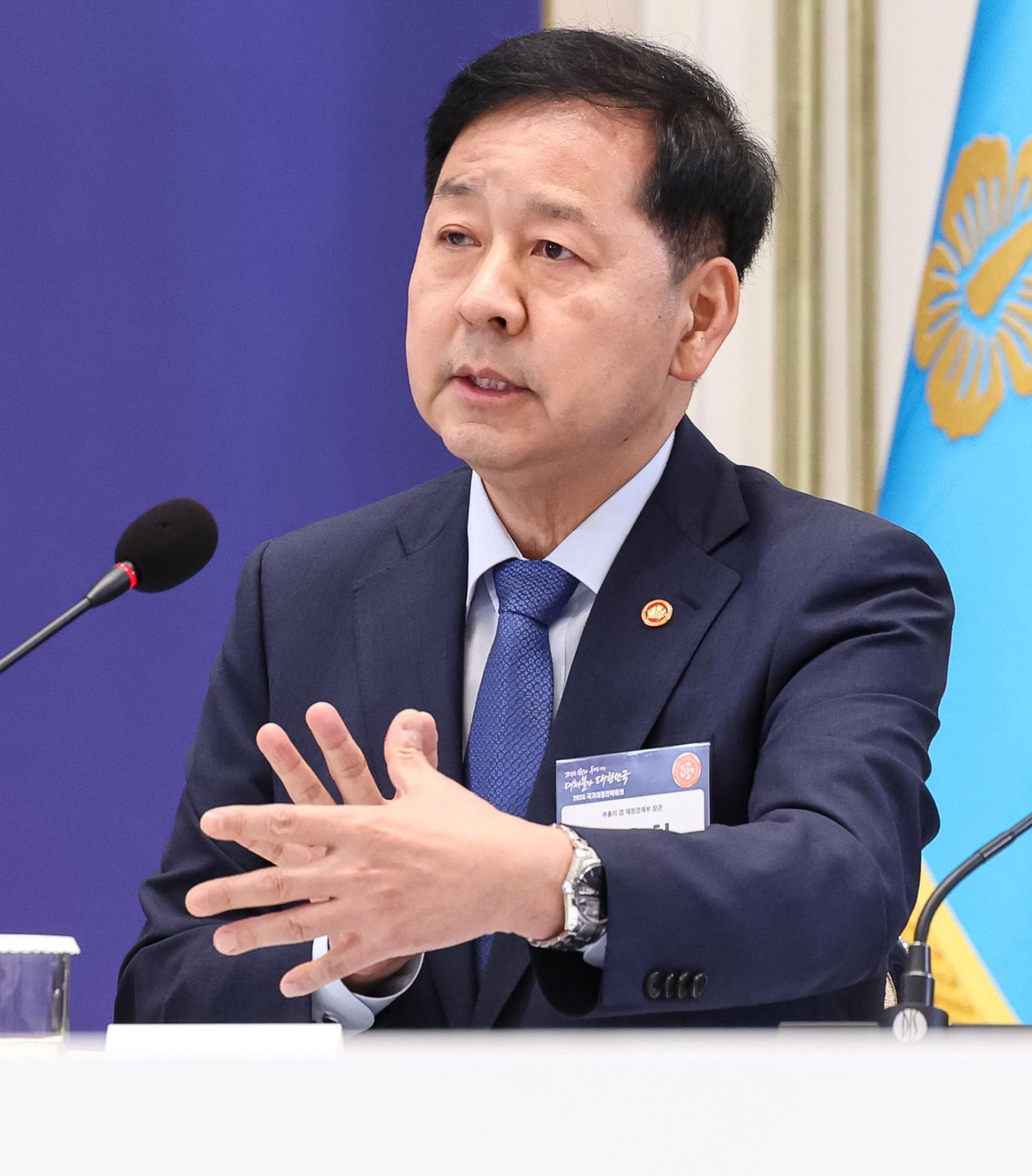
Deputy Prime Minister and Minister of Economy and Finance Koo Yoon-cheol speaks at the 2026 National Fiscal Strategy Meeting held at the State Guest House of the Blue House on the 13th. 2026.7.13 ⓒ News1
The government will train more than 200,000 young professionals in the fields of artificial intelligence (AI), semiconductors, and green transition (GX) by 2030. It will give young people priority access to public rental housing in station areas, which are highly preferred by the younger generation, and establish a youth-type Individual Savings Account (ISA) to support asset building.
At the National Fiscal Strategy Meeting held at the Blue House on the 13th, Deputy Prime Minister and Minister of Economy and Finance Koo Yoon-cheol announced the “Policy Direction for Youth” containing these measures. Koo stated, “The living conditions faced by young people and the policies they expect from the government are very diverse,” adding, “We will listen closely to these varied voices and prepare measures that cover the entire life cycle.”
The government plans to utilize education and training systems in private companies, universities, and the public sector to foster more than 200,000 professionals in AI, semiconductors, and GX by 2030. It intends to enable young people to use the experience gained by performing on-site tasks proposed by companies and public institutions as practical credentials for employment or start-ups. The government outlined a plan to create 200,000 youth jobs in total, including 100,000 in the private sector in areas such as new industries, science and technology, culture, and finance, and 100,000 in the public sector. It will also significantly expand the “Start-ups for All” program, a start-up support initiative, to nurture more than 100,000 young entrepreneurs.
To alleviate housing insecurity among young people, the government will introduce a new type of public rental housing in high-quality locations such as station areas, with standards comparable to private housing, and give young people priority supply. It will also draw up measures to increase jeonse rentals and reduce the burden of monthly and jeonse rents. Koo explained, “More than 80% of young households live in rental housing, but they face a heavy rent burden and difficulties in finding a home.” The government plans to support asset building for young people through the youth-type ISA to be introduced next year. Financial support programs such as Sunshine Loans targeting young people preparing for employment after graduating high school will also be expanded.
In order to change the perception that “getting married is a loss,” the system known as the “marriage penalty” will be improved. A representative example is when a couple becomes ineligible for policy loans after marriage because the income standard switches to combined household income. The government plans to ensure that marriage does not disadvantage recipients of policy support, for instance by temporarily applying special income calculation rules for housing loans for newlyweds. To ensure that young people do not face difficulties in having and raising children, the government will expand free childcare for infants and increase infant classes in national and public daycare centers.
Koo stressed, “Youth policy is only complete when it is created together with young people,” adding, “Going forward, young people will directly participate in major decision-making and we will co-create policies through online and offline platforms.”
ⓒ dongA.com. All rights reserved. Reproduction, redistribution, or use for AI training prohibited.
Popular News