U.S.-Japan already in process with Indonesia-Thailand
Korea-Vietnam signed an MOU in April
Three-way consortium expected to maximize impact
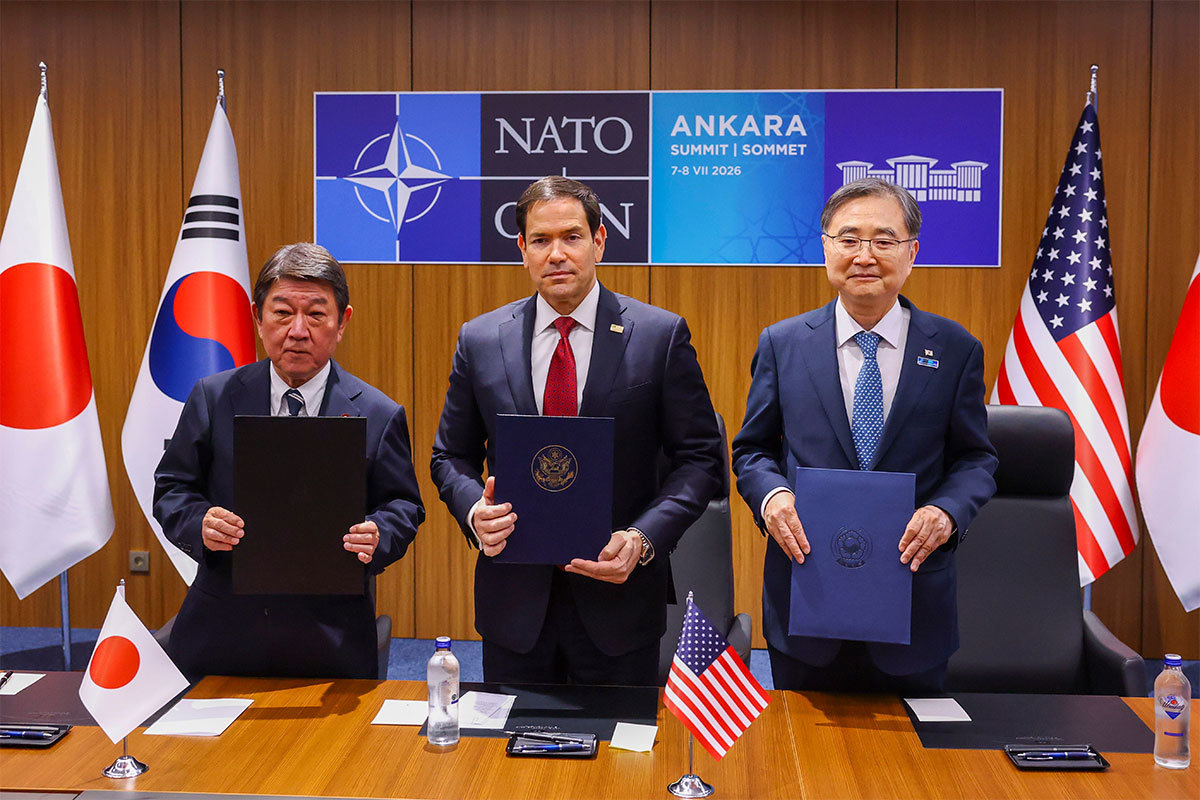
After the ROK-U.S.-Japan foreign ministers’ meeting in Ankara, Türkiye, Foreign Minister Cho Hyun (right) poses for a commemorative photo with U.S. Secretary of State Marco Rubio (center) and Japanese Foreign Minister Toshimitsu Motegi. On the same day, the three top diplomats signed a Memorandum of Cooperation (MOC) to support the introduction of small modular reactors (SMRs) in Indo-Pacific countries. Ankara = AP Newsis
The Republic of Korea, the United States, and Japan have agreed to establish an SMR export cooperation framework to enter nuclear power plant markets in third countries, including the Indo-Pacific region, and are reportedly set to target first the Association of Southeast Asian Nations (ASEAN) members such as Indonesia, Thailand, and Vietnam, which have recently been active in pursuing SMR deployment. The assessment is that there could be greater opportunities for Korea to participate in Thailand, where discussions on nuclear technology cooperation with the United States have already progressed, and in Indonesia’s SMR introduction project, where the U.S. and Japan have been seeking joint entry.
According to the Ministry of Foreign Affairs on the 9th, the government views three to four ASEAN countries that wish to introduce SMRs—such as Indonesia, where ROK-U.S.-Japan companies are currently working to secure projects—as candidate countries for the new MOC on SMR deployment. These countries had been cautious about using nuclear power, but as the spread of artificial intelligence (AI) drives a surge in electricity demand and energy security becomes more critical, they are turning their attention to SMRs. To capture these markets, the three countries plan to combine U.S. nuclear plant design technology, Korea’s construction and engineering capabilities, and Japan’s materials and components strengths.
The expectation is that Korea will also benefit from the MOC, as the United States and Japan have already begun efforts to attract SMR projects. Last month, the U.S. Department of Energy added Thailand to the list of “generally authorized destinations” for exports of nuclear technology and assistance. As a result, U.S. companies can export nuclear technology more quickly without onerous prior approvals. If the three countries form a consortium to win Thailand’s SMR orders, Korean companies are expected to be able to accelerate their own project timelines.
There is also growing speculation that Korean companies could play a larger role in Indonesia’s first SMR project, for which the United States and Japan have already completed a joint feasibility study. The project is being led by U.S. company NuScale Power, and in Korea, Doosan Enerbility, Samsung C&T, and GS Energy are reportedly participating as partners. The licensing process is under way, making the start of construction increasingly visible.
Vietnam, which is reviewing both large-scale nuclear power plants and SMRs as new-build options, is also cited as a promising candidate for trilateral cooperation. In April this year, during President Lee Jae-myung’s state visit, memoranda of understanding (MOUs) were signed between institutions and companies to support the introduction of SMRs. With Korea Hydro & Nuclear Power Engineering and private-sector companies promoting SMR exports, there are expectations that ROK-U.S.-Japan cooperation could enable them to secure a competitive edge.
ⓒ dongA.com. All rights reserved. Reproduction, redistribution, or use for AI training prohibited.
Popular News