LG Electronics, best known for its “white goods,” is now being reassessed in the market on the back of artificial intelligence (AI) and robotics. By deepening its collaboration with Nvidia, it has emerged as a key solution provider leading the physical AI ecosystem.
According to the electronics industry, global investment banks (IBs) have recently issued a series of reports analyzing that LG Electronics is gaining new momentum as its business focus shifts from home appliances to physical AI.
Citi, in a report, analyzed that LG Electronics has solidified its position as a comprehensive robotics solutions provider spanning both industrial and home applications. It noted that robotics is a precision industry that combines drive systems, control, and sensors, and assessed that LG’s manufacturing capability, built on producing tens of millions of motors annually, is well placed to capture demand in physical AI most effectively.
Bank of America (BofA) also named robotics, AI data center cooling solutions, and vehicle components (VS) as the company’s three core growth pillars, arguing that LG Electronics should no longer be grouped solely as a traditional home appliance maker. In particular, it projected that collaboration with U.S. big tech companies such as Nvidia would continue to create long-term growth opportunities.
Big tech partnerships take shape… Group moves in tandem
Jensen Huang, CEO of Nvidia, moves to meet with Koo Kwang-mo, Chairman of LG Group, at LG Twin Towers in Yeouido, Yeongdeungpo-gu, Seoul, on June 8. 2026.06.08. Newsis
In April, the LG Electronics management met with Madison Huang, Jensen Huang’s eldest daughter and Senior Director of Nvidia’s robotics business, to discuss cooperation in physical AI and robotics. In early July, Jensen Huang himself met with LG Group Chairman Koo Kwang-mo. The meeting, held near Hongik University Station in Seoul, was the so-called “Samso (pork belly and soju) gathering.”
The two then met again at LG Twin Towers in Yeouido, Seoul, to flesh out an “AI alliance.” They agreed to expand collaboration across AI infrastructure in order to organically connect every stage from AI model development to robot training and operation and digital twin construction, and to build a next-generation physical AI ecosystem.
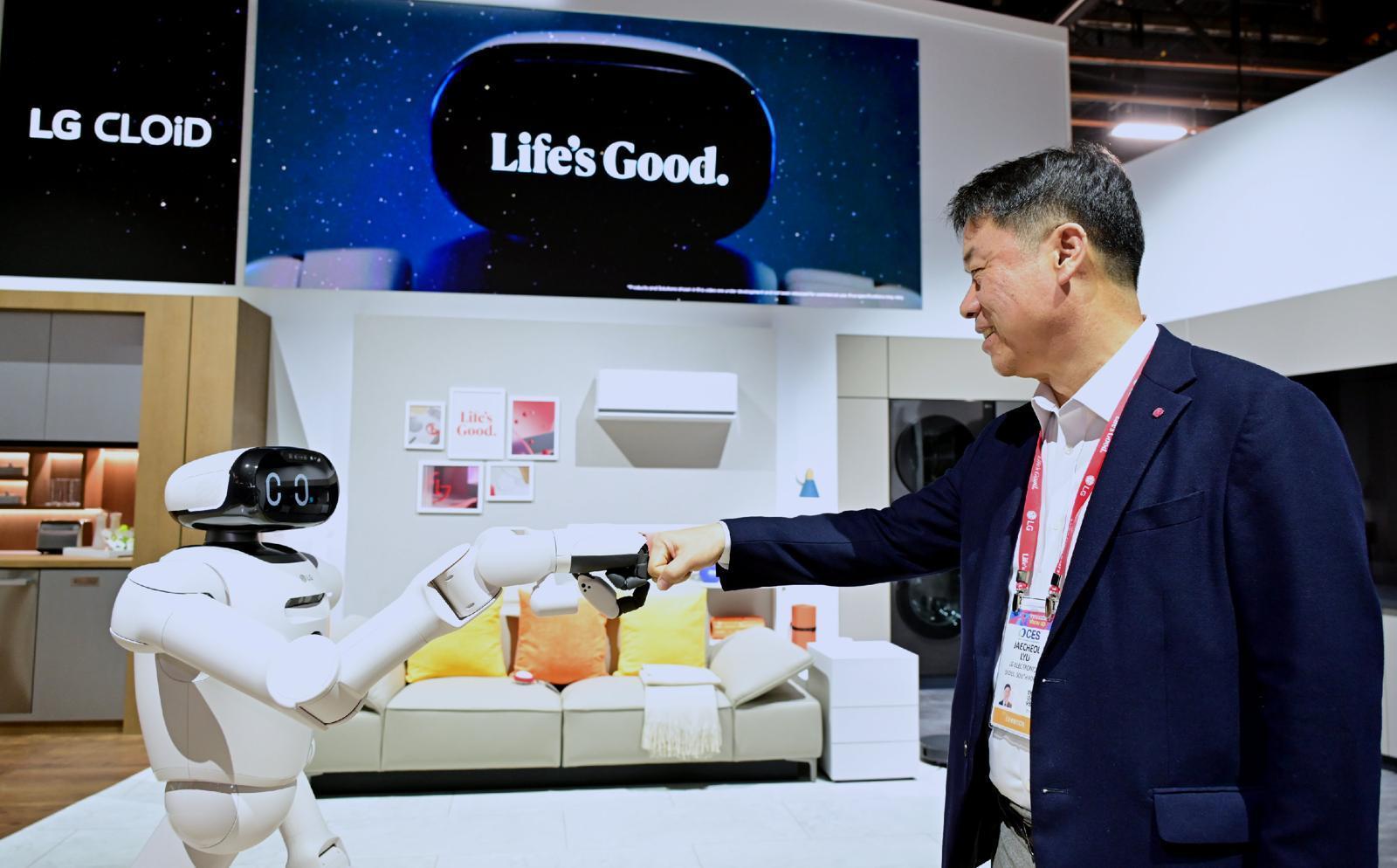
The substance of the technology partnership is also beginning to surface. LG Electronics’ home robot “Cloid” is equipped with Nvidia’s robot-dedicated chipset “Jetson Thor” and has undergone advanced training through the virtual simulation platform “Isaac.”
In addition, on July 1 LG Electronics carried out a one-point organizational reshuffle, establishing a “Robotics Business Center” reporting directly to the CEO. The move reflects a strategic decision to foster the physical AI-based robotics business as a core future growth engine. The new center is to be built as a self-contained organization with functions spanning business development, sales, and operations. Under it, LG has set up a dedicated “data factory” department for robot training data.
The collaboration will also be expanded at the group level. An LG working group comprising LG Electronics, LG Innotek, LG CNS, and LG AI Research recently visited Nvidia’s headquarters in Santa Clara, California. On June 26, LG Electronics CEO Ryu Jae-cheol wrote on his LinkedIn page, “We have further specified the scope of collaboration and strategic partnership opportunities,” adding that “the core is cooperation on robot form factors, which can become the representative devices of physical AI.”
He continued, “Beyond robots, we are discussing broad-ranging synergies, including the advancement of LG’s data factory and AI data center cooling solutions, as well as LG’s mass-production systems for robots,” and added, “We are accelerating preparations for the future of the physical AI ecosystem.”
The “real-world data” held by LG Electronics is also cited as a strength in its physical AI business. CEO Ryu stated, “Through our diverse ThinQ (smart home platform) portfolio, we have been collecting massive volumes of user data,” and added, “We also have access to detailed manufacturing data from 31 production facilities across 14 countries worldwide.”
Physical AI leadership expectations reflected in share price… Earnings also strong
Employees enter and leave LG Electronics’ Magok office center in Gangseo-gu, Seoul, on May 27. 2026.5.27. News1
As LG Electronics is increasingly viewed as a leading physical AI company, expectations are being priced into its shares. The company’s share price, which hovered in the KRW 100,000 range early this year, surged into the KRW 400,000 range in early July. Although it has since declined amid rising stock market volatility, it is still holding in the KRW 200,000 range.
Domestic and overseas securities firms are also raising their target prices in succession. Citi increased its target price for LG Electronics from KRW 170,000 to KRW 400,000, an upward revision of 135%. Bank of America also sharply raised its target price to KRW 350,000.
Kyobo Securities likewise lifted its target price for LG Electronics by 94%, from KRW 180,000 to KRW 350,000. Choi Bo-young, a researcher at Kyobo Securities, explained, “In the past, LG Electronics was perceived only as a home appliance-focused company, but it now needs to be re-evaluated as a growth stock expanding its AI data center cooling solutions (chillers) for North American big tech and its robotics business.”
Meanwhile, LG Electronics posted record-high results in the second quarter of this year. On a consolidated basis, the company’s preliminary figures show revenue of KRW 23.8297 trillion and operating profit of KRW 1.5788 trillion, up 14.9% and 146.9%, respectively, year-on-year.
Both revenue and operating profit exceeded last year’s second-quarter records of KRW 21.6944 trillion in revenue and KRW 1.1972 trillion in operating profit. Notably, first-half operating profit has already surpassed last year’s full-year operating profit of KRW 2.4784 trillion.
According to LG Electronics, second-quarter revenue rose sharply as sales expanded in core businesses such as home appliances and TVs, leveraging its premium market position. The company also continued its growth trajectory in key qualitative growth areas, including component solutions, vehicle components, and heating, ventilation, and air conditioning (HVAC).
ⓒ dongA.com. All rights reserved. Reproduction, redistribution, or use for AI training prohibited.
Popular News