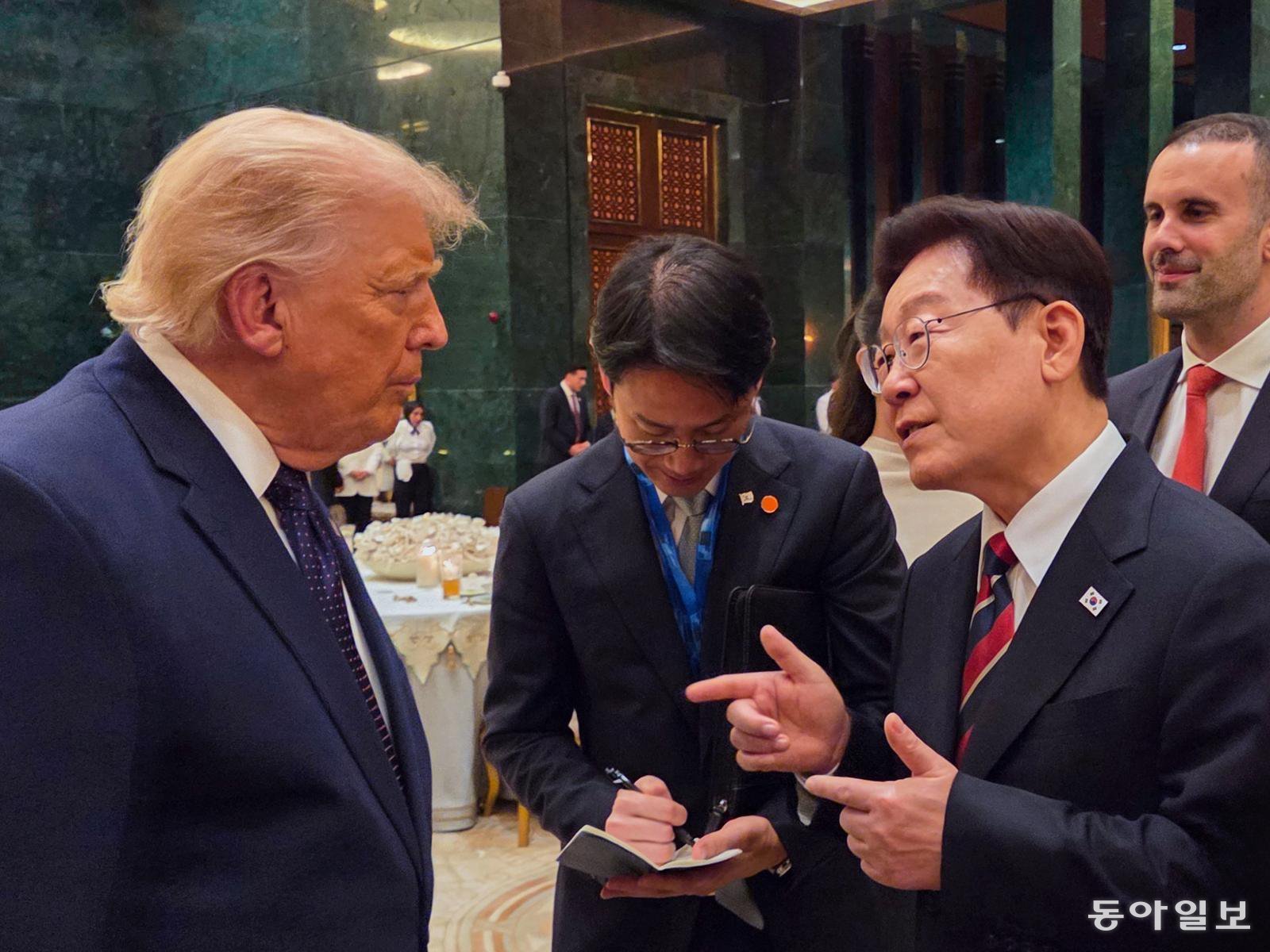
Talking with Trump at the NATO dinner President Lee Jae-myung, who visited Ankara, Türkiye, to attend the North Atlantic Treaty Organization (NATO) summit, speaks with U.S. President Donald Trump at an official welcome dinner held at the Presidential Palace of Türkiye on the 7th (local time). Kang Yoo-jung, senior presidential spokesperson, said in a written briefing, “President Lee held follow-up consultations regarding the construction of military vessels that President Trump had requested,” adding, “The two leaders agreed to continue working-level consultations to review concrete measures.” Ankara = Reporter Kim Jae-myung base@donga.com
At the North Atlantic Treaty Organization (NATO) summit attended by President Lee Jae-myung, South Korea, the United States, and Japan agreed to establish a cooperation framework for exporting small modular reactors (SMRs) in order to enter nuclear power plant markets in third countries, including the Indo-Pacific region. With electricity demand in each country surging due to the spread of artificial intelligence (AI), the three countries decided to launch an SMR “export alliance” based on next-generation nuclear power technology.
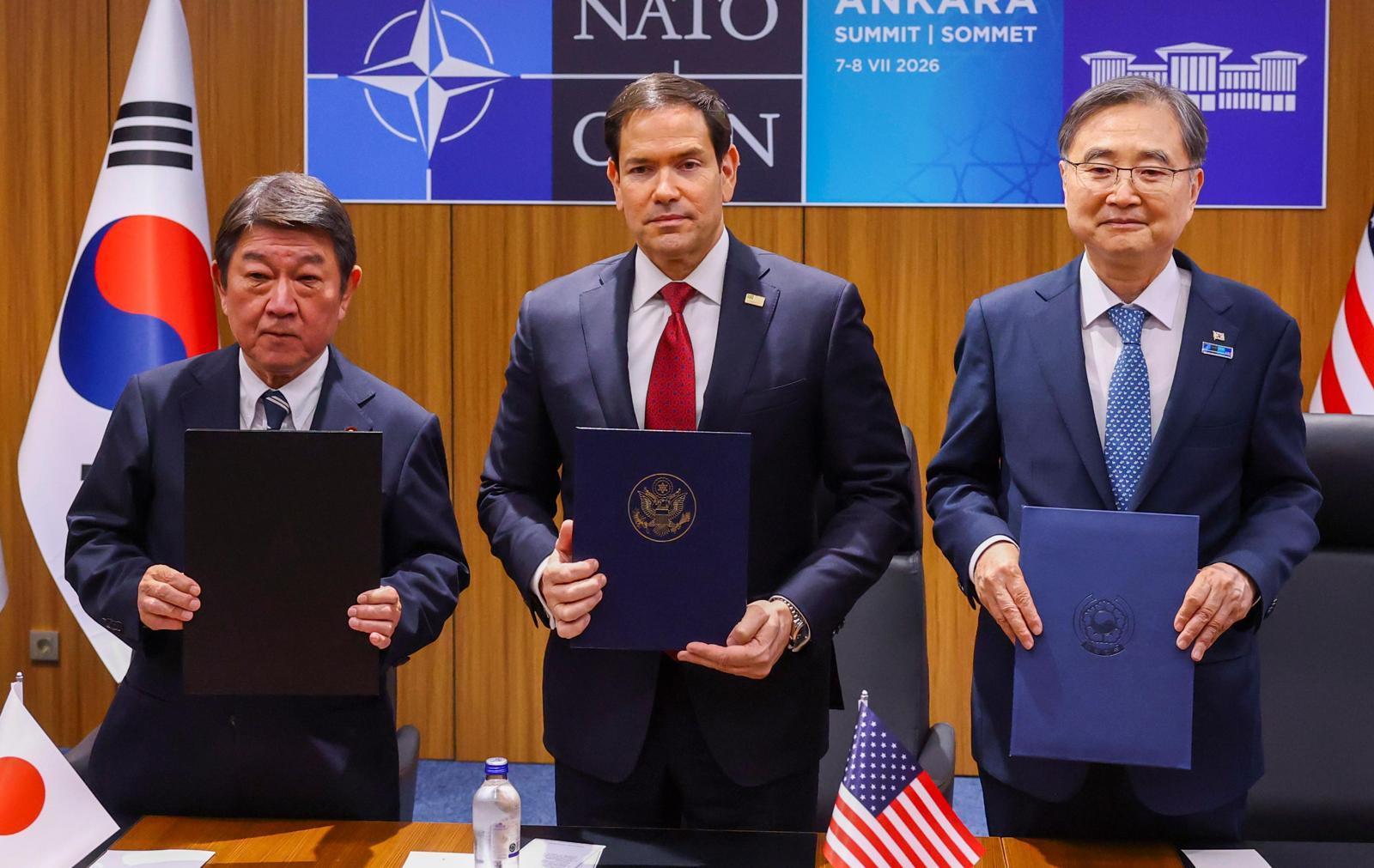
Foreign Minister Cho Hyun, U.S. Secretary of State Marco Rubio, and Japanese Foreign Minister Motegi Toshimitsu (茂木敏充) held a trilateral foreign ministers’ meeting in Ankara, Türkiye, on the 7th (local time) on the sidelines of the NATO summit and officially signed a memorandum of cooperation (MOC) on SMR deployment. The MOC includes support for SMR construction projects, establishment of consortia among companies from the three countries, project financing, and support for technology, fuel, and equipment.
The Ministry of Foreign Affairs and the U.S. State Department emphasized that this represents “a mutually beneficial cooperation opportunity for the nuclear industries of the three countries, each of which has its own strengths in the civilian nuclear sector.” The idea is to generate synergies by combining U.S. nuclear plant design technology, South Korea’s construction and engineering capabilities, and Japan’s strength in materials and components. As China pursues a “nuclear power rise” strategy, accelerating global energy hegemony competition, South Korea, the United States, and Japan have joined hands.
The government plans to strengthen export cooperation with the United States and Japan with several Indo-Pacific countries—around three to four—that are seeking to introduce SMRs in mind. Indonesia, Vietnam, the Philippines, and Singapore are currently moving to adopt SMRs.
Senior Presidential Spokesperson Kang Yoo-jung said that at the welcome dinner hosted the same day by President Recep Tayyip Erdoğan of Türkiye and the First Lady, President Lee met with U.S. President Donald Trump and held follow-up consultations on the construction of military vessels. President Trump had asked President Lee at the Group of Seven (G7) summit in France last month, “Can you quickly build 10 U.S. warships?” According to the presidential office, meeting President Trump again after three weeks, President Lee said he would “cooperate with the request to the maximum extent possible” and introduced South Korean companies with strong shipbuilding capabilities. Kang said, “The two leaders agreed to continue working-level consultations to review concrete measures.” The U.S. Department of Defense and the Navy have recently launched a review by formally inquiring with the South Korean shipbuilding industry about its warship and replenishment vessel design and construction capabilities.
On the same day, President Lee met with NATO Secretary General Mark Rutte and discussed building a “defense industry supply chain” between South Korea and NATO, and officially announced the start of negotiations to conclude a basic procurement agreement. The plan is to overcome the “NATO alliance barrier,” cited as a reason for the failure to win a Canadian submarine contract, by standardizing weapons with NATO and other measures.
U.S. nuclear design – Korean construction capability – Japanese materials and components: ‘Joint SMR exports’ to counter China’s nuclear power rise
[NATO Summit]
South Korea, U.S., Japan form joint front in energy hegemony
Moves also expected toward deregulation at government level
After the trilateral foreign ministers’ meeting between South Korea, the United States, and Japan in Ankara, Türkiye, South Korean Foreign Minister Cho Hyun (right) poses for a commemorative photo with U.S. Secretary of State Marco Rubio (center) and Japanese Foreign Minister Motegi Toshimitsu. On this day, the three foreign ministers signed a memorandum of cooperation (MOC) to support the introduction of small modular reactors (SMRs) in Indo-Pacific countries. Ankara = AP Newsis
The agreement reached by the foreign ministers of South Korea, the United States, and Japan on the 7th (local time) to cooperate on joint exports of small modular reactors (SMRs), regarded as a next-generation power source, is evaluated as an effort to build a joint response framework to the global energy hegemony competition. As the importance of energy security grows amid a surge in power demand driven by the spread of artificial intelligence (AI), the three countries aim to strengthen cooperation for joint SMR exports. Their calculation is that combining U.S. nuclear plant design technology, South Korea’s construction and engineering capabilities, and Japan’s capacity to supply parts and equipment can generate synergies in the Indo-Pacific region, an emerging market.
The foreign ministries of South Korea and the United States emphasized that the SMR memorandum of cooperation (MOC) signed by the three countries “will provide more competitive options for South Korean, U.S., and Japanese companies to meet growing energy demand through coordinated cooperation.”
Until now, cooperation among South Korea, the United States, and Japan on SMRs has been led mainly by private companies. SMRs are expected to become a next-generation power source for the AI era because they can be built more quickly and safely than conventional nuclear power plants and can be situated right next to large data centers. Accordingly, South Korean companies such as Samsung C&T and Doosan Enerbility have been participating in SMR-related projects promoted by U.S. and Japanese entities.
However, as global demand for SMRs increases and government-level cooperation becomes necessary, the three countries are known to have been working together for several months to conclude this memorandum. At the signing ceremony, U.S. Secretary of State Marco Rubio stressed, “One of the most important issues in the world today is energy security,” adding, “(This MOC) will in many ways make our economies stronger in a very safe, efficient, and cost-effective manner.” There is also an interpretation that governments will move to shorten related licensing procedures and ease regulatory levels.
There is also an aspect of jointly responding to China’s “nuclear power rise,” as China has recently entered emerging markets such as the Association of Southeast Asian Nations (ASEAN) and Africa in large numbers by leveraging nuclear construction costs that amount to only one-quarter of those of the United States. Some analyses suggest that by 2030 China will surpass the nuclear power generation capacity of the United States and the European Union (EU), seize nuclear hegemony, and be able to influence energy security.
In response, the United States aims to lead global energy hegemony competition in the SMR market—regarded as next-generation nuclear power—together with its allies South Korea and Japan. It is forecast that if SMRs are deployed on a large scale, global nuclear power capacity will increase to about three times its current level by 2050.
However, the foreign ministers of South Korea, the United States, and Japan showed differing tones over China’s launch of a submarine-launched ballistic missile (SLBM). Japanese Foreign Minister Motegi Toshimitsu (茂木敏充) said at a local press conference, “We shared concerns among the three countries over yesterday’s (6th) missile launch (China’s SLBM test).” In contrast, the official statement from South Korea’s Ministry of Foreign Affairs did not mention China or SLBMs, and instead stated that the three countries would “continue efforts to maintain peace and stability on the Korean Peninsula through dialogue and diplomacy.”
ⓒ dongA.com. All rights reserved. Reproduction, redistribution, or use for AI training prohibited.
Popular News