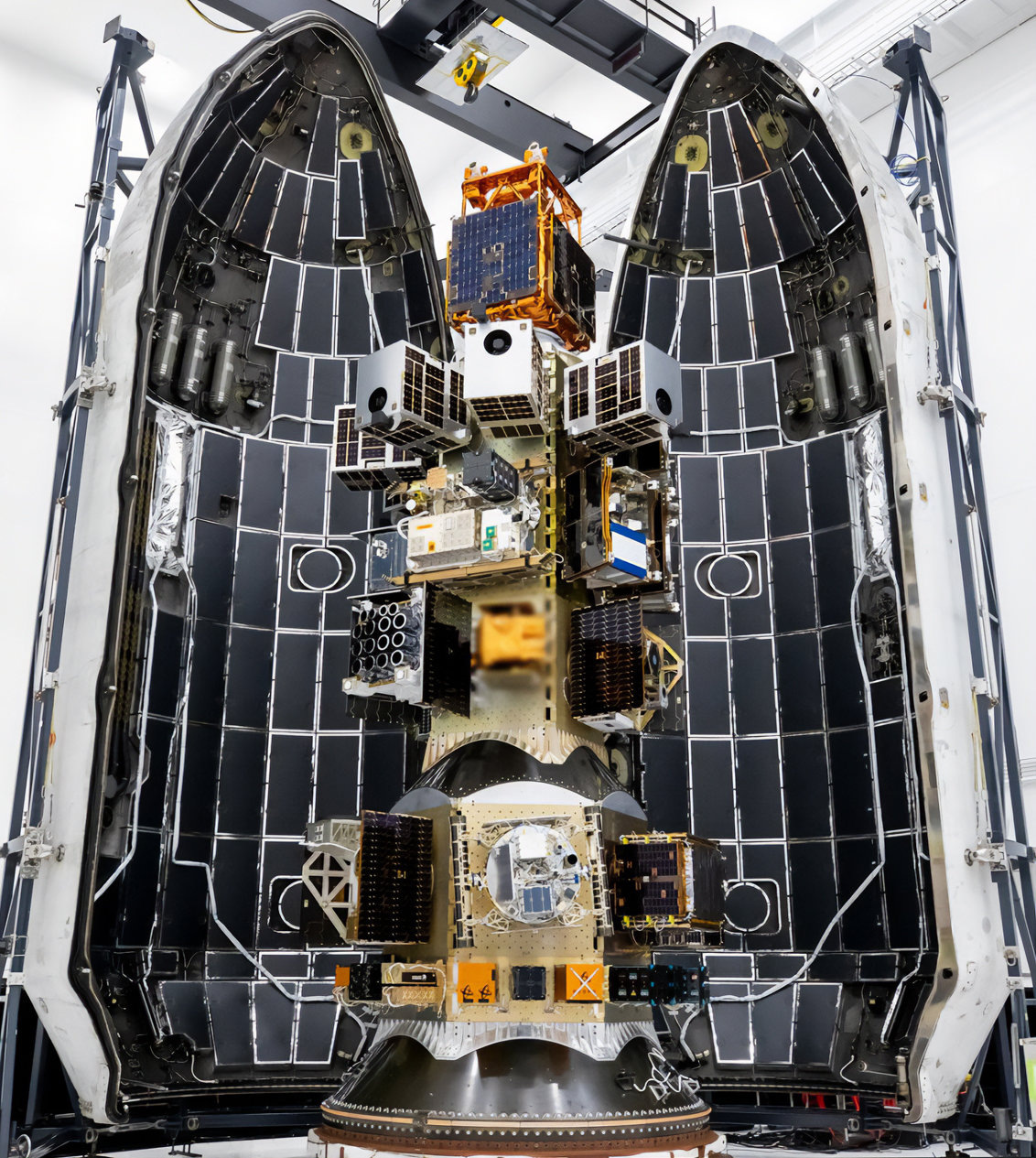
Next-generation Medium-sized Satellite No. 4 mounted on SpaceX’s Falcon 9 launch vehicle. Courtesy of the Korea AeroSpace Administration
Next-generation Medium-sized Satellite No. 4 (NSMS-4), Korea’s first domestically built agricultural and forestry satellite, has been sent into space. Equipped with observation instruments capable of imaging the entire country every three days, the satellite will monitor crop growth and forest changes and quickly identify damage from disasters such as wildfires and landslides.
The Korea AeroSpace Administration, the Rural Development Administration, and the Korea Forest Service announced on the same day that NSMS-4 was successfully launched at 4:12 p.m. on the 7th from Vandenberg Space Force Base in California, United States, aboard SpaceX’s Falcon 9 launch vehicle. NSMS-4 used the same launch vehicle as NSMS-2, which was launched in May. The satellite will separate from the launch vehicle approximately 2 hours and 30 minutes after liftoff and attempt its first communication with the Svalbard ground station in Norway at 7:03 p.m., 21 minutes after separation.
With an observation swath width of 120 km, NSMS-4 can image most regions across the country after just two or three passes over the Korean Peninsula. Utilizing this capability, authorities will be able to assess crop conditions, changes in farmland use, forest ecosystem changes, and wildfire damage more quickly than before. NSMS-4 will undergo on-orbit testing, including initial checkouts and performance verification, for about four months after launch, and is scheduled to begin full-scale operations in the first half of next year (January–June).
NSMS-4 is a 500 kg-class medium-sized satellite developed under the overall management of Korea Aerospace Industries (KAI). Domestic private companies led the entire process from satellite design and manufacturing to testing and verification. More than 75% of the satellite’s core components were localized, which is seen as a significant step forward in enhancing the self-reliance of Korea’s space technology. The government plans to promote the development of follow-on satellites using the standard platform of the next-generation medium-sized satellite series and, based on this, to seek entry into overseas satellite markets in regions such as the Middle East and South America.
Han Chae-yeon
AI-translated with ChatGPT. Provided as is; original Korean text prevails.
ⓒ dongA.com. All rights reserved. Reproduction, redistribution, or use for AI training prohibited.