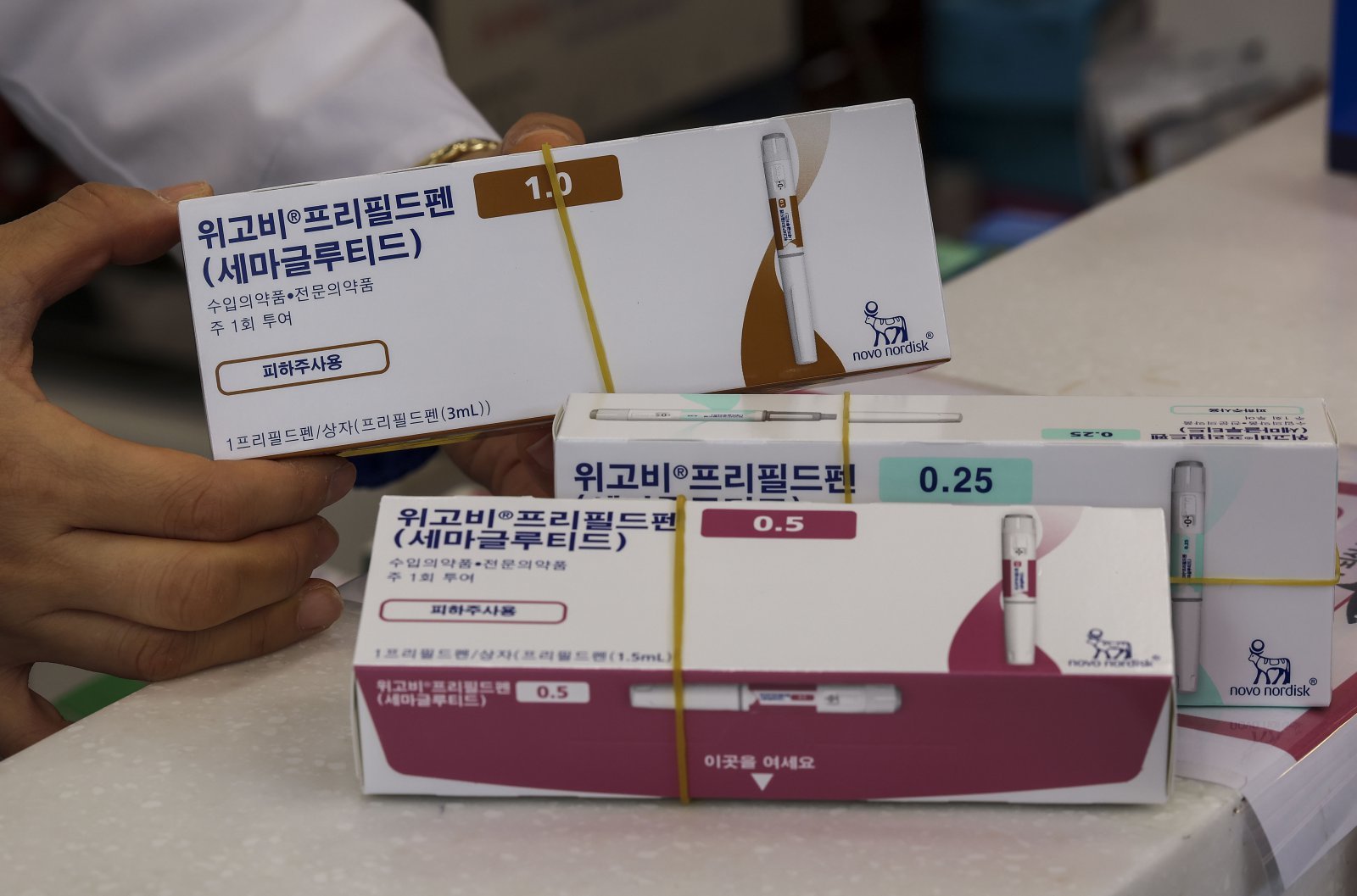
On the 17th, Wegovy, an obesity treatment developed by Danish pharmaceutical company Novo Nordisk, is displayed at a pharmacy in Gangnam-gu, Seoul. 2024.10.17 [Seoul=Newsis]
Artificial intelligence (AI) is increasingly being used in new drug development, accelerating full-scale alliances between global big pharma and big tech companies. Competition that once took place separately within big pharma and big tech is now evolving into “coalition warfare,” with the competitive landscape becoming more complex and intense. In particular, Novo Nordisk and Eli Lilly, which are locked in a fierce race in the obesity treatment segment, are each joining hands with AI companies, drawing even greater attention.
On 14 October (local time), Novo Nordisk, the developer of Wegovy, formed a partnership with OpenAI to introduce AI across its entire business, from new drug development to manufacturing and commercial operations. In January this year, Novo Nordisk launched the oral version of Wegovy, “Wegovy Pill,” and in April entered into a head-to-head competition after rival Eli Lilly swiftly rolled out its oral obesity drug, “Powndayo.” Industry observers assess that Novo Nordisk is seeking a new breakthrough through AI. An industry insider said, “It is highly likely that AI will be used to find the optimal combination of various hormones known to be effective for weight loss,” adding, “They seem to have judged that adopting AI could deliver significant results in the short term.”
(Provided by Eli Lilly)
In March this year, Eli Lilly signed an oral drug development agreement worth a total of US$2.75 billion (about KRW 4 trillion) with Chinese AI company Insilico Medicine. Under this agreement, Eli Lilly acquires the rights to develop, manufacture, and commercialize an oral new drug candidate discovered by Insilico Medicine for a specific disease. The disease area to be targeted has not yet been disclosed. Insilico Medicine is an AI-based drug discovery company whose idiopathic pulmonary fibrosis treatment candidate “Rensovotid,” discovered using AI, is about to enter Phase 3 clinical trials. In January, Eli Lilly also announced at the JP Morgan Healthcare Conference in San Francisco that it would establish a joint AI innovation lab in collaboration with Nvidia.
On the same day, Anthropic appointed Vasant (Vas) Narasimhan, Chief Executive Officer (CEO) of Novartis, as a director. The appointment is interpreted as a strategic move to develop AI that can contribute to new drug development and clinical trials. On 3 October (local time) this month, Anthropic acquired Coefficient Bio, a startup developing a platform to support the entire new drug development process with AI, in a further step to expand into the pharmaceutical field. Google is also stepping up efforts in AI-based drug development. Its subsidiary Isomorphic Labs unveiled an AI model named “IsoDDE” in February this year, claiming performance that surpasses AlphaFold 3.
Market attention is now focused on which player will be the first to launch an AI-based “blockbuster” new drug. OpenAI has previously stated that if its AI delivers tangible results in new drug development, it could share in the revenues from such pharmaceuticals.
ⓒ dongA.com. All rights reserved. Reproduction, redistribution, or use for AI training prohibited.
Popular News